- HOME
- Investor Relations
- Management Policy
- Business Risks
Business Risks
Uncertainties in business operations are increasing due to growing frequency of extreme weather events caused by climate change, rising geopolitical risks such as armed conflicts between nations, and political and economic tensions among countries. Toray Group established a system to respond quickly to rapidly emerging risks and crises, and a dedicated organization oversees risk management during normal times and immediate response in the event of a crisis. However, if any risks were to occur, they could affect the Group’s results of operations and financial conditions.
(1) Risk management structure and activities in Toray Group
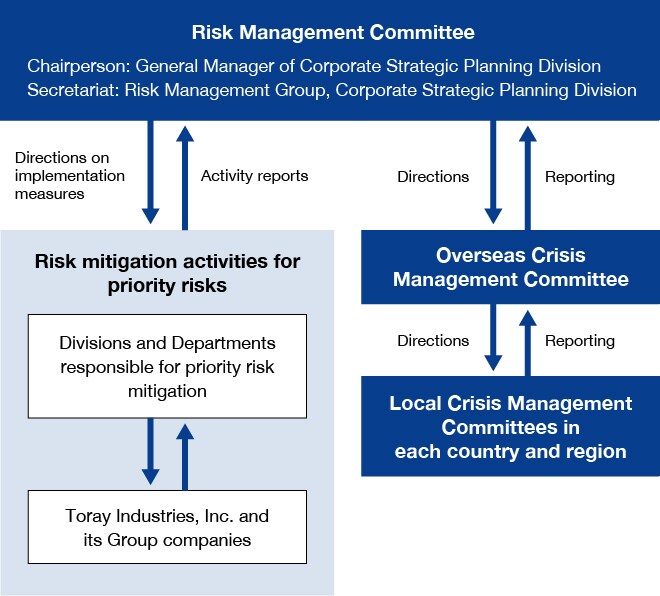
In order to respond to risks that rapidly emerge due to changes in the surrounding environment and to respond immediately in the event of a crisis, Toray Group has a dedicated organization to communicate closely with the Board of Directors and top management and to pursue risk management as an integral part of the management strategy. The Group has the Risk Management Committee, chaired by the General Manager of the General Administration, Legal & Risk Management Division, to deliberate, discuss, and share information to promote risk management (see Figure 1). The Risk Management Committee regularly reports the result of deliberations and discussions to the Board of Directors and reports important emergency matters whenever such occur to the Board of Directors without fail. In addition, as subordinate organizations of the Risk Management Committee, the Overseas Crisis Management Committee and Local Crisis Management Committee have been established to manage employees’ overseas travel under normal conditions and compile information on overseas risks, as well as responding to ensure employee safety in the event of an emergency.
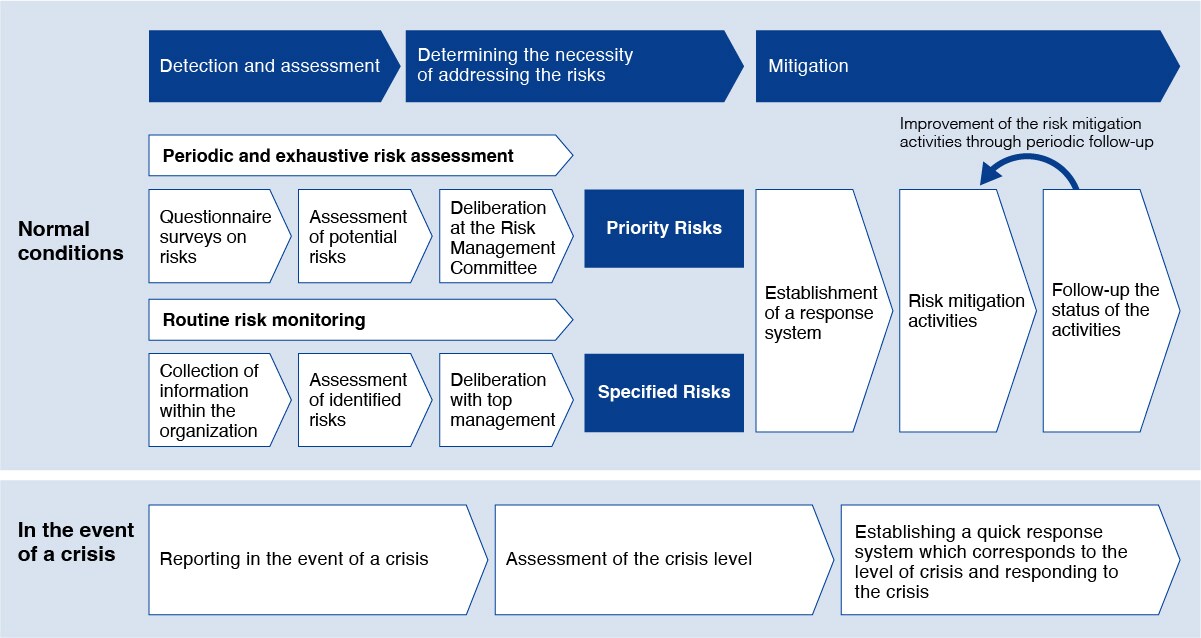
The Group defines risk management as overseeing risk management during normal times and immediate response in the event of a crisis. For risk management in normal times, the Group has implemented a PDCA cycle to manage Toray Group Priority Risks (hereinafter referred to as Priority Risks) and Specified Risks (see Figure 2).
Priority Risks are set based on an evaluation of risks that have been exhaustively identified through a periodic assessment conducted once every three years. These are risks deemed to have a high degree of impact and urgency and require a company-wide response. For each Priority Risk, a division or department responsible for promoting risk mitigation focuses on reducing the risk.
On the other hand, specified Risks are determined by a dedicated organization that routinely monitors domestic and overseas trends, conducts surveys and analyses, identifies and assesses risks that may have a major impact on management, and consults with top management. Specified Risks include risks arising in a short period of time, and have a complementary relationship with priority risks, which are three years as one term.
In the event of a crisis, a quick response system is established according to the level of the crisis, in accordance with internal regulations.
(2) Identifying and evaluating risks
In 2025, Toray Group conducted the identification and assessment of the seventh three-year set of Priority Risks for FY 2026-2028. This term covered the entire Group and focused primarily on identifying and assessing risks that could hinder the achievement of the management challenges set out in the Medium-Term Management Program for FY 2026–2028. The process used for the identification and assessment is outlined below.
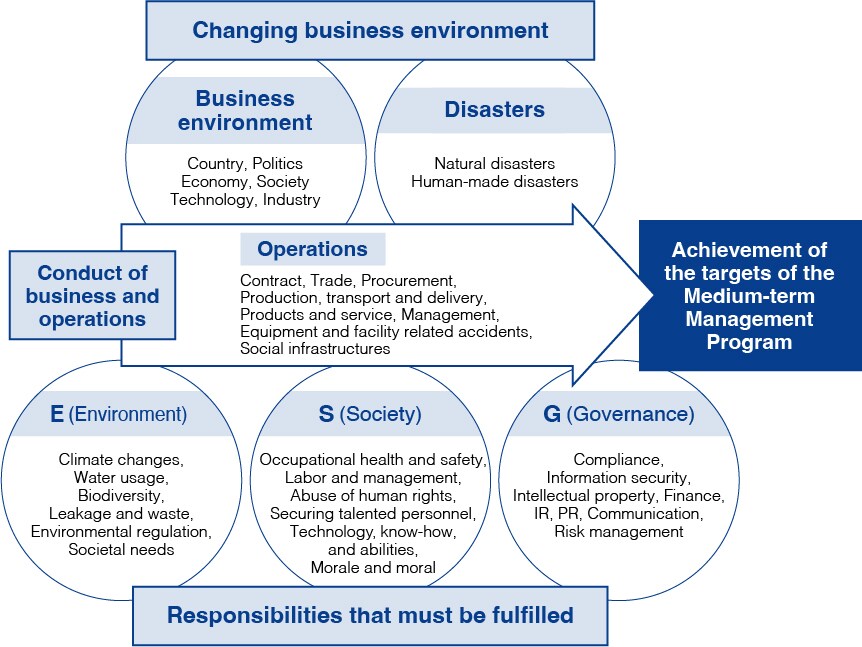
- (a) A survey was conducted to assess the impact, imminence, and status of countermeasures for 110 risks (see Figure 3) comprehensively organized in the categories of "business environment," "disasters," "operations," "E (environment)," "S (society)," and "G (governance)" surrounding the Group.
- (b) After aggregating and analyzing information obtained from the survey, discussions on risk awareness, issues, and countermeasures were held with risk-related departments and top management.
- (c) Summarizing the analysis of the questionnaire survey and information obtained from the discussions, draft of Priority Risk is deliberated and decided by the Risk Management Committee.
Figure 3. Identifying Risks that Inhibit the Achievement of the Targets of the Medium-Term Management Program
(3) Priority Risks
As Priority Risks for the seventh three-year set of priority risks from FY 2026-2028, Toray promotes following two themes.
| Summary of the risk |
The following risks may increase due to tight procurement of raw materials and parts required for production, or invocation of force majeure clauses by suppliers, which occur in conjunction with changes in market conditions including crude oil price fluctuations, geopolitical issues such as political situations in resource-rich countries, environmental issues such as climate change, and social disruption such as human rights issues.
|
|---|---|
| Toray Group’s response | Based on the recognition that Toray Group has social responsibilities and the mission to provide stable supply of materials required for manufacturing products that are essential for people’s daily lives or important to the Group’s business strategies, the Group designated the risk of product supply disruption as a Priority Risk for the sixth term (FY 2023–2025). Under this initiative, the Group analyzed vulnerabilities throughout its supply chains and implemented risk mitigation measures, including multiple sourcing of raw materials, changes to formulations, and strategic inventory stockpiling. To further strengthen risk mitigation efforts across the entire Group from FY 2026 onward, this theme has been continuously positioned as a Priority Risk, and related measures are being expanded. Under a cross-functional promotion structure, the Group shares the know-how and expertise accumulated through these risk mitigation activities across the organization and is working to further enhance the resilience and continuity of product supply. |
| Summary of the risk | Cyberattacks are becoming increasingly sophisticated and complex, particularly those targeting manufacturing companies. In some cases, affected companies have experienced the shutdown of core systems and production facilities, as well as the leakage of confidential and personal information, resulting in the suspension of business operations. Toray Group also faces the risk that a similar incident could adversely affect its business activities. |
|---|---|
| Toray Group’s response | Toray Group’s information systems and networks are fundamentally essential in the Group’s business operations and every security precaution is taken in their development and operation. Toray Group positions information security as an important management issue and has established the Toray Group Information Security Basic Policy. Under the supervision and management of the Toray Group Information Security Steering Committee, the Group monitors its overall risk status and strives to maintain and enhance information security through the formulation and operation of Group-wide security management standards, as well as periodic security assessments and monitoring. Furthermore, in light of the increasing risk in recent years, the risk of business disruption caused by cyberattacks has been designated as a Priority Risk since FY 2026. Toray Group is strengthening countermeasures on a company-wide basis and promoting risk mitigation efforts throughout the Group and its supply chains. |
(4) Major risks
(Classification: listed in the order of Business, E (environment), S (society), G (governance))
In addition to Priority Risks, major risks that Toray Group has evaluated which may have significant impacts are listed below. For those risks, risk mitigation measures are promoted mainly by group-wide committees, dedicated departments, and business divisions.
| Risks related to product demand, market trends, and business plans | Classification | Business | |
|---|---|---|---|
| Summary of the risk |
As a supplier of basic materials to a broad range of industries, Toray Group is exposed to various factors including a sharp drop in demand for its products caused by changes in both worldwide and regional supply-demand conditions, increased use of substitute materials, and changes to the purchasing policies of business partners. Due to these factors, the following risks could increase.
|
||
| Toray Group’s response |
In order to respond to changes in product demand and market conditions, Toray Group continues to make a great effort to secure competitive advantage of its products and makes capital expenditures in a wide range of business fields. Furthermore, for business expansion and enhancement of competitiveness, its other activities include formation of various joint ventures or strategic alliances with third parties as well as business acquisitions after thorough consideration of profitability and the possibility of investment return from a variety of perspectives. To achieve the targets of the Medium-Term Management Program, IGNITION 2028, the Group is working to improve its business portfolio by expansion of high-profitability businesses, structural reform of low-profitability businesses, and continuing investment in R&D for entry into next-generation markets. For each business field, various initiatives are set and promoted, such as new sales channel development, efficient differentiated product development without rework, review of supply chains, and inventory optimization. |
||
| Risks related to global business development | Classification | Business | |
| Summary of the risk |
Toray Group has extensive business operations overseas, including in Asia, Europe, and the U.S. The occurrence of armed conflicts, political instability, deteriorating public security, or other similar events in the countries and regions where the Group operates could adversely affect its business activities. In addition, geopolitical and economic security risks have increased in recent years, including heightened political and military tensions between regions, cross-border conflicts, changes in trade policies, and the strengthening of export control regulations. Against this backdrop, the Group is exposed to risks such as the following.
|
||
| Toray Group’s response | Through its Overseas Crisis Management Committee, Toray Group promotes preventive measures for potential overseas crises and works to strengthen its crisis response framework. In particular, in countries and regions with a high risk of armed conflict, Toray Group has established emergency response manuals and conducts response drills. With respect to economic security, Toray Group has established a dedicated team comprising members from a wide range of functions, including legal, purchasing and logistics, marketing, and R&D. The team continuously collects and analyzes information on political, economic, and regulatory developments in various countries, shares its findings across the Group, and utilizes them in business operations. In addition, based on information relating to Toray Group’s business activities, including supply chains, financing, R&D, human resource management, and data management, the Group promotes the establishment of mechanisms to avoid and mitigate risks, while taking necessary measures in a timely manner when risks materialize. | ||
| Risks related to foreign currency, interest rate and securities market fluctuations | Classification | Business | |
| Summary of the risk |
Toray Group engages in foreign currency-denominated transactions, including procurement of raw materials and other items. Items in the financial statements of business operations outside Japan are translated into yen for preparing consolidated financial statements. The Group raises funds mainly by borrowing from financial institutions and issuing commercial paper and corporate bonds. These include following risks.
|
||
| Toray Group’s response | Leveraging strengths of the Group of having business sites around the world, Toray Group promotes local production for local consumption and makes an effort to build management structure invulnerable to foreign currency fluctuations by flexibly expanding its global operations. Moreover, representative of the head office and each country or region, chief financial and accounting officers of each region, and representatives of overseas affiliates stay up-to-date on the latest information and share it within the Group, while hedging risks with forward exchange contracts on foreign currency-denominated bonds and debts to respond to sudden fluctuations in exchange rates. To prepare for the sharp rise of the interest rate in the future, Toray Group will closely monitor interest rate trends and execute financing in an optimal manner. | ||
| Risks related to environmental issues such as climate change, resource depletion, and ecosystem destruction | Classification | E (Environment) | |
| Summary of the risk |
Growing expectations and demands on companies to address environmental issues may increase the following risks for Toray Group.
|
||
| Toray Group’s response | To realize the world envisioned by TORAY VISION 2050, Toray Group is promoting projects focused on resource circulation, GHG emissions reduction, nature positive initiatives, and sustainability disclosure. | ||
| Risks related to natural disasters and accidents | Classification | E (Environment) | |
| Summary of the risk |
Climate change is raising the risk of natural disasters such as typhoons, floods, and other storm and flood damages. Toray Group could have following risks.
|
||
| Toray Group’s response | Toray Group places top priority on safety, accident prevention, and environmental preservation. To minimize losses caused by the suspension of production, the Production Division Executive Meeting, an advisory board to study and deliberate on safety, disaster prevention, and environmental preservation, conducts regular accident prevention inspections, maintenance of its manufacturing facilities, and safety activities. For mega-earthquake and mega-flood, the Group has established guidelines to promote safety measures for employees and local communities as well as continuing business. | ||
| Risks related to human resource strategies | Classification | S (Society) | |
| Summary of the risk |
Due to diversification of work style and perspectives on employment, declining working population, and acceleration of longevity and aging, the environment surrounding human resource strategies is changing. Toray Group faces following risks.
|
||
| Toray Group’s response | Toray Group has formulated a human resource strategy aligned with its management strategy, and established basic policies on talent development, compensation and evaluation, workstyle reform, and the enhancement of the work environment. Based on these policies, the Group is building a human resource portfolio that will support our future business competitiveness. | ||
| Risk related to compliance | Classification | G (Governance) | |
| Summary of the risk |
Toray Group is subject to various laws and regulations in the countries and regions where the Group conducts business, including those related to the environment, commercial transactions, labor, intellectual property rights, taxation, foreign exchange, antitrust and unfair competition, as well as investment approvals and import/export controls, and faces risks such as the following.
|
||
| Toray Group’s response | Led by the Ethics and Compliance Committee, a group-wide committee, Toray Group aims to deepen ethics and compliance activities of entire Toray Group and further enhance compliance awareness by deterring risk from the perspectives of motivation, opportunity, and justification, creating an organizational culture that prevents misconduct, and promoting the use of the whistleblower system and AI tools. In addition, the Group is working to enhance the effectiveness of its internal controls by further strengthening its internal control system and advancing the sophistication of internal audits. | ||