- HOME
- Sustainability
- History
History
Companies are Public Institutions
Since our founding, we at Toray have assumed the role of a public institution and have executed our corporate activities with the foremost goal of contributing to society. Below, we introduce initiatives taken throughout Toray's history that anticipated the modern sustainability movement, while examining our insights and the historical context.
1926
Our founder's slogan was "To generate major benefits for the nation and the economy."Toggle
- Context
-
The time was between the First and Second World Wars.
Japan was in the process of transforming from an agricultural to an industrial nation but suffered from a lack of foreign exchange reserves and products for export. To complicate matters, on September 1, 1923, the Great Kanto Earthquake struck 1.9 million people in what is still the greatest natural disaster in Japanese history. This ushered in a period of extended stagnation for the Japanese economy.
- TORAY’S Episode
-
Toyo Rayon's founding objective was to spur major development of the nation and the economy.
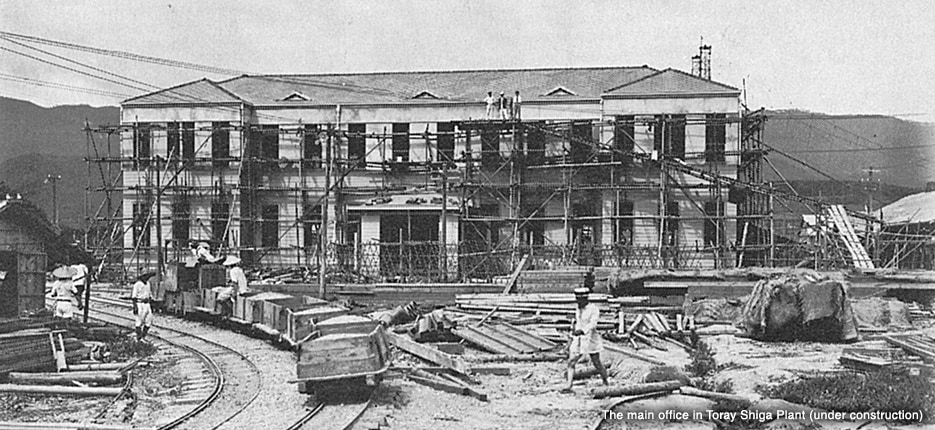
At the time, Japan relied heavily on imports of wool and raw cotton for its clothing. Yunosuke Yasukawa, Toyo Rayon's first chairman and the managing director of what was then Mitsui & Co., believed that by achieving domestic production of rayon made from locally sourced pulp, Japan would be able to reduce its dependence on foreign imports, provide better clothing for the nation, and secure much-needed foreign currency. Following Toyo Rayon's founding in 1926, newly-hired technicians acquired technical knowledge and skills from foreign engineers, while the company dedicated itself to improving equipment and facilities, and to developing new products.
Toray Insights
- We will develop the rayon business to become a major contributor to the nation and the economy, both by achieving self-sufficiency in clothing production and in helping secure foreign currency.
- Through young Japanese technicians' early adoption of technical knowledge from foreign engineers and the in-house development of products, facilities, and equipment, we will establish our own production technology and secure competitive strength internationally.
- Based on the belief that "the plant should be a place for the cultivation of human character," our first Shiga Plant manager, Asahiko Karashima (later our second chairman) has focused on educating and nurturing the abilities of our employees while creating a model plant that possesses both the latest technology and high moral standards.
- From establishing a company to scouting for locations, we understand the necessity of examining and paying sufficient attention to labor and waste issues surrounding the manufacturing and chemical industries.
1951
DuPont introduces American nylon technologyToggle
- Context
-
After Japan's defeat in the Pacific War, the country set out to rebuild its economy.
Three years and eight months after the outbreak of the Pacific war in December 1941, the Second World War finally ended with Japan's defeat in August 1945. Following the war, the Supreme Commander of the Allied Powers (GHQ) led efforts to democratize Japan, and the Japanese economy, after suffering the devastating ravages of war, set out on the road to recovery.
- TORAY’S Episode
-
Began a technology partnership with DuPont following the development of original nylon processing technology.
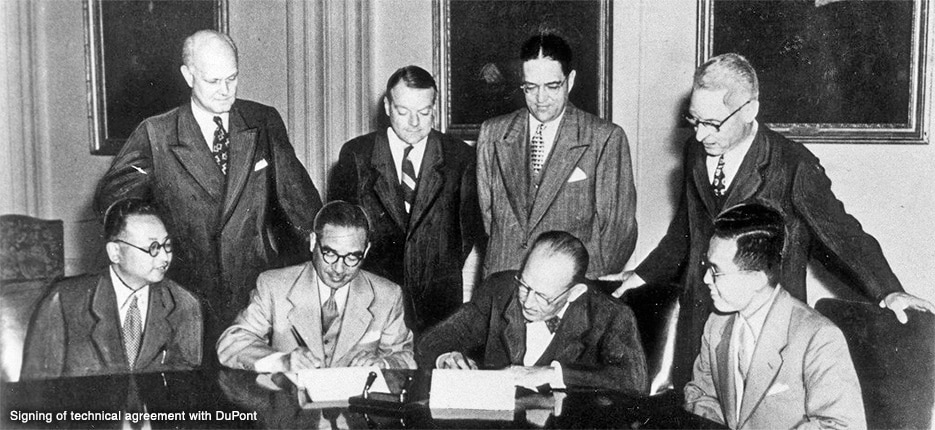
Toyo Rayon succeeded in the synthesis and melt spinning of nylon 6 fiber in 1941 but did not begin plans for its mass production until after the war. In 1951, Toyo Rayon concluded a patent licensing agreement with America's DuPont and began full-scale production of nylon fiber.
Toray Insights
- After getting started with nylon production, we can expand our portfolio to include polyester and other fibers.
- We have entered into a technical partnership with DuPont, as we have both been independently developing Nylon 6, and will begin turning our attention to the export market thanks to the added value achieved through high-order processing.
- We have realized the essential importance of collaborating with customers on each application of new materials in order to develop products, improve quality, and open new markets.
1955
Established the company motto, "Toyo Rayon contributes to communities"Toggle
- Context
-
After making a miraculous recovery, the Japanese economy entered a period of rapid economic growth.
In 1954, the Japanese economy launched into a period of remarkable growth. At the time, people were hungry for prosperity, and economic development became the nation's top priority. Globally, this period saw the beginning of the Cold War, as capitalist and communist nations began their battle for global dominance.
- TORAY’S Episode
-
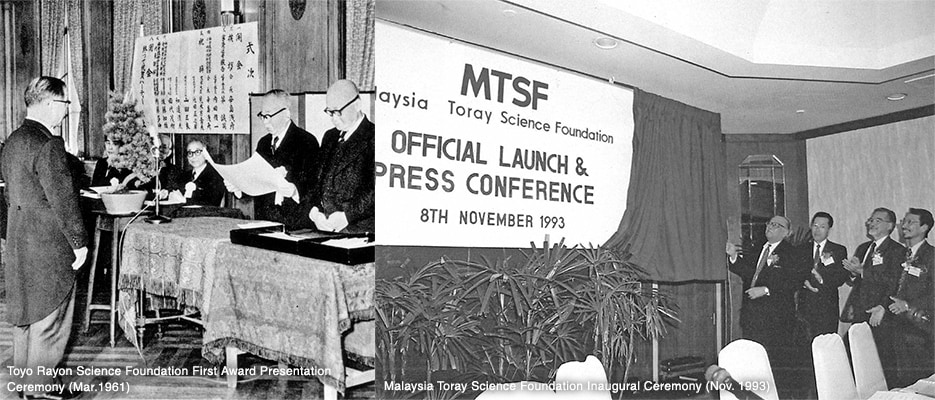
In 1955, Toyo Rayon expressly laid out a company motto reflecting the management philosophy passed down since its founding. This was revisited in 1986, after which a new corporate motto of "Contributing to society through the creation of new value with innovative ideas, technologies and products." was established. In 1960, Toyo Rayon set up a foundation to promote and support basic science in Japan. In 1993 and 1994, it established independent science foundations in three Southeast Asian nations, where the company had expanded early on.
Toray Insights
- From the start, Toyo Rayon's main business objective has been to improve people's quality of life by helping develop the nation and the economy; increasing profit has been the means to achieve this.
- The dramatic expansion of Toray's achievements is due to the support it has received from communities in recognition of its efforts to implement its corporate principle of "contributing to society."
- As a resource-poor nation, Japan will prosper only if its manufacturing industry is further developed and primary importance is placed on promoting and developing the country's science and technology.
1950 -
Establishing a corporate culture of active engagement in R&DToggle
- Context
-
With the rise of mass consumerism, Japan emerged as a dominant economic power.
Companies from developed nations laid the technical foundation of the manufacturing industries that supported Japan's postwar recovery. Furthermore, the manufacturing industry was able to build its export competitiveness under a fixed exchange rate of 360 yen to the dollar. By 1986 Japan had grown to just below the US as the world's second largest economy by nominal GDP.
- TORAY’S Episode
-
A robust R&D infrastructure for developing new products through original technology
Toray's management understood the essential nature of producing new products and technologies based on the results of its own research and technical developments. To achieve this, the company made sure not to rely on technologies borrowed from the West or other companies and circumvented competition from domestic and international firms by differentiating its products and services.
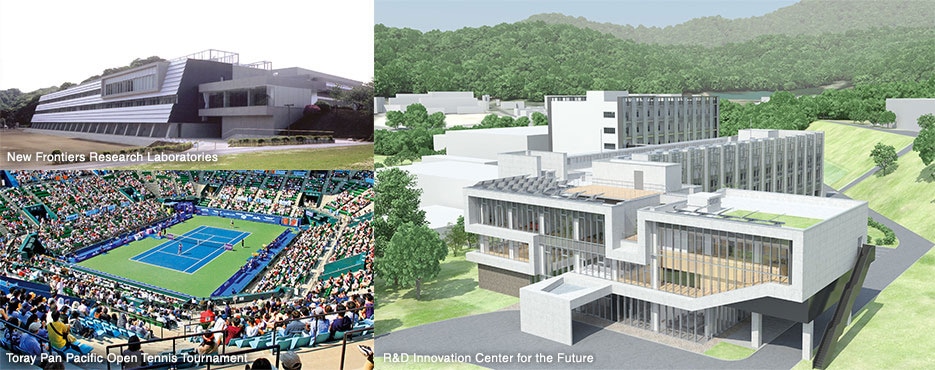
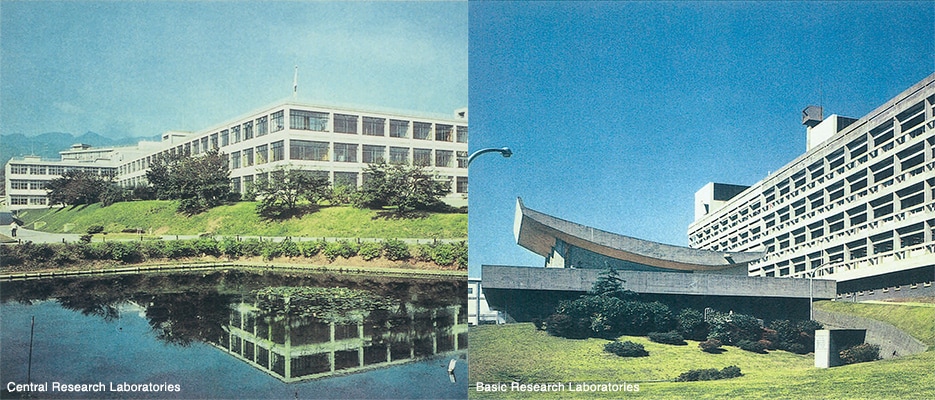
In 1956, Toray established the Central Research Laboratory in Otsu (Shiga Prefecture) and, in 1962, its Basic Research Laboratory in Kamakura (Kanagawa Prefecture). From here, it devoted itself to developing new products. At the Basic Research Laboratory, Toray anticipated strong results from the creative research and technical developments it achieved based on fundamentals in independent research.Toray Insights
- We have realized the importance of creating new growth businesses through independent basic research in order for Toray to continue to grow.
- As a manufacturing company, strengthening core technologies and basic research is a pivotal and ongoing management issue. Japan's national prosperity also depends on its ability to produce industrial products, making R&D vitally important to the country as a whole.
- We recognize the importance of undertaking ambitious research not only for improving the products in front of us today but also for providing solutions to future challenges 5, 10, and 20 years down the line.
1960 -
New endeavors in the Neo-Plastic AgeToggle
- Context
-
Dramatic economic growth for both the Japanese and global economies.
The global economy during the 1960's experienced a period of remarkable growth that lasted until the Nixon and Oil shocks of 1971 and 1973, respectively. In Japan, household appliances, automobiles and other consumer durables became widespread in society giving birth to an era of mass consumption. Following the Tokyo Olympics in 1964, the Japanese economy temporarily stagnated after a round of investments in infrastructure but rebounded shortly thereafter, leading to a wave of economic prosperity lasting until 1970.
- TORAY’S Episode
-
Toray's plastics business blossoms into the company's 2nd operational pillar.
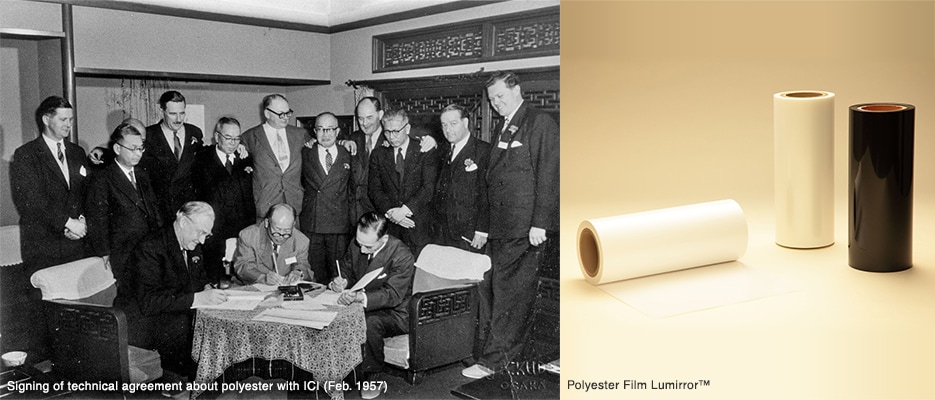
Along with Toray's original development of nylon and acrylic fibers, the company licensed polyester technology from the U.K. firm ICI in 1957. With this agreement, Toray became one of the world's leading manufacturers of all three major types of synthetic fiber in the 1960's.
This period saw a rapid growth in plastics with the expansion of the household appliance and automotive industries. Against this backdrop, Toray found success with a business model of guaranteed quality backed by constant exploration of new materials and applications.Toray Insights
- We recognize that "materials, which form the base of all products, have the power to intrinsically change society."
- As a materials manufacturer, Toray pioneers new markets and applications alongside its clients, while offering new and innovative materials with a mission to meet the demands of both its customers and society.
1960 -
Establishing an overseas manufacturing subsidiary through technology transfersToggle
- Context
-
Countries around the world pursued economic growth through the development of their textile industries.
In the 1960's, America pressured the Japanese textile industry - heavily dependent on US exports - to restrict its international output.
Conversely, developing nations hoping to achieve economic independence pursued economic growth through the development of their manufacturing industries. Many countries began implementing industrialization policies. Some looked to Japan, hoping to transfer its fiber and textile technologies given the rapid growth the country had displayed over the past several decades. - TORAY’S Episode
-
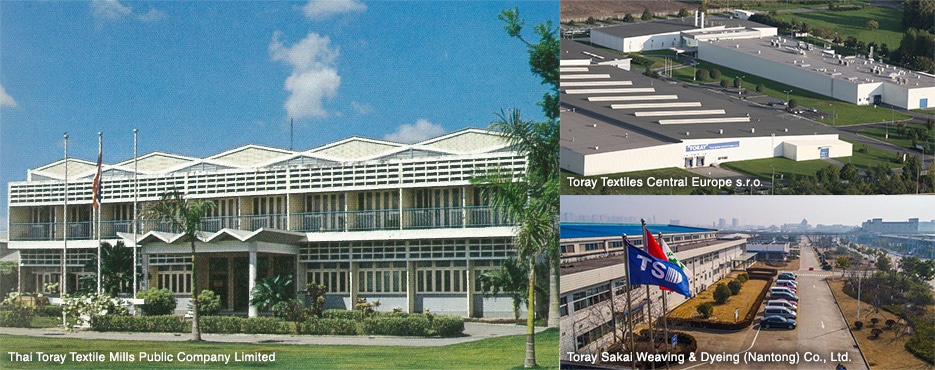
Toray's first joint venture in Thailand in 1963 and the transfer of its technology.
Toray established its first joint venture in Thailand with a business that provided integrated spinning, weaving and dyeing of polyester-rayon fabric. Toray's original objective in setting up this venture was to secure a place to export its staple polyester fiber but began overseas production of yarn and raw fiber at about the same time.
Toray Insights
- While considered a sunset industry by some, we believe that globally the fibers and textiles trade is growing and intend to further expand our business.
- We will continue to create advanced materials through innovative, cutting-edge research and technical developments, while building a business centered on high value-added products. We will also achieve dramatic reductions in costs by developing transformative operational processes.
- To best address matters such as demand and competitive pricing, we will carry out production at the most suitable overseas locations and develop product applications according to local needs. Profit received through our global operations will be reinvested in the research and development of new innovative processes and the next generation of advanced materials, creating an on-going cycle of development and growth.
- Concerning its overseas expansion of operations, Toray will focus on contributing to the long-term growth of local communities in all its business activities.
1970
Toyo Rayon Co., Ltd. renamed Toray Industries, Inc.Toggle
- Context
-
Japan and the world find the limits of economic growth.
Within an ongoing climate of rapid economic growth, Japan faced a financial recession in 1964 and 1965. Among companies in the fibers and textiles industry this was known as the "Nylon shock." In the 1970's the global economy suffered two additional shocks with the Nixon and oil crises that occurred in 1971 and 1973.
- TORAY’S Episode
-
A two-pronged strategy of internationalization and diversification
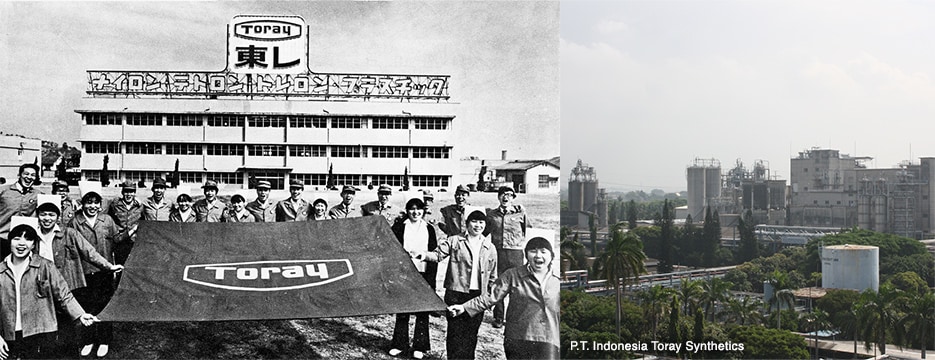
After surviving the Nylon shock, Toray foresaw the eventual maturation of the domestic textile market and began taking measures to expand and develop its overseas operations. The company further sought to diversify into new businesses. To mark this occasion, Toray rebranded with a new name, Toray Industries, Inc., and accelerated the internationalization of its fibers and textiles operations, while diversifying into plastics and other new ventures.
Toray Insights
- We are beginning plans to expand our plastics business in addition to our core synthetic fiber business.
- Toray is gaining wide recognition with its Toray Nylon and Toray Tetoron product lines.
- As part of our corporate redesign, Toray is launching an internal organization for developing new businesses, while simultaneously accelerating the expansion of our overseas fibers and textiles business.
1980 -
Expansion of Toray's carbon fiber business for the next generation of aircraft structures.Toggle
- Context
-
Fluctuation in exchange rates due to Japan-US trade frictions and international compromise.
In 1980, Japan sunk into its longest recession since World War Two, which lasted for three years. It began with the second oil shock brought on by the Iranian revolution. Domestic demand stagnated, but with a booming American economy, Japan expanded its US-bound exports, helping to rekindle the economy. At the same time, this sparked trade tensions between the US and Japan. At the 1985 G7 summit, the Plaza Accord was signed, further exacerbating the yen's appreciation.
- TORAY’S Episode
-
Developing strong and heat-resistant high-performance carbon fibers.
After successfully developing polyacrylonitrile-based carbon fiber, Toray initiated its test production in quantities of a few hundred grams per month in 1970. Thanks to a boost from the "black shaft" revolution, Toray's production saw stable growth early on that translated into the fiber's adoption as a primary structural material in aircraft in the 1980's. Today, the Toray Group manufactures its carbon fiber around the globe in Japan, France, America, and Korea, earning it the number 1 spot globally in terms of both quality and quantity.
Toray Insights
- Cultivating and expanding a new core business on top of our plastics, fibers, and textiles operations is essential to Toray's long-term ongoing growth.
- Toray's polyacrylonitrile-based carbon fiber is increasingly being used as a light-weight material with the potential to reduce the environmental burden of textiles.
- Given the strong, lightweight, and rust-proof qualities of carbon fiber composite materials, we recognize the potential they offer in constructing aircraft and are accelerating our R&D efforts accordingly.

2000 -
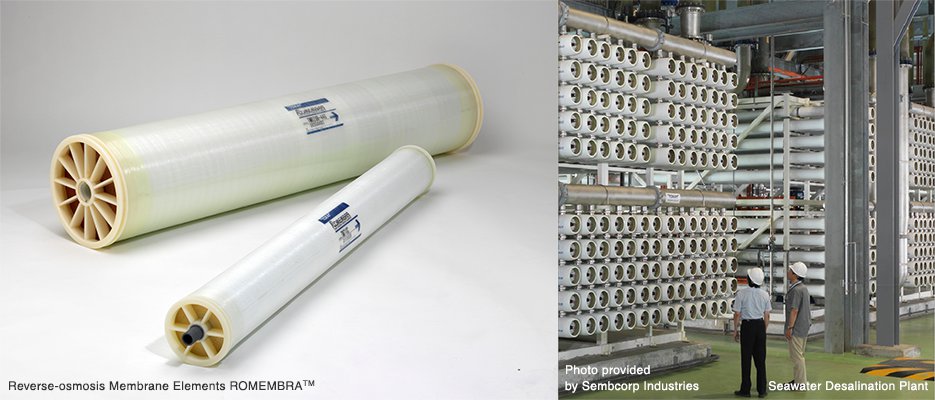
Increased orders for reverse osmosis (RO) membranes used at water treatment facilitiesToggle
- Context
-
Many regions still lack access to clean water in the 21st century.
Research and development of membranes for reverse osmosis began in the 1960's, with many envisioning their application in seawater desalination. In recent years, membrane treatment methods have proven to offer much lower treatment costs than conventional evaporation methods, leading to large plants placing constant orders for these transformative membranes. In combination with other functional membranes, reverse osmosis membranes are also helping solve the challenge of wastewater reclamation.
- TORAY’S Episode
-
Toray's functional membranes give around 400 million people access to clean water.
Toray began its research on reverse osmosis membranes in the 1960's and started developing its water treatment membrane business in the 1980's. Today, as part of its integrated system proposals, Toray has developed a lineup of membranes with functions covering reverse osmosis, ultrafiltration, microfiltration, and more. Toray currently supplies membranes to 70 countries worldwide, which collectively are capable of processing 60 million tons of water a day. This is equivalent to the amount of water used by around 400 million people.
Toray Insights
- The dramatic increase in global population has created the threat of water shortages around the world. Recognizing that access to clean water is a pressing issue humanity must address, we have initiated early measures to tackle this challenge.
- From the start, we have advanced R&D that aims to make seawater desalination a reality and have led comprehensive efforts to improve Toray's manufacturing efficiency. With current bases positioned in Japan, America, Europe, China, Korea, and the Middle East, our seawater desalination plants will begin taking orders on a global scale.
- Toray will provide pivotal support in national projects to develop large-scale, high-efficiency desalination plants.
Current
Onto the next hundred yearsToggle
- Context
-
With a long-term plan in place, Toray continues pursuing future challenges.
The 20th century was defined by war. Even today, regional conflicts continue to unfold, trade wars escalate between superpowers, and even talk of conflict in space begins. Against this backdrop, the United Nations has taken the lead in efforts to address global challenges through international collaboration in order to ensure the continued well-being of humanity and the environment. For its part, Toray has established a long-term plan in continuing to pursue new challenges moving forward.
- TORAY’S Episode
-
Believing perseverance is power, Toray maintains a steady management philosophy.
Toray has focused special attention on basic research to create innovative products. While some products take as much as fifty or sixty years to find market success, Toray's tenacious investments in R&D have borne fruit in a rich and broad portfolio. With a management philosophy that perseverance is power, Toray has continued to honor its dividend policy towards its shareholders, while providing consistent support to sports and culture through long-term sponsorships of worldwide women's tennis tournaments, the Shanghai International Marathon, and more.
Toray Insights
- Toray will engage in research activities inspired by the twin slogans of "long-term continuity" and "the deeper, the newer." Centered on its core technologies, Toray will pursue research and technical developments with long-term objectives firmly in mind.
- We intend to contribute to society directly through our business activities and will work to solve social and environmental issues concerning the planet and the health and longevity of human society through the power of materials.