- HOME
- Sustainability
- Toray Sustainability Principles
- Governance
- Risk Management
Risk Management
We will identify and analyze risks on an ongoing basis and strive to reduce and prevent them. In the event of a crisis that could significantly impact our business activities, we will respond swiftly and appropriately to prevent escalation and work toward prompt resolution and a return to normal operations.
Basic Approach
Toray Group identifies potential management risks affecting the Group’s management activities in order to mitigate risks and seeks to prevent a crisis.
In addition, the Group strives to prevent damage from spreading and to promptly control and normalize the situation by ensuring quick and appropriate responses using the emergency quick response system it has established.
Structure
The risks affecting Toray Group are constantly changing. Toray Industries, Inc. recognizes the critical importance of reinforcing its system for responding to risks that materialize suddenly due to changes in the surrounding environment and for responding promptly when crises do occur, which is essential for the operation of the business.
To this end, Toray Industries established a dedicated team within the General Administration, Legal & Risk Management Division to manage overall risk under normal conditions and to ensure a quick response when crises do occur.
The general manager of the General Administration, Legal & Risk Management Division regularly reports on the status of risk management to the Board of Directors and makes certain to inform the Board when a critical issue or emergency arises.
In addition, risk management activities across Toray Group are conducted in accordance with the Risk Management Regulations, which are defined as group-wide rules. Deliberation, discussion, and information sharing are carried out through the Risk Management Committee. The Risk Management Regulations were established after approval by the president.
Structure of the Risk Management Committee
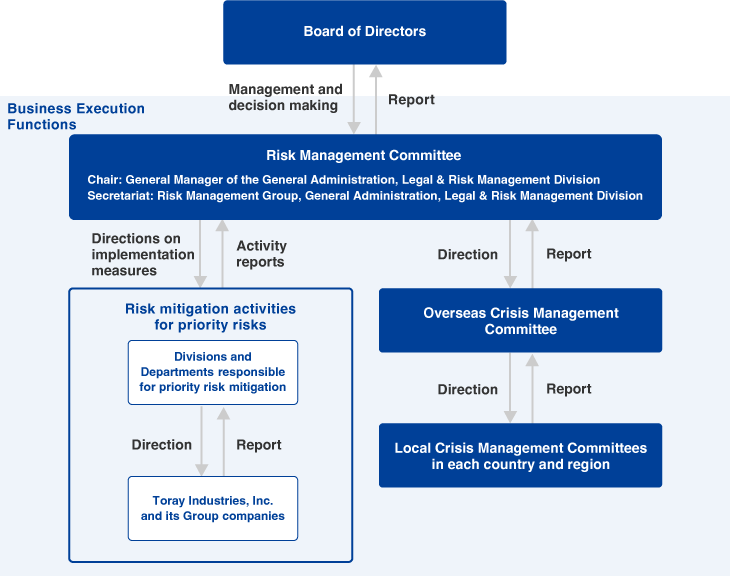
Chaired by the general manager of the General Administration, Legal & Risk Management Division1, the Risk Management Committee is tasked with reviewing, discussing and promoting shared awareness of risk management across the entire Toray Group. This committee primarily carries out mitigation activities for Toray Group Priority Risks as part of regular risk management.
In addition, the Overseas Crisis Management Committee and Local Crisis Management Committees have been established as subordinate organizations. Under normal conditions, they manage employees’ overseas travel and compile information on overseas risks, while in the event of an emergency, they take measures to ensure the safety of employees.
Discussions and reports from the Risk Management Committee are regularly reported to the Board of Directors.
Moreover, the Risk Management Committee has been created in accordance with the Three Lines Model2, a global standard for internal control. Specifically, the committee includes representatives of internal organizations representing the first line (i.e. business operation functions such as production, R&D, and sales), the second line (i.e. corporate functions), and the third line (i.e. internal auditing), with each line taking on their respective roles in risk management. This model promotes the efficient alignment of organizational roles and processes to enhance governance and risk management.
Secretariat: Risk Management Group, General Administration, Legal & Risk Management
Division
for priority risks
Departments responsible
for priority risk mitigation
and its Group companies
Committee
in each country and region
decision making
implementation
measures
reports
Functions
- 1 As of July 2026, a senior vice president serves as the Risk Management Committee Chair.
- 2 Three Lines Model: This is a global standard model for internal control.
• First line: Provides products and services to customers and manages risks.
• Second line: Provides expertise, support, monitoring, and objections on matters related to risk.
• Third line: Conducts internal auditing and provides independent and objective assurance and advice on the appropriateness and effectiveness of governance and risk management.
Within the Toray Group, the first line conducts self-assessments across a wide range of control areas, including legal and compliance, product safety, quality assurance, occupational health and safety, and information systems. The second line carries out monitoring and support, while the third line provides assurance and advice.
Emergency Quick Response System
Toray Group has established Risk Management Regulations, a set of clear fundamental principles that form the basis of a company-wide response in the event of a major crisis. The Group works to ensure the thorough implementation of these rules when required. Moreover, the Group reviews the rules as appropriate to prepare for new risks that emerge due to changes in the social environment.
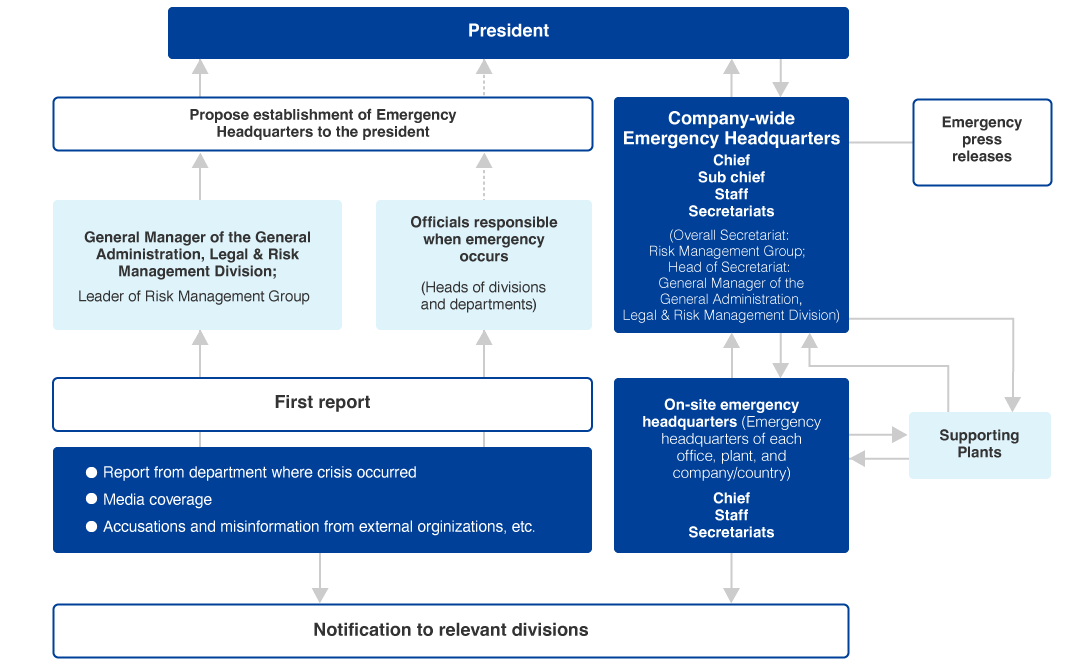
In order to ensure quick management decisions especially in the event of a crisis, Toray Group has clarified the reporting channel from a department where a crisis has occurred, covering group companies in and outside of Japan.
Risk Management Activity Process
At Toray Group, the plan-do-check-act (PDCA) cycle method is used for managing Priority and Specified Risks as part of regular risk management activities. The Auditing Department of Toray Industries monitors these activities every six months.
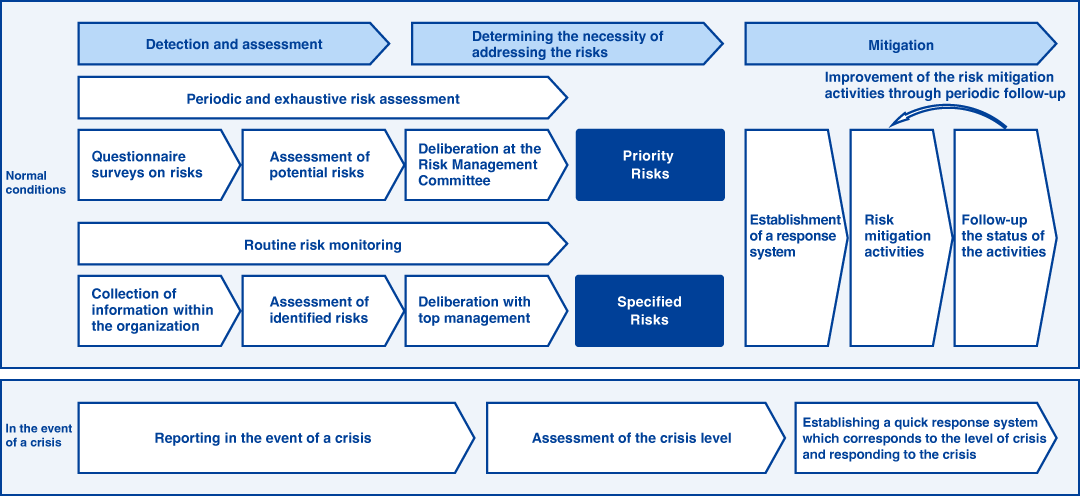
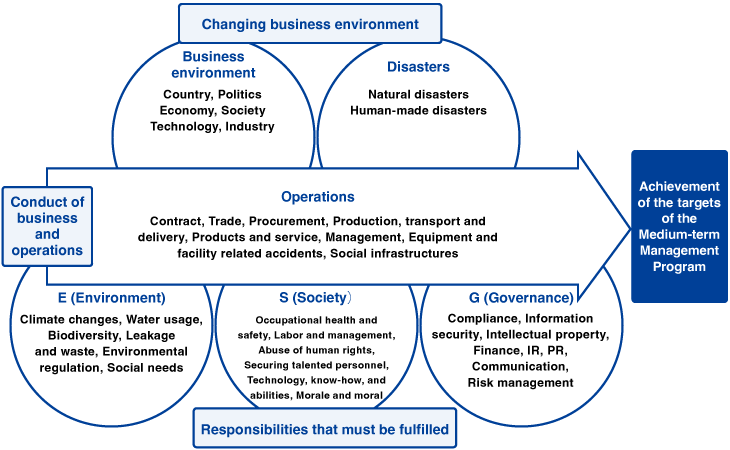
Toray Group Priority Risks are determined every three years in conjunction with the formulation of each new Medium-Term Management Program, based on an evaluation of risks comprehensively identified. Risks that are determined to have a high degree of impact and urgency and to require a company-wide response are designated as Priority Risks. For each risk, the division or department responsible for its mitigation leads efforts to reduce the risk as a priority.
With regard to Specified Risks, a dedicated department routinely monitors domestic and overseas risk trends, conducts surveys and analyses, identifies and assesses risks that may have a major impact on management, and designates risks as Specified Risks in consultation with top management. Specified Risks enable the Group to respond to risks that materialize over a short period of time and have a complementary relationship with Priority Risks, which are managed on a three-year cycle.
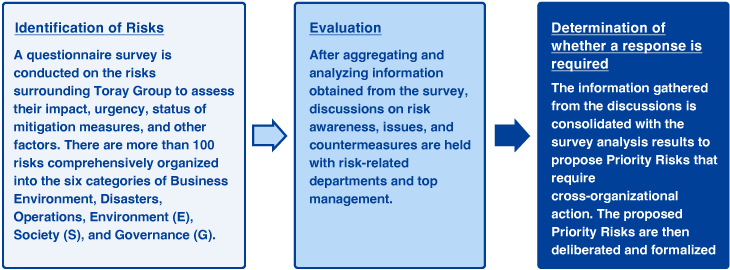
A questionnaire survey is conducted on the risks surrounding Toray Group to assess their impact, urgency, status of mitigation measures, and other factors. There are more than 100 risks comprehensively organized into the six categories of Business Environment, Disasters, Operations, Environment (E), Society (S), and Governance (G).
After aggregating and analyzing information obtained from the survey, discussions on risk awareness, issues, and countermeasures are held with risk-related departments and top management.
The information gathered from the discussions is consolidated with the survey analysis results to propose Priority Risks that require cross-organizational action. The proposed Priority Risks are then deliberated and formalized by the Risk Management Committee.
business
and
operations
of the targets
of the
Medium-term
Management
Program
environment
Economy, Society
Technology, Industry
Human-made disasters
delivery, Products and service, Management, Equipment and
facility related accidents, Social infrastructures
Biodiversity, Leakage
and waste, Environmental
regulation, Social needs
safety, Labor and management,
Abuse of human rights,
Securing talented personnel,
Technology, know-how,
and abilities, Morale
and moral
security, Intellectual property,
Finance, IR, PR,
Communication,
Risk management
Related Information
- Business Risks
See the following page for information on Toray Group Priority Risks and other major risks that could have a significant impact on the Group, as well as its mitigation measures.
Targets and Results
CSR Roadmap 2025 goals
- Reduce risks by identifying and mitigating risks that affect the resolution of management issues across the Group
- Enhance internal controls across the Group and raise the level of risk mitigation efforts
- Instill greater risk management among employees by rolling out risk management education throughout the Toray Group
Main Initiatives and Key Performance Indicators
KPI |
|
⑴ Under normal conditions, manage risks by identifying and addressing two main types of risks:
|
- |
⑵ In the event of an emergency, respond appropriately in accordance with the Risk Management Regulations |
- |
⑶ Follow up on progress made to address Toray Group’s priority risks |
- |
⑷ Follow up on the status of internal control implementation at each group company concerned |
5-❶ |
⑸ Enhance cooperation with crisis management committees at Group sites outside Japan concerning crisis management under normal conditions |
- |
⑹ Implement risk reduction across the Group for information security risks such as cyberattacks and information leaks |
5-❷ |
⑺ Provide risk management education |
- |
| Key Performance Indicator (KPI) | Targets / Results | ||
|---|---|---|---|
| FY 2023 | FY 2024 | FY 2025 | |
| 35% / 35% | 70% / 70% | 100% / 100% | |
| 35% / 35% | 70% / 54% | 100% / 82% | |
- Reporting scope: Toray Group
- 3 Self-assessments and results follow-ups are carried out for all group companies in and outside Japan, with the level of these assessments being gradually raised over a three-year period.
For the first stage conducted in fiscal 2023, self-assessments and follow-ups were completed to determine whether rules and frameworks for risk management are in place at each group company, and a 35% achievement level was reached.
In fiscal 2024, self-assessments and results follow-ups were completed regarding specific risk management activities at group companies. This marked a 70% achievement level for the second stage.
As the third stage in fiscal 2025, self-assessments were conducted to determine whether the activities confirmed in the second stage had been improved through the plan-do-check-act (PDCA) cycle, and results follow-ups were completed. Accordingly, the achievement level was evaluated at 100%.
Click here (834KB)PDF for the main initiatives and KPIs for CSR Guideline No. 5 “Risk Management” during the CSR Roadmap 2025 period (FY 2023-2025).
Sustainability Targets from FY 2026
In fiscal 2026, Toray began carrying out activities in accordance with newly established sustainability targets based on the Toray Sustainability Principles. For more information, please visit the website below.
| Sustainability Targets | FY 2026 | FY 2027 | FY 2028 |
|---|---|---|---|
| Risk reduction activities for priority risks | Qualitative target | ||
| Evaluation by external institutions / clarification of medium- to long-term issues | Qualitative target | ||