- HOME
- Sustainability
- Toray Sustainability Principles
- Governance
- Risk Management
- Risk Management Initiatives
Risk Management Initiatives
Basic System for Group-Wide Risk Management
Periodic risk management (priority risk mitigation activities)
As part of the sixth three-year set of Priority Risks (fiscal 2023-2025), the Group has established two Priority Risk areas: crisis response risks based on the possibility of war, and product supply disruption risks, and has proceeded with risk mitigation efforts.
Crisis response risks based on the possibility of war
This risk area was adopted to ensure employee safety in the countries and regions where Toray Group operates, while facilitating rapid decision-making and action to ensure business operation continuity when such regions are affected by war. In high-risk countries and regions, emergency response manuals were prepared and response drills were conducted.
Product supply disruption risks
To mitigate the risk of interruptions in raw materials caused by supply disruptions from suppliers due to various factors such as economic fluctuations, natural disasters, or cyberattacks, this risk area was adopted with the aim of strengthening the continuity of product supply. The Group analyzed vulnerabilities in the supply chain and implemented risk mitigation measures such as diversification of procurement sources for raw materials, recipe changes, and stockpiling of inventory.
As the seventh three-year set of Priority Risks (fiscal 2026–2028), the Group has designated “product supply disruption risks” as a continuing theme from the sixth set. Under a company-wide cross-functional promotion structure, risk mitigation know-how accumulated to date is shared group-wide, and Toray is working to further strengthen the continuity of product supply.
In addition, in light of the increasing risks in recent years, the Group has designated “business disruption risks due to cyberattacks” as a Priority Risk, strengthened measures on a company-wide basis, and is promoting risk mitigation across Toray Group and its supply chain.
Follow-up on internal control implementation by group companies
In line with the Basic Policy on Internal Control System outlined in Toray’s Basic Policy on Corporate Governance, Toray Industries regularly provides guidance on risk management systems to its group companies worldwide and verifies their operational status.
In fiscal 2025, Toray Industries conducted follow-ups on the progress of improvements in risk management activities for 130 group companies in and outside Japan selected based on their capital ratios, business scale, and other factors, in accordance with the internal control classifications.
Group companies implementing self-assessment and results follow-up using the internal control checklist (%)1

Target
100%

Result
100%
FY 2025, Toray Group
- 1 Self-assessments and results follow-ups are carried out for all group companies in and outside Japan, with the level of these assessments being gradually raised over a three-year period.
For the first stage conducted in fiscal 2023, self-assessments and follow-ups were completed to determine whether rules and frameworks for risk management are in place at each group company, and a 35% achievement level was reached.
In fiscal 2024, self-assessments and results follow-ups were completed regarding specific risk management activities at group companies. This marked a 70% achievement level for the second stage.
As the third stage in fiscal 2025, self-assessments were conducted to determine whether the activities confirmed in the second stage had been improved through the plan-do-check-act (PDCA) cycle, and results follow-ups were completed. Accordingly, the achievement level was evaluated at 100%.
Crisis management for operations outside Japan
Under its Risk Management Committee, Toray Industries has established an Overseas Crisis Management Committee at its headquarters, as well as Local Crisis Management Committees at various group sites worldwide.
As part of its regular activities, the Overseas Crisis Management Committee continuously collects risk-related information from sites worldwide, shares it within the Toray Group, manages overseas travel, and provides risk education to traveling employees. Meanwhile, the Local Crisis Management Committees carry out risk mitigation activities specific to the conditions in their respective locations.
The Overseas and Local Crisis Management Committees are strengthening their cooperation through initiatives such as the joint use of a system for confirming the safety of overseas business travelers during a crisis.
Activities to raise employee awareness
To raise risk management awareness among employees, Toray Group conducts risk management training that includes crisis response every year. The training is provided to new employees, newly appointed managers, and department heads. This training was also provided in fiscal 2025.
Economic Security Risk
Toray Group established a specialized department in April 2021 to address economic security risks in response to increasing geopolitical risks. This department collects information on economic security policies in various countries. It also executes a comprehensive review of the Group’s business activities, including supply chains, investment, technology, human resources, and data from the perspective of economic security risks, and provides management support for risk countermeasures.
Two key aims of these activities are the strengthening of supply chain resilience and the prevention of critical technology leakage.
Enhancing Supply Chain Resilience
The Group has established Supply Chain Management Rules on Economic Security and is adopting a third-party screening system to reduce the risk of inadvertently conducting transactions with sanctioned or restricted entities. In addition, for items that are dependent on other countries and become chokepoints in the supply chain, follow-up on procurement planning is being conducted.
Preventing Sensitive Technology Leakage
The Critical Technologies Management Rules on Economic Security have been established to clarify the technologies that must be protected by Toray Group. Furthermore, rules to ensure research security have been developed to mitigate the risk of technology leaks from joint research and development partners.
Information Security Risk
Toray has established the Toray Group Information Security Steering Committee to centrally manage and improve information security across the entire Group. Under this committee, risk mitigation activities are promoted based on the Toray Group Information Security Basic Policy.
For more information, please see Addressing Information Security Risks.
Quick Response to an Emergency or Crisis
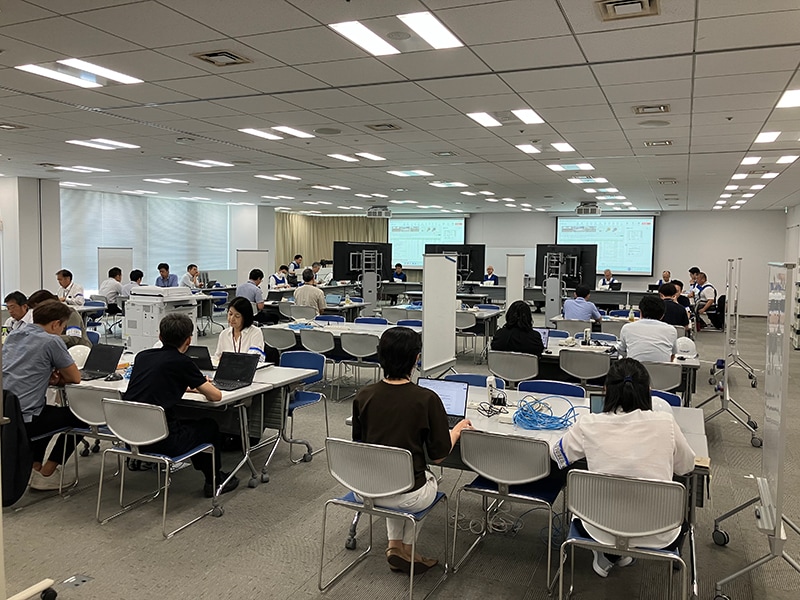 Thirteenth Company-Wide Earthquake Response Headquarters Drill Conducted in Fiscal 2025
In the event of a crisis, Toray Group responds by swiftly establishing a company-wide quick response system (Company-Wide Emergency Headquarters) based on its Risk Management Regulations. In particular, since fiscal 2012, the Group has regularly conducted exercises for setting up the Company-Wide Emergency Headquarters, as part of preparations for a large-scale earthquake in Japan. When the Noto Peninsula Earthquake struck in January 2024, the Company-Wide Emergency Headquarters was set up on the same day. It acted quickly to confirm the safety of personnel, assess the damage, and initiate recovery and support efforts.
To strengthen its emergency response capabilities, Toray Group has designated major earthquakes as Priority Risks in the first through fourth three-year sets of these risks (fiscal 2009-2020) and flooding-related disasters as a Priority Risk in the fifth set (fiscal 2021-2022), and has continuously maintained and revised its business continuity plan (BCP). Toray Group’s basic policy for business continuity is to prioritize ensuring the safety of employees and preventing any impact on the local community, while striving to prevent the expansion of damage and secondary disasters. At the same time, the policy seeks to ensure the continued supply of critical products and the early recovery of business operations, thereby fulfilling its social responsibility for business continuity.
Going forward, the Group will continue to work to further improve its capabilities for responding to emergencies.
Related Information
- Initiatives for Managing Water Resources
See the following page for information on water stress areas and water resource management.