- HOME
- Sustainability
- Toray Sustainability Principles
- Society
- Resilient Supply Chain
Resilient Supply Chain
In cooperation with suppliers, contractors, customers, and logistics providers, we will work to build and maintain a resilient supply chain that supports environmental preservation and respects human rights.
Basic Approach
Toray Group operates a wide range of businesses in countries and regions around the world. As a result, its procurement of raw materials and supplies and the locations and industries of its contractors and suppliers are diverse.
At the same time, sustainability initiatives in today’s global society are increasingly important. They have become more diverse and advanced in the effort to address climate change, environmental protection, respect for human rights and improvements to the labor environment. These initiatives can no longer focus solely on a single company and are being extended to encompass its entire supply chain. Based on this recognition, Toray Group declares in the Toray Group Sustainability Procurement Policies its commitment to building a supply chain that not only ensures quality and supply stability, but also incorporates ethical, environmental, social and human rights considerations.
Furthermore, the Group has formulated the Toray Group Sustainability Procurement Guidelines as specific and detailed action guidelines for suppliers to follow, and is promoting sustainability initiatives throughout the entire supply chain.
Toray Group recognizes that, in promoting sustainability as a group that provides a wide range of materials and products, it is important to advance initiatives in the upstream part of the supply chain, including production facility management and the procurement of raw materials and other supplies. It has therefore established the Basic Purchasing Policies and Basic Distribution Policies as criteria for selecting business partners and promotes initiatives group-wide relating to social responsibilities in procurement and logistics. These include measures to ensure fair and equitable transactions, quality improvement, legal compliance, environmental protection, and respect for human rights.
Finally, these policies are continuously reviewed and updated in response to changes in society and other environmental factors.
Policies
Revised August 2026 (Approved by the Board of Directors)
- While appropriately managing chemical substances, pursue raw materials procurement that takes into account impacts on the environment.
- Take into account the impacts that purchasing activities have on the labor environment and health and safety.
- Maintain and strive to improve product quality and safety.
- In selecting business partners, take into account their efforts regarding social responsibility, such as compliance with laws and regulations, respect for human rights, environmental preservation, and the like, while seeking strict adherence to the Toray Group Sustainability Procurement Guidelines and promoting sustainability throughout the supply chain.
- Do not use minerals from conflict regions or high risk regions, nor minerals that clearly contribute to conflicts or infringe upon human rights.
- Respect human rights, eliminate all forms of discrimination, and strive to improve workplace environments. Additionally, do not be complicit in the infringement of human rights in the supply chain, such as through forced labor, slave labor, child labor, and unjust low-wage labor.
- Strive for dialogue and collaboration with business partners and other stakeholders, and promote appropriate information disclosure.
- Establish an internal organization to promote sustainability throughout the supply chain and sincerely commit to it.
- Engage in risk management through, for example, responding swiftly to unexpected situations and disclosing accurate information.
- Prevent leaks of confidential information and respect intellectual property rights.
- Promote fair transactions grounded in corporate ethics, and comply fully with all laws and regulations, as well as social norms inside and outside Japan, when making purchases.
- 1 Approved by a resolution of the Board of Directors, the Toray Group Sustainability Procurement Policies are the new and revised version of the earlier CSR Procurement Guidelines, which were formulated in 2004.
Revised August 2026 (Approved by the Board of Directors)
- Ethics and Compliance
- (1) Legal Compliance
- Strictly adhere to the laws and regulations of each country and region, and carry out business activities grounded in corporate ethics. Establish compliance policies and build a framework and training system in order to ensure thorough compliance.
- (2) Strict Adherence to Competition Laws
- Refrain from conduct that obstructs fair competition, such as unjust transaction restrictions (private monopolies, cartels, bid rigging, etc.), as well as unfair trade practices or abusing a dominant bargaining position.
- (3) Preventing Corruption and Prohibiting Bribery
- Do not, for the purpose of obtaining improper advantage, provide to or solicit money or goods (including facilitation payments) from parties concerned, and do not provide or accept gifts or hospitality exceeding the acceptable range of social norms. Furthermore, do not engage in illegal political donations and the like.
- (4) Prohibition against Behavior that Presents a Conflict of Interest
- Do not engage in behavior that is against the interest of the Company and in the interest of yourself, a business partner, or a third party, and do not accept inappropriate demands from Company customers or employees of business partners.
- (5) Protecting Confidential Information and Personal Information
- Strictly adhere to each country and region's laws and regulations on business partner, third party, and Company employee personal information, as well as business partner and third party confidential information. Obtain said information, strictly manage and protect it, and use it within an appropriate scope of business.
- (6) Whistle-blowing System and Whistle-blower Protections
- Establish a system for Company employees and business partners to report legal and statutory violations, as well as matters of concern related to the business. Safeguard whistle-blowers to ensure that they are not subject to termination, threats, harassment, or other disadvantages, nor are they subject to retaliation.
- (7) Appropriate Import/Export Management
- Follow appropriate import/export procedures and properly manage the import/export of technologies and goods subject to the laws and regulations of each country and region.
- (8) Respect for and Safeguarding of Intellectual Property
- While appropriately safeguarding the Company's intellectual property, demonstrate respect for the intellectual property of third parties and do not infringe upon their intellectual property rights.
- (9) Appropriate Information Disclosure
- Engage in the timely and appropriate disclosure to stakeholders of management, financial, business activity, and other information stipulated for disclosure in the laws and regulations of each country and region. Also, strive for mutual understanding and the maintenance and enhancement of relationships of trust with stakeholders through communication.
- (10) Responsible Procurement of Minerals
- Carry out procurement activities with due consideration to ensure that raw materials, such as mineral resources, contained in our products are not contributing to human rights violations (including forced labor), environmental destruction, or conflicts in the areas in which they are produced. If there are materials of concern, carry out measures to avoid the use of these materials.
- (11) Elimination of Antisocial Forces
- Maintain absolutely no relationship with antisocial forces that pose a threat to social order or safety. Furthermore, do not provide any form of benefit to antisocial forces.
- Safety, Accident Prevention, and Risk Management
- (1) Occupational Safety Management
- In order to protect the safety and health of employees, ensure that equipment, working conditions, and working procedures are safe. While adhering to the labor laws and regulations of each country and region, strive to avoid occupational accidents by establishing educational programs and safety measures to prevent incidents.
- (2) Occupational Health Management
- Assess the work environments of each workplace, including chemical substance control, noise, odors, etc., and, while establishing measures to avoid injuries to health, strive to manage employee health through regular health exams and the like.
- (3) Responding in Times of Emergency
- In order to protect lives and physical well-being, anticipate potential disasters, diseases, etc. and prepare and disseminate response measures for times of emergency.
- (4) Business Continuity Plan (BCP) Initiatives
- In order to maintain the continuity of business activities, identify risks that may interfere with the activities and carry out initiatives for preventing and mitigating those risks.
- (5) Response to Unforeseen Circumstances and Information Disclosure
- In the event of a crisis that threatens to have a material impact on business activities, take prompt and precise actions, and appropriately report and provide information, in order to prevent the situation from escalating and to achieve a swift resolution and normalization.
- (6) Appropriate Management of Information Security
- Establish an internal management system for information security and implement appropriate defensive measures against computer network threats. Through these actions, prevent the leakage of information regarding the Company and its business partners and other stakeholders, as well as the suspension of business activities. In the event that the Company is affected by such a threat, appropriately report and provide information to stakeholders, and strive to minimize damage.
- Environmental Preservation
- (1) Environmental Management
- While strictly adhering to the environmental laws and regulations of each country and region, build a company-wide management framework regarding environmental due diligence, including appropriate risk management, and strive to continually utilize and improve those frameworks.
- (2) Reduce Emissions of Greenhouse Gases
- Control greenhouse gas emissions in business activities and promote activities that continually reduce those emissions, while striving to effectively utilize energy.
- (3) Minimize Impacts on the Environment
- Manage and reduce emissions of substances that have an impact on the environment, and strive to prevent air, water, and soil pollution.
- (4) Resource Reduction and Waste Product Management
- Engage in improving water use efficiency and appropriate treatment of wastewater to reduce the impact on local water environments, while striving to mitigate and reduce water consumption. Furthermore, aim to reduce waste production by promoting recycling and other measures, and promote the building of a circular economy.
- (5) Chemical Substance Management
- While endeavoring to keep products free of chemical substances legally prohibited by each country and region, appropriately manage and handle chemical and other substances released into the outside environment.
- (6) Concern for Biodiversity
- While preserving biodiversity and striving for its sustainable use, engage in raw materials procurement and land use that takes biodiversity into account. Through activities such as halting and reducing deforestation and conserving greenery, promote initiatives that contribute to the conservation and restoration of the natural environment.
- Product Quality and Safety
- (1) Maintain and Improve Quality
- Strive to improve quality while building frameworks for appropriate quality control and quality assurance, and maintaining quality that meets expectations.
- (2) Product Safety
- Strictly adhere to the laws, regulations, and standards of each country and strive to ensure product quality and safety. In the event that a quality issue does arise, handle it promptly and appropriately.
- Human Rights Promotion
- (1) Respect for Fundamental Human Rights, Elimination of Discrimination and Harassment, and Provision of Equal Opportunity
- Respect fundamental human rights and individuality and, in all aspects of employment, including recruiting, hiring, placement, compensation, training, and resignation, do not engage in and do not be complicit in any discriminatory treatment on grounds of race, ethnicity, language, color, physical characteristics, age, nationality, national origin, religion, sex (including sexual orientation and gender identity), disability, health issues, thought, creed, origin, social origin, family status, marital status, economic status, etc., or engage in any form of harassment. Striving for an organization where diverse talent can thrive, endeavor to realize equal opportunity and a rewarding workplace. Furthermore, recognizing that digital technologies, artificial intelligence, and social media used in business activities have the potential to impact people's privacy, dignity, equality, freedom of expression, and other human rights, respect human rights when utilizing these technologies.
- (2) Prohibition of Child Labor and Due Consideration toward Young Workers
- Do not hire workers who do not meet the eligible working age stipulated by the laws and regulations of each country and region. Additionally, exercise particular consideration for the health and safety of employees under the age of 18, based on the laws and regulations of each country and region.
- (3) Prohibition of Forced Labor and Slave Labor
- Do not utilize forced, compulsory, involuntary, exploitative, or slave labor, nor labor obtained through human trafficking. Additionally, no forms of work shall be forced and employees shall be assured the ability to voluntarily end their employment.
- (4) Wages and Benefits
- Appropriately manage wages and benefits based on the laws and regulations of each country and region regarding minimum wage, payroll deductions, piecework payments, overtime work, other benefits, and employment. Additionally, do not carry out any unjust wage reductions and endeavor to improve employees' quality of life by ensuring wage levels that reflect the concept of a living wage and fair treatment.
- (5) Working Hours
- Strictly adhere to the laws and regulations of each country and region regarding the determination of employee work hours and holidays, and the granting of annual paid leave.
- (6) Dialogue and Cooperation with Employees
- As a means of achieving management-labor consultations regarding working conditions, the working environment, and wage levels, recognize the right of employees to associate or not, as well as the right to collective bargaining, in accordance with the laws and regulations of each country and region. Furthermore, ensure that employees or their representatives can engage in dialogue and consultation with management without fear of retaliation, intimidation, or harassment.
- (7) Coexistence with Local Communities
- In addition to understanding the impact of our business activities on local communities and understanding the culture and customs of each country and region, respect the health of local residents and the rights of indigenous peoples, and aim to coexist with local communities as a good corporate citizen.
- (8) Implementation of Human Rights Due Diligence
- Establish a framework for human rights due diligence based on the United Nations Guiding Principles on Business and Human Rights, and implement it on a continual basis. Specifically, identify adverse impacts on human rights associated with business activities and endeavor to prevent or mitigate them.
- Management System
- (1) Establishment of Implementation System for Guidelines
- Establish an internal system to implement these Guidelines and clearly designate a person to be responsible. The responsible person shall regularly review the internal system.
- (2) Remediation
- In the event that it becomes clear that the Company caused or contributed to an issue related to the requirements of these Guidelines, take prompt and appropriate action and work toward remediation. To that end, establish hotlines and consultation desks in each country and region, and proceed with developing effective grievance mechanisms.
- (3) Education and Training
- Encourage a correct understanding of these Guidelines among all officers and employees, and ensure they implement the requirements.
- Ensuring Strict Compliance and Adherence to Guidelines throughout the Supply Chain
- (1) Request for Initiatives to Business Partners
- While requesting that suppliers, contracted processors, and other business partners strictly adhere to the provisions of these Guidelines or their equivalent, work to thoroughly promote these Guidelines through regular surveys and inquiries on the status of implementation by business partners.
Revised August 2026 (Approved by the Board of Directors)
- Toray does its utmost to select suppliers and determine actual purchases fairly and on the basis of economic rationality, with consideration for price, quality, capability to provide stable supplies, technological capabilities, reliability, and other factors.
- In selecting suppliers, Toray opens its doors to a wide range of companies inside and outside Japan. Toray does not rely solely on vendors it has existing or past relationships with, or on members of its corporate group.
- Toray works to maintain and improve the quality of purchased products through cooperation with its suppliers.
- Toray strictly adheres to its Toray Group Sustainability Procurement Policies and Toray Group Sustainability Procurement Guidelines, and works to promote purchasing activities that contribute to the sustainable development of society on a company-wide basis.
Revised August 2026 (Approved by the Board of Directors)
- Toray does its utmost to select transport and warehousing providers and determine individual agreements impartially and based on factors such as economic rationality with consideration given to price, quality, supply stability, technological capabilities, reliability, and efforts to reduce environmental impact.
- In selecting transport and warehousing providers, Toray opens its doors to a wide range of companies, rather than relying exclusively on companies with which we have done business in the past or companies affiliated with Toray Group.
- With the cooperation of our transport and warehousing providers, Toray works to improve the quality of transport and warehousing services while gauging and reducing environmental impacts.
- Toray strictly adheres to its Toray Group Sustainability Procurement Policies and Toray Group Sustainability Procurement Guidelines, and works to promote distribution activities that contribute to the sustainable development of society on a company-wide basis.
Structure
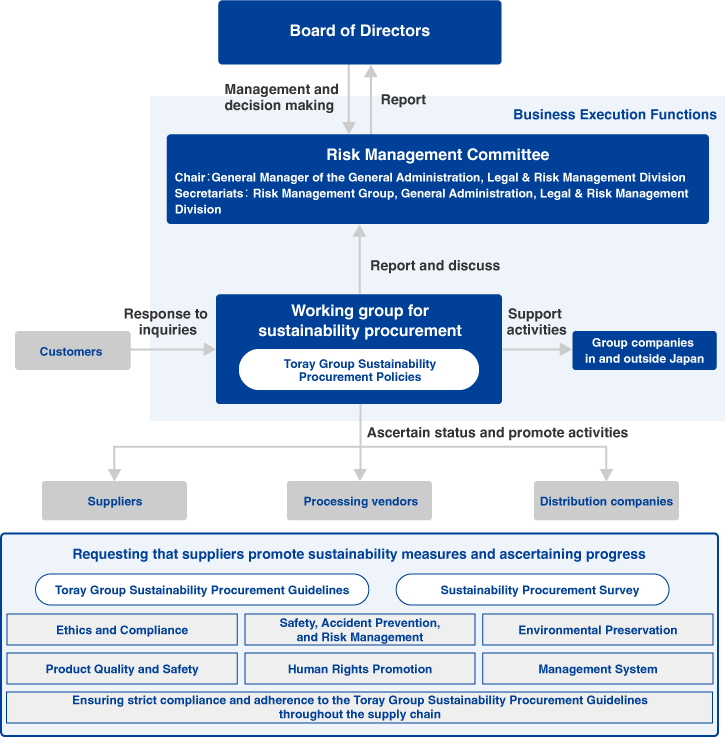
Toray Industries, Inc. regularly reports on and discusses the progress of sustainability procurement and risk mitigation initiatives across the Group with the Risk Management Committee2, the Company’s risk management body. The activities of the Risk Management Committee are reported to the Board of Directors, the Company’s supreme governing body, which oversees the substance of the activities and makes policy adjustments or decisions as necessary.
As a framework for promoting sustainability procurement across the Group, Toray Industries has established the Sustainability Procurement Working Group as part of its company-wide risk management initiatives. The working group is responsible for ascertaining the status of sustainability initiatives at suppliers, responding to sustainability procurement surveys conducted by customers, and supporting the promotion of sustainability procurement at group companies worldwide.
Secretariats: Risk Management Group, General Administration, Legal & Risk Management
Division
sustainability procurement
Procurement Policies
and Risk Management
in and outside Japan
companies
decision making
inquiries
activities
throughout the supply chain
- 2 As of July 2026, the senior vice president responsible for risk management serves as the Risk Management Committee Chair.
Initiatives for Human Rights and Environmental Due Diligence3 in the Supply Chain
In order to identify and assess human rights violations, environmental impacts, and other risks in the supply chain, and to take measures to prevent or mitigate these risks, Toray Group conducts human rights and environmental due diligence in accordance with the Organisation for Economic Co-operation and Development (OECD) Due Diligence Guidance for Responsible Business Conduct.
As the framework underpinning these initiatives, Toray Group has established relevant policies and is working to promote respect for human rights and environmental protection throughout the entire supply chain. The main policies are as follows.
| Category | Main Policies | Main Content |
|---|---|---|
| Human Rights |
|
|
| Environment |
Toray Group Recycling Activity Principles |
|
| Procurement |
|
In addition, when entering into contracts with new business partners, Toray Industries specifies compliance with the Toray Group Sustainability Procurement Guidelines in the basic business agreement and requires them to undertake sustainability initiatives.
Information on these activities is disclosed publicly through the Company’s website and other channels.
For details on specific initiatives related to human rights and environmental due diligence in the supply chain, please click here.
- 3 Due Diligence: To prevent or reduce the negative impacts that a company may have on society, a continuous due diligence process is used. It involves proactively investigating and identifying problems, correcting them through appropriate measures, and publicly disclosing these activities.
Related Information
Targets and Results
CSR Roadmap 2025 goals
To ensure socially responsible procurement by the Toray Group, work with suppliers, processing vendors, subcontractors and other business partners to implement CSR initiatives that include compliance with laws and regulations, amelioration of global warming, environmental conservation, and respect for human rights
Main Initiatives and Key Performance Indicators
KPI |
|
⑴ Request suppliers to comply with the Toray Group CSR Procurement Guidelines, and strive to ascertain the status of each company’s CSR initiatives |
9-❶ |
⑵ Identify high-risk areas that may have a negative impact on the environment and human rights, and promote supply chain due diligence to implement measures to prevent or mitigate the identified risks |
9-❷ |
⑶ Promote procurement of responsibly sourced materials such as non-conflict minerals and sustainable palm oil |
9-❸ |
⑷ Reduce CO2 emissions intensity from distribution activities |
9-❹ |
⑸ Continually investigate and ascertain logistics risks related to natural disasters such as typhoons and heavy rains, and strive to reduce risks |
9-❺ |
⑹ Continually work to reduce the environmental impact and improve the quality of distribution activities |
- |
⑺ In accordance with the Declaration of Voluntary Activities for the White Logistics Movement4, contribute to sustainable logistics, for instance by selecting logistics companies that are engaged in working style reform, etc. |
- |
| Key Performance Indicator (KPI) | Targets / Results | ||
|---|---|---|---|
| FY 2023 | FY 2024 | FY 2025 | |
| At least 75% / 76.8% | At least 85% / 85.5% | At least 90% / 88.1% | |
| At least 60% (Fiscal 2024) / -(Fiscal 2023)5, 66.7% (Fiscal 2024) | At least 90% / 100% | ||
| At least 70% (Fiscal 2024) / -(Fiscal 2023)5, 94.9% (Fiscal 2024) | At least 90% / 100% | ||
| 1% / 11.5% | 1% / -5.5% (increase) | 1% / 2.6% | |
| At least 60% / 58.8% | At least 75% / 70.6% | At least 90% / 88.2% | |
- Reporting scope : Toray Group (9-❶ and 9-❷)
Toray Industries, Inc. (9-❸ and 9-❺)
Toray Group (Only specified consigners, Toray Industries, Inc., TAF) (9-❹)
- 4 The White Logistics Movement: A movement aimed at ensuring stable logistics function necessary for people’s lives and for industrial activities while also contributing to economic growth in response to the shortage of truck drivers
- 5 As these are targets for fiscal 2024, there are no figures to report for fiscal 2023.
Click here (834KB)PDF for the main initiatives and KPIs for CSR Guideline No. 9 “Establishing Sustainable Supply Chain” during the CSR Roadmap 2025 period (FY 2023-2025).
Sustainability Targets from FY 2026
In fiscal 2026, Toray began carrying out activities in accordance with newly established sustainability targets based on the Toray Sustainability Principles. For more information, please visit the website below.
| Sustainability Targets | FY 2026 | FY 2027 | FY 2028 |
|---|---|---|---|
| Percentage of suppliers consenting to Toray Group Sustainability Procurement Guidelines6 | 95% by FY 2028 | ||
| Implementation rate of due diligence for health and safety, human rights and labor, and environmental risks | 70% | 80% | 90% |
| Reduction rate of CO2 emissions intensity in logistics compared to previous fiscal year | 1% | 1% | 1% |
| Percentage of sites where mitigation measures for major risks have been completed | 90% | 95% | 100% |
- 6 At the time this target was set, the document was titled the “Toray Group CSR Procurement Guidelines.” However, following a revision of its content, the title was changed to the “Toray Group Sustainability Procurement Guidelines” after approval by the Board of Directors in August 2026.