- HOME
- Sustainability
- Toray Sustainability Principles
- Environment
- Reducing Environmental Impact
- Biodiversity Initiatives
Biodiversity Initiatives
Alongside climate change, the issue of biodiversity preservation has been a major focus of the international community in recent years. Natural capital such as water, air, plants, animals, and minerals that support human life and industrial activities is sustained by biodiversity. However, due to advancing climate change, depletion of natural resources, ecosystem destruction, and species extinction, nature and biodiversity are being lost at an alarming rate, making this a serious problem.
Against this backdrop, there is an international call for action to achieve a nature positive approach that stops biodiversity loss and turns the tide toward recovery.
Toray Group views conservation of biodiversity as a critical global environmental issue that is of equal importance to reducing greenhouse gas emissions. The Group is committed to conserving biodiversity through its business activities. This includes water treatment technology to produce reliably safe drinking water, water conservation through the reuse of treated wastewater, and air purification using fiber filter-related materials.
The Group also uses environmental assessment checklists to conduct safety reviews for all products and to carry out environmental risk investigations before making capital investment. The checklists enable the Group to ensure that it is not exceeding legal limits on regulated substances contained in exhaust gas, wastewater, and waste. Furthermore, when utilizing new land, the Group confirms biodiversity-related factors such as regulations governing the vicinity of production sites, the need for surveys of endangered species, and any concerns from citizen groups.
Through these efforts, the Group aims to appropriately assess and manage its impact on biodiversity and help build a sustainable world.
Policies
Revised August 2026 (Approved by the Board of Directors)
■Basic Approach
Toray Group supports the philosophy of the Kunming-Montreal Global Biodiversity Framework (KMGBF), appreciates the gifts of nature that biodiversity provides, and strives to realize the conservation, restoration, and sustainable use of biodiversity. The Group contributes to society through the development and dissemination of products and technologies which advance conservation of biodiversity.
■Action Guidelines
- We take into consideration the impact of our business activities on biodiversity and strive to realize the conservation, restoration, and sustainable use of biodiversity.
- We endeavor to develop technologies and products that take into consideration the impact on biodiversity, and contribute to the conservation and restoration of biodiversity by making them available for use.
- We practice fair use of genetic resources on the basis of relevant international agreements, including the Nagoya Protocol.
- We take into consideration the impact of our supply chain on biodiversity and pursue coexistence with nature.
- We strive for land use and raw materials procurement that do not involve deforestation, while urging the entire supply chain to halt and reduce deforestation and promoting initiatives that contribute to the conservation and restoration of the natural environment through activities such as greenery conservation.
- We work to improve the efficiency of water use, ensure the proper treatment of wastewater, and develop and promote water reuse technologies, thereby reducing adverse impacts on local water environments and biodiversity while striving to control and reduce water use.
- We strive to raise employee awareness regarding biodiversity and contribute to building a society that fosters biodiversity through communication with diverse stakeholders, including local communities, governments, academic institutions, NGOs, and supply chain partners.
- We regularly disclose the details and results of our biodiversity initiatives through our reports and website.
(Approved by the Board of Manufacturing Directors)
- Toray Group contributes to the preservation of the natural environment by promoting tree planting using planting methods suitable for the biodiversity of local habitats.
- Toray Group aims to surround its production plants with greenery by giving priority to tree planting in areas at the boundaries of factory sites.
- Toray Group sets goals for making each of its production plants greener while considering how to attain harmony with the surrounding environment as well as regulations concerning green space ratios in each respective country or region.
- 1 Toray Group Basic Policy on Increasing Green Areas was established in 2012, evolving out of greenery policies that were first established in 1973.
Participation in External Initiatives
Toray Group respects Nippon Keidanren's Declaration of Biodiversity (Guide to Action Policies) and the Japanese Ministry of the Environment's Guidelines for Private Sector Engagement in Biodiversity, and is advancing its initiatives on biodiversity based on these guidelines.
The Group is a promotion partner of Nippon Keidanren's Declaration of Biodiversity. The policies and details of Toray Group's initiatives are outlined in the Initiative based on the Declaration of Biodiversity by Keidanren (703KB)PDF.
Toray Industries, Inc. has also participated in the 30 by 30 Alliance for Biodiversity2 since its launch by Japan's Ministry of the Environment on April 8, 2022.
2 With the goal of halting and reversing biodiversity loss (nature positive approach), the Alliance is a voluntary coalition established by businesses, government bodies, and civil society organizations, with the Ministry of the Environment at its center. Its purpose is to achieve the 30by30 Target, an international goal that aims to effectively conserve 30% or more of Earth's land and ocean area as healthy ecosystems by 2030. The Alliance contributes to promoting biodiversity conservation.
Toray Group Strategy
Established in 2018, the Toray Group Sustainability Vision outlined a range of goals to be achieved by 2050. As one of these goals, the Group declared its aim of achieving a world with a restored natural environment, with clean water and air for everyone—in other words, a nature positive world.
To this end, Toray Group has advanced six themes identified as being of overall high importance to the Group: reducing environmentally burdensome substance use, improving water-use efficiency, reducing GHG emissions, promoting a circular economy, reducing and optimizing the use of natural resources, and conserving nature and ecosystems.
In 2020, under the Long-Term Management Vision TORAY VISION 2030, Toray Group set forth its goal of expanding businesses that contribute to solving environmental and social issues. In 2023, under the Medium-Term Management Program Project AP-G 2025, the Green Innovation Business and Life Innovation Business were integrated, and project activities were developed as the Sustainability Innovation (SI) Business.
Following these initiatives, the project activities of the SI Business concluded at the end of fiscal 2025. From fiscal 2026, under TORAY VISION 2050, Toray has reorganized its sustainability strategy and set forth the realization of “a world where people live in harmony with the planet, resources are recycled, and nature regenerates” (environment) as one of the global scenarios in the “World that Toray envisions in 2050.” In addition, under IGNITION 2028, our medium-term management program, Toray established the Toray Sustainability Principles as basic action guidelines for sustainability activities that promote the principle of Reducing Environmental Impact, including easing the burden on natural capital and consideration for ecosystems.
Furthermore, as the basic policy for sustainability activities to realize TORAY VISION 2050, Toray has positioned “environment” and “people” as important perspectives and defined four areas related to these as its key sustainability focuses. The environment perspective consists of responding to climate change (carbon neutrality: CN), realizing a circular society (circular economy: CE), and reducing impacts on and dependencies on natural capital (nature positive: NP), while the people perspective consists of realizing a society where people can live fulfilling lives (Well & Comfort Life: WL3). Nature positive is thus positioned as one of the key areas in the environmental field.
Toray Group will promote initiatives based on its dependencies and impacts on natural capital and advance its efforts toward realizing nature positive outcomes.
- 3 Well & Comfort Life is our proprietary term for businesses that support safety, health, and comfort in people’s lives.
Structure
Structure Evolution
In 2010, Toray Group launched a cross-organizational working group to develop biodiversity initiatives. The CSR Committee adopted the Toray Group Biodiversity Basic Policy in December of the same year, and the Group has been working to identify issues, prioritize them, and promote initiatives based on that policy.
In 2023, the team was renamed the Nature Positive (NP) Subcommittee, and some of its functions were updated. Then in 2024, the entire promotion framework for realizing the Toray Group Sustainability Vision was also reorganized and the Group promoted initiatives centered on the following two projects.
- Sustainability Innovation Business Expansion Project (SI Business Expansion Project)
Under this project, Toray Group worked to expand its SI businesses with the aim of helping to reduce society’s environmental impact through the Group’s business activities.
While initiatives were basically promoted within each business division, subcommittees were established separately in cross-business areas such as mobility, circular economy, and hydrogen, working together to expand the SI business. - Climate Change Action Project (Climate Change Project)
With the objective of reducing the environmental burden from its own operations, Toray Group pursued an integrated approach to GHG emissions reduction and actions to help achieve a nature positive world. Within this framework, the Nature Positive (NP) Subcommittee reviewed the formulation of an overall strategy and external communication concerning initiatives to help achieve a nature positive world.
Current Structure
In 2025, to strengthen its response to growing and increasingly complex sustainability issues, Toray Group established the Corporate Sustainability Strategic Management Division as an organization under the direct supervision of the president, through the integration of related departments. This structure enables the Group to centrally promote the expansion of sustainability-related businesses such as biodiversity and natural capital, reduction of environmental impact, and information disclosure.
In addition, as a result of the review of the implementation structure, the SI Business Expansion Project was reorganized into the four key sustainability areas (CN, CE, NP, and WL). By strengthening the linkage between initiatives and businesses in each area, Toray Group is implementing its growth strategy and working to create value.
Furthermore, the Climate Change Project was reorganized by reviewing its previous initiatives and establishing a GHG Reduction Project and an NP Project, with initiatives being promoted in each respective area.
Oversight and Decision-Making Processes by Senior Management
The Board of Directors receives reports on the Group’s biodiversity response measures at least once a year and appropriately monitors them. Furthermore, when making management decisions, the Board considers opportunities and risks related to biodiversity as one of the key elements and exercises appropriate oversight and decision-making.
At the Executive Committee (an advisory body to the Board of Directors), key policies and agenda items related to sustainability are also discussed. In addition, important issues related to fundamental strategies and capital investment in equipment under the NP Project, as well as other matters related to management strategy, are deliberated as needed by the Executive Committee, taking into account the rapidly changing business environment.
By enhancing agility in both oversight and execution, Toray Group is accelerating its response to reducing environmental impacts across society and within its own operations.
Risk Assessment and Responses
Business-Related Risk Analysis
Toray Group conducted a risk analysis focusing on water risks (drought and flooding) and pollution risks in order to identify priority regions from the perspective of dependencies and impacts related to biodiversity and natural capital, as well as associated opportunities and risks. The analysis covered 423 production sites and offices. As a result, 45 sites were identified as being located in high-risk regions.
Subsequently, on-site assessments at each location confirmed that either appropriate risk mitigation measures had been implemented, or that no actual or potential risks were identified, at all locations.
Reference: Analysis Tools
- Water risk: Aqueduct Water Risk Atlas, a water risk assessment tool provided by the World Resources Institute (WRI)
- Pollution risk: WWF Biodiversity Risk Filter (BRF)
Analysis of Opportunities and Risks in the Supply Chain
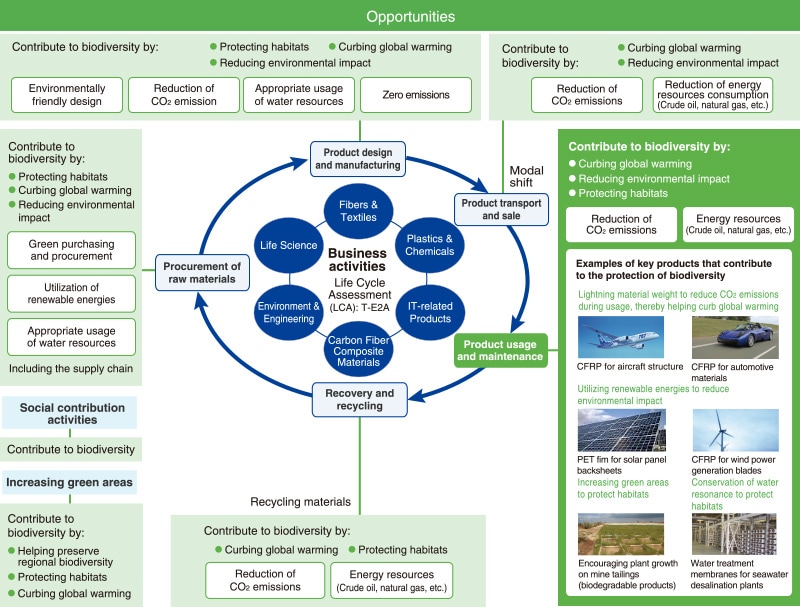
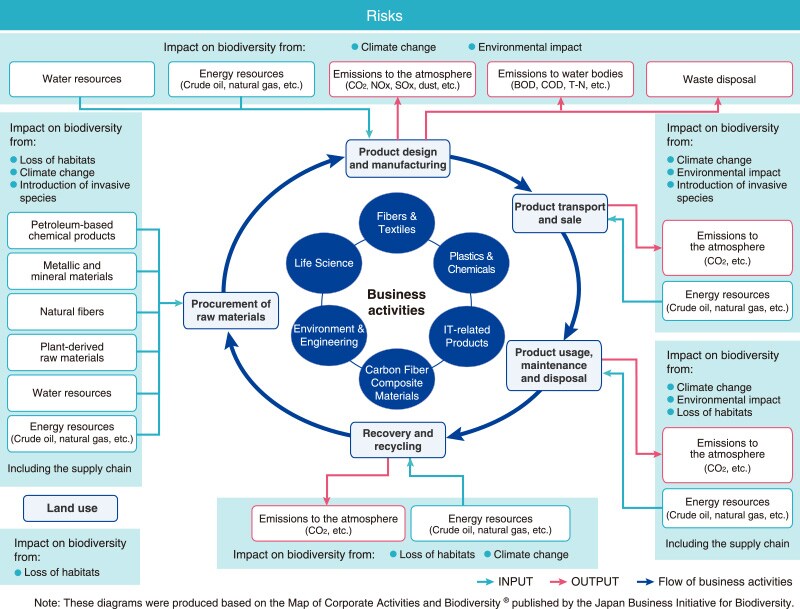
The Group conducted an analysis of the biodiversity opportunities and risks relating to its business activities, namely, upstream raw material procurement, water and energy resource use, product and service design, operational emissions, and land use for operations, as well as downstream product use, disposal, collection, and recycling.
Supply Chain Risks and Opportunities Related to Biodiversity
| Category | Description | Relationship to Biodiversity |
|---|---|---|
| Opportunities |
|
Forest conservation and habitat protection |
| Risks |
|
Adverse impacts on ecosystems |
The two diagrams below show the biodiversity-related opportunities and risks across Toray Group's supply chain.
Responding to Deforestation
Toray Group recognizes that deforestation is a critical issue that has significant impacts on the global environment and human lives, contributing to wildlife extinction, accelerating climate change, and spreading infectious diseases.
Based on this recognition, the Toray Group Biodiversity Basic Policy supports the principles of the Kunming-Montreal Global Biodiversity Framework (KMGBF) and stipulates that the Group will strive to conserve and restore biodiversity and ensure its sustainability. The policy also clarifies the Group’s commitment to promoting the procurement of raw materials and land use without deforestation, as well as efforts to stop and reduce deforestation throughout the entire supply chain.
Furthermore, in the first of its Ten Basic Environmental Rules, namely, “prioritize environmental preservation,” the Group stipulates that it complies with relevant laws, regulations, and agreements in all its business activities. The Group also conducts its business operations with environmental preservation as the highest priority, including consideration for biodiversity, stable use of water resources through the control and reduction of water consumption, and avoidance of deforestation.
In addition, the Toray Group Policy for Human Rights and the Toray Group Sustainability Procurement Policies emphasize respect for human rights, explicitly stating that the Group will not engage in or be complicit in human rights violations such as forced labor or child labor.
In accordance with these policies, the Group conducts its business activities with consideration for forest conservation and the protection of related human rights.
Examples of Toray Group Activities
- Use of Paper Sourced from Responsibly Managed Forests
For its Message to Shareholders (in Japanese only) and in-house magazines, the Group uses paper made from wood harvested from responsibly managed forests. - Promotion of Green Procurement
The Group promotes the purchase and use of recycled paper. - Reduction of Paper Resource Use
The Group works to reduce overall paper resource consumption, including paper cups and copy paper. - Implementation of Green Space Conservation Activities
Each plant and group company carries out green space conservation activities both on and around its premises. - Tree-Planting Activities in Collaboration with Local Communities
As part of its social contribution activities, the Group continuously conducts tree-planting activities in collaboration with local residents and local governments.
Specific Initiatives
| Theme | Initiative Overview | Related Information | |
|---|---|---|---|
| Business Activities (Products and Technologies) |
|
||
| Production Activities |
|
Initiatives for Managing Water Resources |
|
| Supply Chain |
|
||
| Local Communities | |||
| Increasing Green Areas | For details on the progress on Increasing Green Areas, please click here. | ||
| Social Contribution Activities |
|
||
| Internal Education | |||
| Education for All Employees | Providing ongoing educational opportunities to promote understanding of biodiversity and natural capital, including through webinars (the concept of nature positive, international trends, and introduction to TNFD Report) | Webinars |
|
| Strengthen Environmental Management |
|
- | |
Increasing Green Areas
Plants at Toray Industries and its group companies in Japan are operating greenery policies and plans, guided by the Toray Group Basic Policy for Increasing Green Areas. The plans encompass initiatives to conserve green areas, including natural forests4 that have been protected since the plants began operating. These ongoing initiatives contribute to maintaining and restoring the natural environment around Toray plants, as well as to environmental conservation in the local communities.
Under the guidance of the late Akira Miyawaki, professor emeritus at Yokohama National University and renowned plant ecologist, Toray Industries has been promoting an initiative to create forests on its manufacturing sites. This initiative involves collecting acorns from nearby shrines and forests to cultivate saplings for planting. The aim is to help grow forests that preserve the genetic characteristics of local ecosystems.
Altogether, Toray Industries has created green areas covering approximately 200,000 m² at 12 plants, including Mishima Plant, as well as at the Basic Research Center through the shrine forest method5.
- 4 Natural groves or forestation by species based on potential native vegetation
- 5 Modeled after traditional forestry techniques used by Japanese shrines, this greening method reproduces green spaces in a state close to natural forests by using trees that are native to the area. In order to create forests with local genes, Toray employees collected seeds from shrines and forests near plants, grew them into seedlings, and planted the seedlings to create forests at production sites.
Toray Industries, Inc. Mishima Plant
In 1973, this activity began at the Mishima Plant when approximately 4,000 employees collected acorns from Mishima Taisha Shrine and Mount Hakone. Over the past 50 years, these efforts have created an environmental conservation belt surrounding the plant. The native trees grown from these acorns, including Japanese bay tree, camphor, and bambooleaf oak, now cover an area of approximately 10,000 square meters.
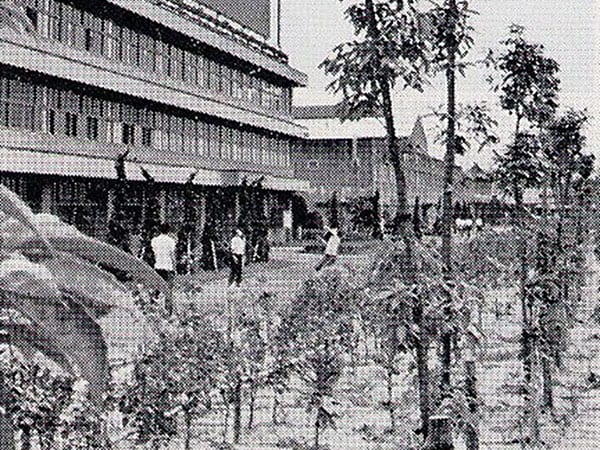
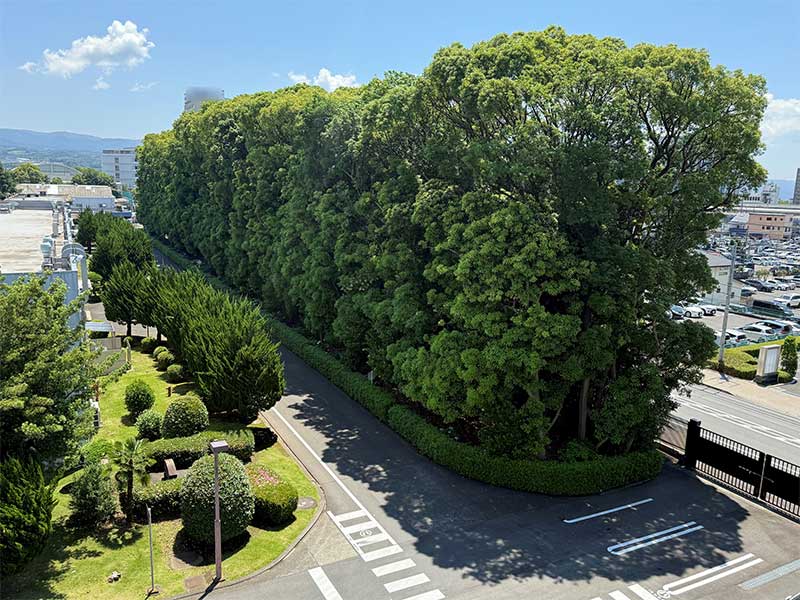
A greening initiative has taken root, and through decades of care, the trees are still flourishing (The photo on the left shows the trees just after planting in 1973)
Toray Industries, Inc. Tokai Plant
As a result of its efforts to conserve biodiversity and help develop the next generation of human resources, the Toray Industries Tokai Plant was certified in 2022 as Excellent Stage 2 in the OMA (Operation, Management and Active use) category of the Social and Environmental Green Evaluation System (SEGES)6, a green certification program provided by Japan's Organization for Landscape and Urban Green Infrastructure.
Moreover, Aichi Prefecture, where the Tokai Plant is located, adopted the Aichi Biodiversity Strategy 2030 in February 2021. This strategy aims to promote initiatives related to biodiversity conservation through collaboration among a variety of entities such as companies, universities, environmental organizations, and government agencies. Companies are expected to play a central role in local communities by contributing to biodiversity conservation through activities such as developing biotopes on company premises and having employees participate in conservation activities.
Therefore, in order to promote corporate initiatives related to biodiversity conservation, in 2022, Aichi Prefecture established the Aichi Biodiversity Company Certification Program to recognize companies that are implementing outstanding initiatives in this area. The Tokai Plant is collaborating with university students to conserve the rare southern Japanese rice fish that lives in the plant biotope, along with an herbaceous plant Fujibakama that helps provide a network of ecosystems for the chestnut tiger butterfly. As a result, Toray Industries has been recognized as an Aichi Biodiversity Certified Company.
In 2023, the Chita Peninsula Greenbelt, a collaborative initiative involving various stakeholders including Toray Industries, was certified as a “nature symbiosis site” by Japan’s Ministry of the Environment. This kind of site is certified by the government as an area where biodiversity conservation is being promoted through private initiatives. The designation is part of Japan's 30by30 Roadmap initiative, based on the 2030 Nature Compact agreed upon at the G7 Summit in June 2021. The certification system was launched in fiscal 2023, and the Chita Peninsula Greenbelt was recognized as one of its first certified sites.
- 6 The Social and Environmental Green Evaluation System (SEGES): This system evaluates and certifies outstanding corporate green space initiatives that contribute to society and the environment.
A certification system in which the Organization for Landscape and Urban Green Infrastructure certifies green spaces created and maintained by companies and other organizations, as well as their daily activities and initiatives. When green spaces meet criteria such as their level of contribution to society and the environment, and the appropriateness of their management, they are certified under one of three categories: OMA (Operation, Management and Active use), PDC (Planning, Designing and Construction), and ESW (Environmental Friendliness, Safety and Well-Being).
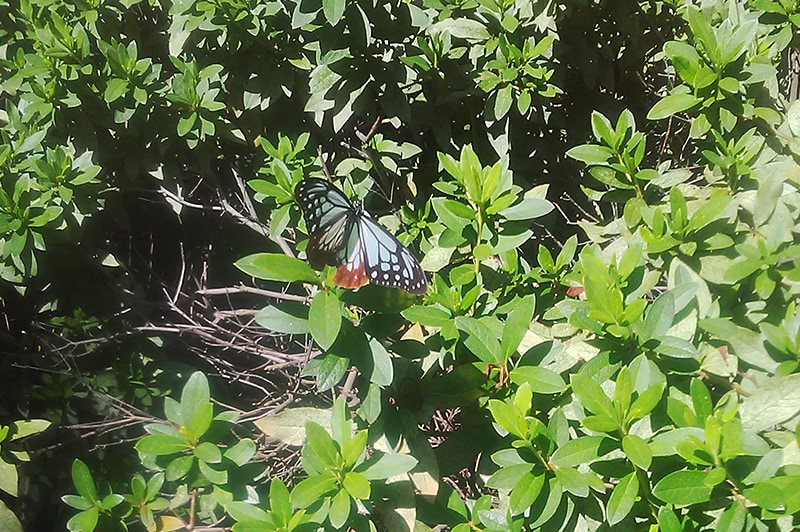 A chestnut tiger butterfly in a plant biotope
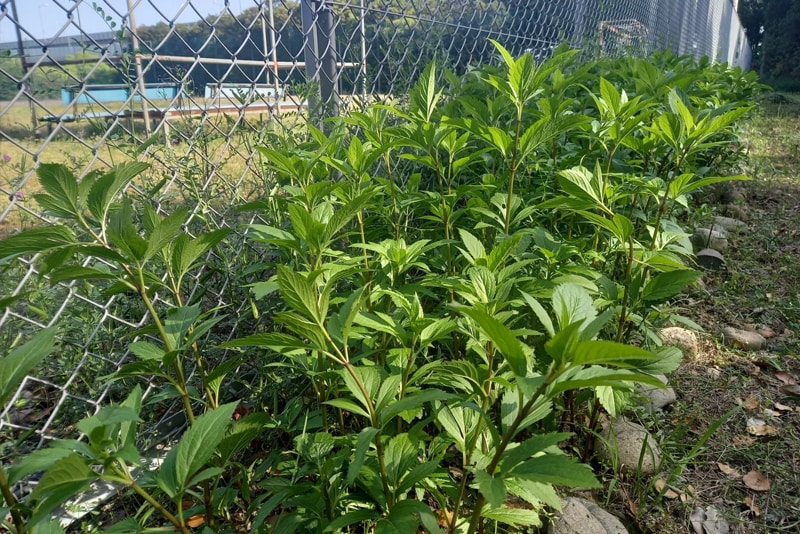 Fujibakama (Eupatorium japonicum) being cultivated at the Tokai Plant
 SEGES Excellent Stage 2 certification
 Aichi Biodiversity Certified Company logo
Toray Industries, Inc. Shiga Plant
The Toray Industries Shiga Plant is actively engaged in community-based green space management, including maintenance of the Sonoyama Park green space located on its grounds. This park is open to the public as a place of relaxation for local residents and also serves to strengthen ties with the community.
In addition, while working to reduce the environmental burden associated with production activities, the plant promotes the manufacture, research, and development of products that contribute to environmental conservation, such as fuel cell components and technologies for water treatment and water electrolysis systems.
These initiatives were recognized in fiscal 2024, when the plant achieved the highest rating (three stars) under the Shiga Biodiversity Initiative Certification7.
- 7 Shiga Biodiversity Initiative Certification: Established by Shiga Prefecture in fiscal 2018, this program certifies companies engaged in biodiversity conservation and the sustainable use of natural resources. The program aims to make such corporate initiatives visible, enhance the brand value of certified companies, and promote awareness of the importance of biodiversity-conscious practices in social and economic activities. Depending on the scope of initiatives, companies are given a rating of up to three stars.
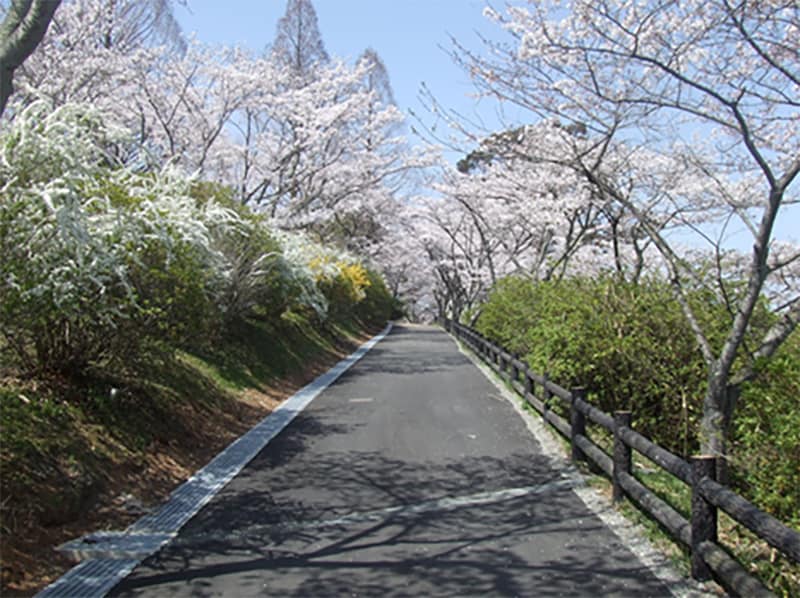 Sonoyama Park green space
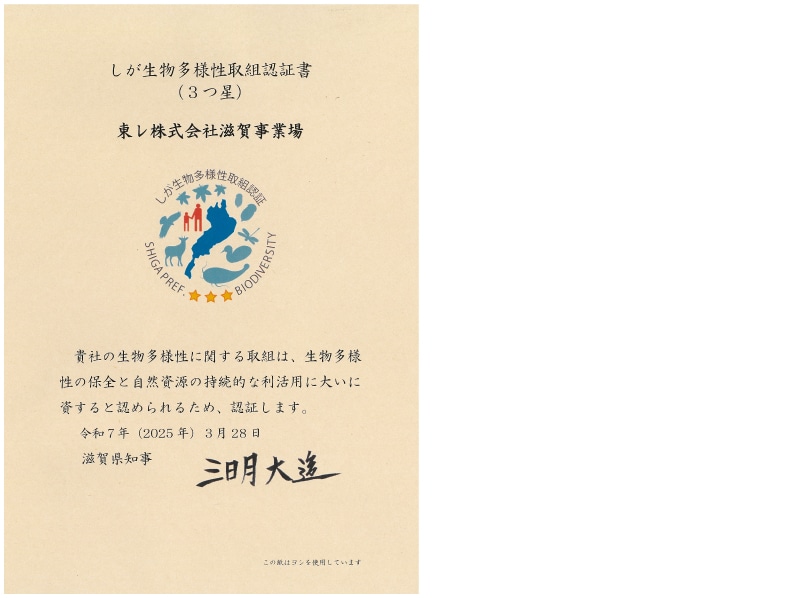 Shiga Biodiversity Initiative Certificate (3-star rating)
- Reports Download (TNFD Report)
Toray Industries has organized its biodiversity-related risk assessments, strategies, indicators, and targets based on the recommendations of the Taskforce on Nature-related Financial Disclosures (TNFD).
For details, please see the following page.