- HOME
- Sustainability
- Toray Sustainability Principles
- Society
- Resilient Supply Chain
- Promotion of Sustainable Distribution
Promotion of Sustainable Distribution
Toray Group is working to reduce its environmental impact and improve efficiency in the logistics sector as part of its efforts to realize a sustainable society. Logistics is an important foundation supporting business activities, while also being closely connected to social issues such as CO2 emissions and working conditions.
With the aim of improving logistics quality while reducing environmental impact, Toray Group is promoting collaboration with partner companies and implementing a range of initiatives, including holding briefings on its basic policies, participating in Japan’s White Logistics Movement, reforming on-site logistics operations, and introducing smart pallets. Through these activities, the Group aims to establish an efficient and sustainable logistics system.
Working Together with Business Partners
Holding Basic Distribution Policy Briefings
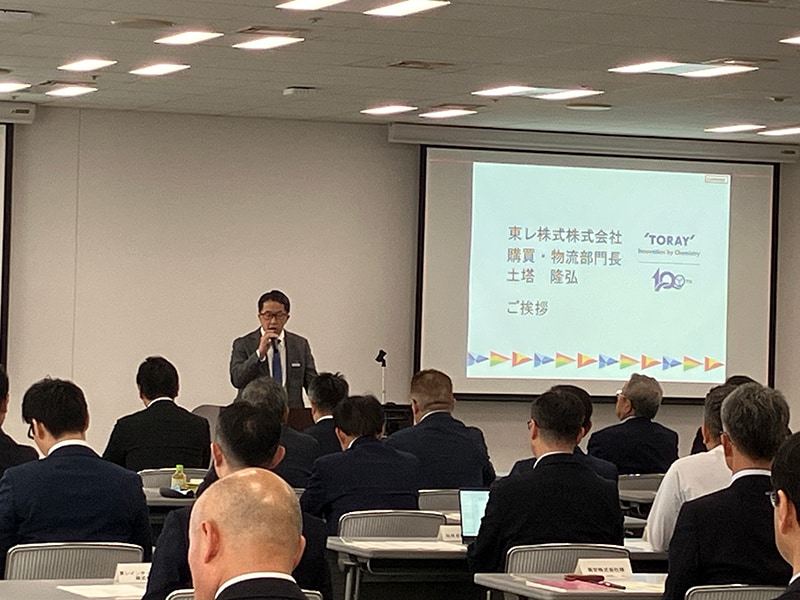 Basic Distribution Policy Briefing (fiscal 2025)
Toray Industries, Inc. promotes understanding of Toray Group’s distribution policies and works to improve distribution performance with annual Basic Distribution Policy Briefings for logistics companies as part of its ongoing effort to improve quality and reduce the environmental impact of its distribution process. In addition, Toray Group promotes continuous improvement throughout the entire supply chain by recognizing and awarding logistics service providers that demonstrate outstanding logistics quality initiatives.
FY 2025 Results
| Number of Participating Companies | Format |
|---|---|
| 61 | Hybrid: Online and in person |
Participation in White Logistics Movement1 and Efforts to Improve the Logistics Environment
Toray Industries participates in the White Logistics Movement, an initiative designed to ensure the provision of the stable logistics necessary for consumers’ lives and for industrial activities, while also contributing to economic growth.
In line with the declaration of voluntary activities given below, the Company is actively working to improve the logistics environment based on mutual understanding and cooperation with business partners and logistics companies.
| Voluntary Action Declaration | |
|---|---|
| Cooperate with the logistics improvement and proposals | Seriously work on eliminating incidental work, etc. that leads to increased duty hours of truck drivers. |
| Use pallets, etc. | Expand use of packing styles (pallets, etc.) that enables loading using forklifts to reduce cargo loading time. |
| Extend lead time | Secure sufficient lead time corresponding to the transportation distance. |
| Take legal compliance status into account | Give utmost priority to assess compliance status with relevant laws upon selecting logistics companies for signing agreements. |
| Actively utilize logistics vendors engaged in working style reforms, etc. | Actively utilize logistics companies engaged in work-style reforms, improvement of transportation safety and logistics quality. |
| Suspend or discontinue operations in case of extreme weather or natural disasters | Give utmost priority to truck driver safety in the event of extreme weather or a natural disaster |
- 1 The White Logistics Movement: In response to the growing shortage of truck drivers in Japan, the Ministry of Land, Infrastructure, Transport and Tourism (MLIT), Ministry of Economy, Trade and Industry (METI) and Ministry of Agriculture, Forestry and Fisheries (MAFF) are working together to encourage the participation of shipping and logistics companies. The aim is to improve the productivity of truck transportation and raise logistical efficiency, while looking to realize a fairer labor environment, thereby making it easier for women and drivers over the age of 60 to work in the industry.
Addressing the 2024 Logistics Problem Through the Physical Internet Realization Council
While logistics centered on small-lot shipments is increasing in Japan’s logistics industry, it continues to face a shortage of transportation capacity due to the aging of drivers and ship crews, as well as labor shortages. Additionally, with Japan’s so-called “2024 logistics problem”, addressing the shortage of transportation capacity continues to be an important challenge. Predictions indicate a 34% shortfall in logistics transportation capacity by 2030 if the situation remains unchanged, making this an extremely critical challenge for the chemical industry.
Furthermore, chemical products have unique properties, packaging formats, and are often heavy. This results in diverse transport methods and conditions, making it difficult for individual companies to implement effective measures.
To address these challenges, Toray Industries, alongside Mitsubishi Chemical Group Corporation, Mitsui Chemicals, Inc., and Tosoh Corporation, established the Chemicals Working Group in July 2023, under the Physical Internet Realization Council, organized by the Ministry of Economy, Trade and Industry and the Ministry of Land, Infrastructure, Transport and Tourism. The four companies serve as the secretariat for the working group.
The Chemicals Working Group currently includes 87 organizations (86 companies and one university, as of April 2026), primarily consisting of shippers and logistics providers. Representatives from the Ministry of Economy, Trade and Industry, the Ministry of Land, Infrastructure, Transport and Tourism, the Ministry of Health, Labour and Welfare, the Japan Chemical Industry Association, and the Japan Petrochemical Industry Association also participate in the working group. The group announced a voluntary action plan on March 29, 2024. (For more details, click here (469.8KB)PDF Japanese only)
In addition, among the participating companies, Mitsubishi Chemical Group Corporation, Mitsui Chemicals, Inc., Tosoh Corporation, Prime Polymer Co., Ltd., and Toray Industries conducted demonstration trials from September to December 2024, utilizing the logistics data platform and logistics information standardization guidelines promoted by the government under the Physical Internet Realization Council, with support from subsidies provided by the Ministry of Land, Infrastructure, Transport and Tourism and the Ministry of Economy, Trade and Industry.
These demonstrations included on-site verification of round-trip logistics between the Yokkaichi and Ichihara industrial complexes (in Mie and Chiba prefectures), simulations of joint logistics between the Nagoya metropolitan area and the Hokuriku region, and analyses of transport efficiency between Ichihara and the Tohoku region, thereby testing the effectiveness of joint transport and the usefulness of a shared logistics platform.
In particular, the on-site verification confirmed significant benefits, including a 20-point improvement in truck loading rates and a 28% reduction in CO2 emissions. (For more details, click here.)
Utilization of Autonomous Trucks
As the shortage of truck drivers becomes increasingly serious in Japan, Toray Industries has introduced autonomous trucks operated by T2 Inc. for the transportation of its products and has been conducting trials toward establishing a sustainable logistics system.
The operating route covers approximately 440 kilometers, from the Ayase Smart Interchange (IC) on the Tomei Expressway in Kanagawa Prefecture to the Ibaraki Sentaiji IC on the Shin-Meishin Expressway in Osaka Prefecture.
A total of four demonstration tests were conducted between September 2025 and April 2026.
Based on the test results, commercial operations for transporting TOYOLAC™ ABS resin began in fiscal 2026.
In addition, to achieve more environmentally friendly transportation, low-carbon fuels are being used in commercial operations following the demonstration tests. These include B5 diesel, a diesel fuel blend containing less than 5% biodiesel, as well as renewable diesel fuel, which is primarily produced from used cooking oil and waste vegetable oils and animal fats and is expected to significantly reduce CO2 emissions.
Leveraging the knowledge gained through the demonstration tests, Toray Industries is promoting the establishment of a sustainable logistics system using autonomous trucks in collaboration with T2 Inc., with the commercial operations launched in fiscal 2026 serving as the starting point.
Plant Logistics Innovation
Improving Loading Operations
The Mishima Plant of Toray Industries has faced the issue of trucks waiting for excessive periods of time at the plant’s film warehouse before being able to load. As part of Japan's White Logistics Movement to enhance logistics efficiency, Toray Industries introduced a new digital system in fiscal 2021. The drivers can now check loading congestion online before entering the site and reserve an appropriate time slot for loading. As a result, the system has helped shorten waiting times.
Also, in fiscal 2022, shipping-related forms that had previously been printed on paper were digitized and managed using tablet devices. This eliminated the need to hand over paper forms, reducing the burden on workers and drivers, while also contributing to paperless operations.
| Initiative | Before New System | After New System |
|---|---|---|
| Reduction of average truck waiting times | 56 minutes per vehicle | 15 minutes per vehicle (73% reduction) |
| Digitization of shipping documents | 120 sheets of paper per day | 0 sheets of paper per day |
Toray Industries is also advancing similar initiatives at its other plants. The Gifu Plant introduced a loading reservation system and digitized shipping-related forms between fiscal 2022 and fiscal 2023. The Nagoya, Okazaki, and Chiba Plants have also implemented loading reservation systems.
The Company will continue to promote internal logistics reforms, thereby helping to improve logistics efficiency as a consignor.
Improving Logistics Productivity by Using Smart Pallets
Toray Industries is the first in the industry to use smart pallets equipped with active RFID tags developed by UPR Co., Ltd.
Typically, pallets must be replaced with different pallets during transportation and storage to prevent their loss or outflow, and the loaded products must be reloaded each time.
On the other hand, smart pallets equipped with active RFID tags enable remote management of pallet movement and inventory, eliminating the need to exchange pallets.
Adoption of these smart pallets allows Toray’s products to go on the same pallet from production to storage, transportation, and use by the customer. This has reduced handling work by truck drivers and warehouse personnel, and shortened loading and unloading times. These initiatives are helping to improve working conditions and enhance logistics productivity.
Moreover, the Company is reducing CO2 emissions related to pallet recovery by using its packaging materials recovery system to recover empty pallets.
Reducing the Environmental Impact of Distribution
Reduction in CO2 emissions per unit of sales from distribution activities (year-on-year)

Target
1.0%

Result
2.6%
(Average annual reduction of 5.7% over the past five years)
FY 2025, Toray Group (Only specified consigners, Toray Industries, Inc., TAF)
- CO2 emissions from distribution activities refers to “CO2 emissions related to the transportation of cargo entrusted to freight carriers” stipulated in the Act on Rationalizing Energy Use (Revised Energy Conservation Act)
- CO2 emissions from distribution activities ÷ transport-related indexes
- Specified consigners are consigners with an annual cargo transport totaling 30 million ton-kilometers or more. Specified consigners are required to endeavor to meet the legal mandate to reduce CO2 emissions intensity by an average of at least 1% every year over the medium- and long-term.
Toray Group is working hard to reduce CO2 emissions in transport. These initiatives include reducing transport distances, shifting modes of transport to those which have less environmental impact such as sea and rail (modal shift), and raising transportation efficiency.
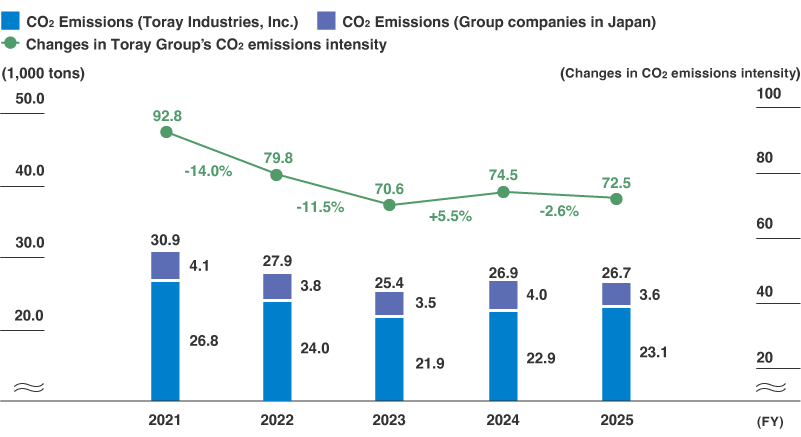
Notes:
- Changes in Toray Group’s CO2 emissions intensity = Change in CO2 emissions intensity at each specified consigner group company × Each group company’s CO2 emissions / Total Toray Group CO2 emissions
- The change in CO2 emissions intensity at each group company is calculated as follows:
Change in CO2 emissions / Change in logistics-related indicator (Toray Industries, Inc. = sales, TAF = shipping volume; FY 2014 = 100)
CO2 Reduction Effects of Environmental Impact Reduction Initiatives (Toray Industries, Inc.)
| Details of initiatives | CO2 Reduction (1,000 tons) |
|---|---|
| Full-load transport, and increased loading rates, etc. | 0.330 |
| Revision of inventory storage locations, and loading at the nearest port, etc. | 0.088 |
| Modal Shift | 0.025 |
| Total | 0.443 |
New EV Truck at the Shiga Plant (Toyo Logistics Co., Ltd.)
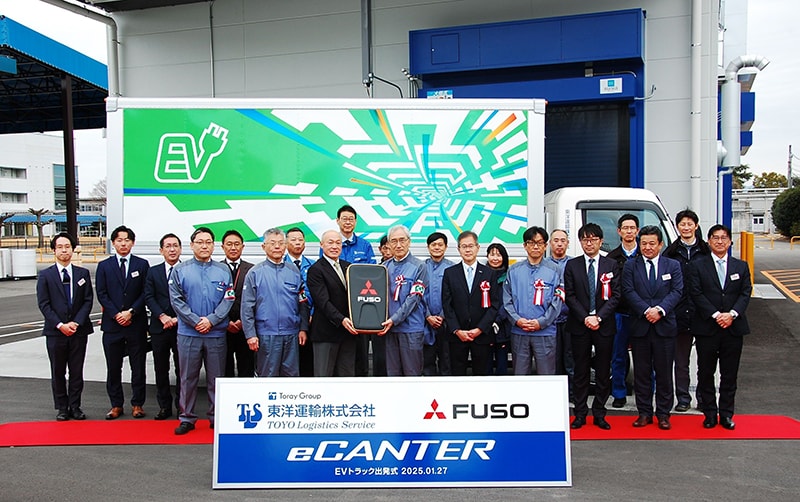 EV truck launch
Group company Toyo Logistics acquired an EV truck for cargo transport within Toray’s Shiga Plant, marking a first for Toray Group factories. This initiative is expected to reduce CO2 emissions by approximately one ton, representing a 99.7% reduction compared to the previous vehicle.
Expanding Collection and Reuse of Packaging Materials
Toray Group is establishing a global framework to collect and recycle packaging and shipping materials that are included with products used by customers. In order to reduce the amount of new material purchasing, the Group internally shares information on the inventories of used shipping materials being collected, such as temporary inventories at collection centers.
Monetary Amounts Recovered for Packaging Materials (FY 2025, Toray Industries, Inc.)
| Monetary Amounts Recovered for Packaging Materials | Year-on-Year Change | Main Factor |
|---|---|---|
| 640.8 million yen | Increase of 20 million yen (3.1%) | Increase in the recovered value due to the larger size of products and packaging materials for film products |
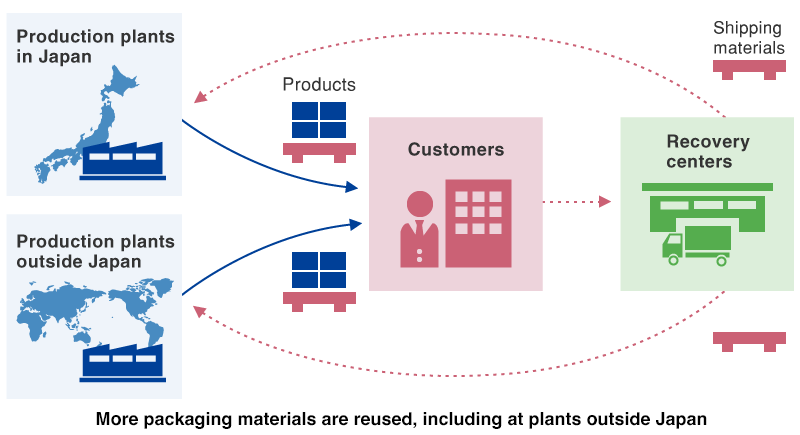
Related Information
Promoting a Modal Shift
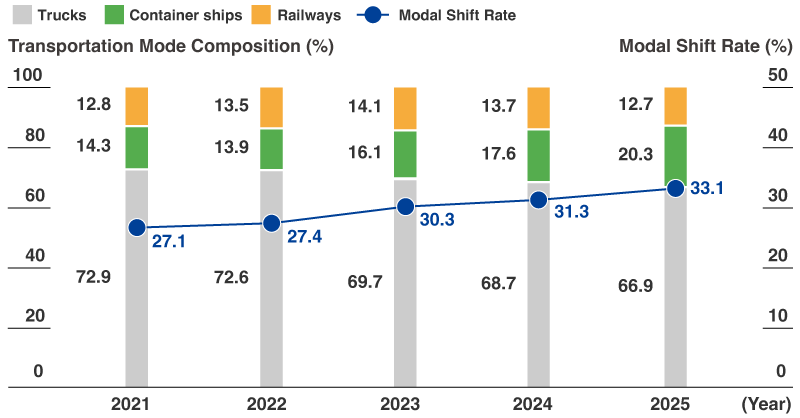
Toray Industries aims to promote environmentally friendly logistics while strengthening competitiveness through cost reductions, in accordance with its Basic Distribution Policies. As part of these efforts, the Company is actively pursuing modal shift (switching from trucks to rail and ship transport). In addition, modal shift is also effective as a measure to address the recent vulnerabilities in truck transport caused by a shortage of drivers.
Toray Industries pursues opportunities for modal shifts across all types of transportation, including the transportation of products and raw materials, and works to reduce the environmental impact of the distribution process in collaboration with relevant parties.
Modal Shift Rate (FY 2025, Toray Industries, Inc.)
| Modal Shift Rate | Year-on-Year Change | Main Factor |
|---|---|---|
| 33.1% | Increase of 1.8 points | Shift to maritime transport |
Acquisition of Eco Rail Mark and Eco Ship Mark
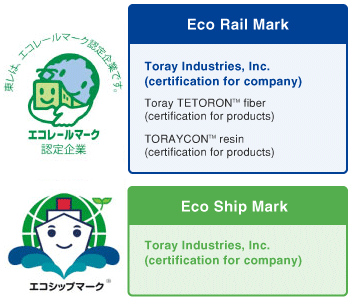
Toray Industries has been certified as an Eco Rail Mark Company by Japan's Ministry of Land, Infrastructure, Transport and Tourism and the Railway Freight Association. This recognizes Toray's active efforts to use rail freight transport, a relatively environmentally friendly means of transportation. The Company also obtained Eco Rail Mark Product certifications for its TORAY TETORON™ fiber and TORAYCON™ polybutylene terephthalate (PBT) resin.
Moreover, in fiscal 2017 Toray Industries achieved the Eco Ship Mark certification related to its film products, which are difficult to ship by rail. This program recognizes companies that are switching to ship transport and use maritime transport, which has a low environmental impact, to a certain extent.
Minimizing Natural Disaster Risks
Key external inventory sites that have been assessed for natural disaster risk and have implemented measures to mitigate serious risks (%)
Target
At least 90%
Result
88.2%
FY 2025, Toray Industries, Inc.
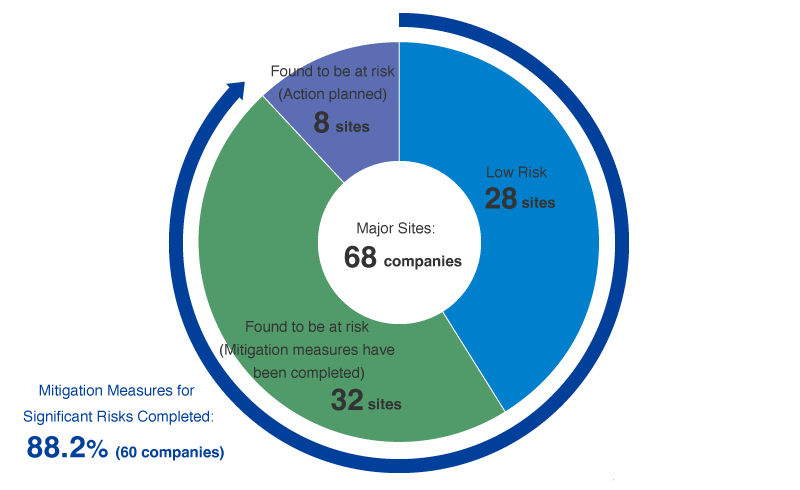
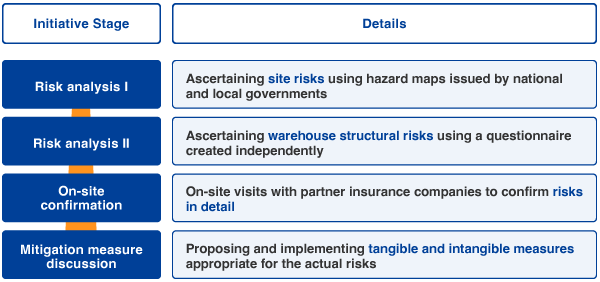
Toray Industries continuously assesses natural disaster risks at external warehouse locations in Japan and works with these warehouses to implement measures to prevent or mitigate damage caused by natural disasters such as typhoons and heavy rainfall. Assessments are conducted based on hazard maps issued by the national and local governments as well as on warehouse structures, and on-site surveys are carried out at locations identified to be at high risk. Measures include creating disaster prevention manuals, preparing portable water dams, and raising floor levels.
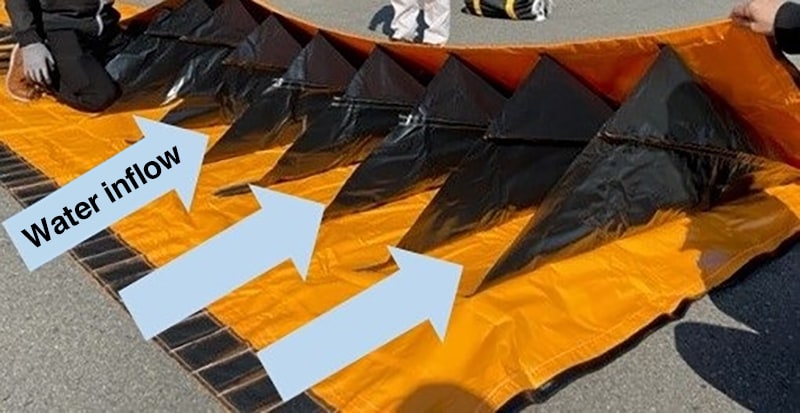 Portable water dam
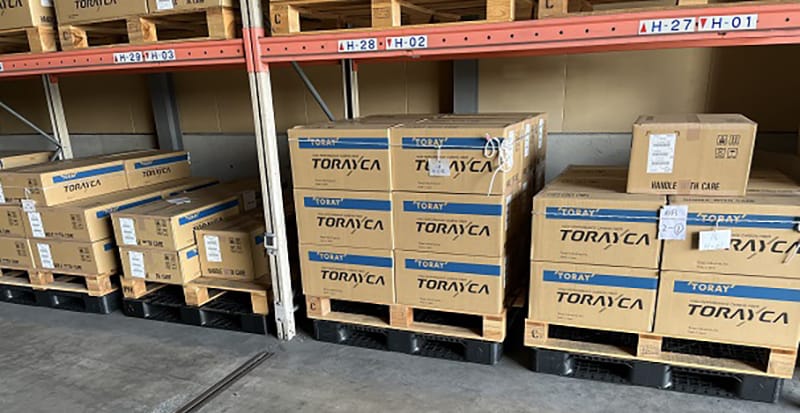 Pallets raised above the floor level
Distribution Safety and Quality Improvement
Toray Industries is working on a project to improve transport quality. The Company works with distribution partners to improve distribution quality and safety and to reduce the incidence of problems by sharing accident analysis data and distribution quality enhancement reports, conducting on-site inspections and holding quality control meetings with partners.
Partners that make outstanding contributions to improving quality are recognized through annual awards. These initiatives are aimed at reducing the number of problems such as those involving breakage, and reducing transport delays and incorrect shipments of Toray products.
| Distribution-partner companies receiving awards in fiscal 2025 (alphabetical order) | Iyoshoun Inc., Shikoku Meitetsu Transportation Co., Ltd., Chuo Warehouse Co., Ltd., Nagahama-Reizou, NIKKON Logistics CO., LTD., NISSUI LOGISTICS CORPORATION, MITSUI-SOKO Co., Ltd., MITSUNORI CORPORATION |
|---|
Distribution Incidents (Toray Industries, Inc.)
Recently, logistics companies in Japan have experienced a labor shortage, and incidents such as product damage during transport have become more common.
Consequently, Toray Industries has seen an increase in product damage and misdelivery during transport on routes for smaller packages. In order to improve distribution quality, the Company approached distribution partners with high incident rates. Discussions were held on improvement measures, on-site visits were made, and educational activities were carried out.
| FY | 2021 | 2022 | 2023 | 2024 | 2025 |
|---|---|---|---|---|---|
| Number of distribution incidents | 538 | 622 | 589 | 544 | 507 |
Legal Compliance and Safety Initiatives in Distribution
Toray Group regards compliance with laws and regulations and ensuring safety in logistics as its highest priorities and is advancing a wide range of initiatives. These include responding to import and export regulations, recommending the acquisition of third-party certifications, and establishing emergency response systems. The activities are aimed at ensuring compliance with international regulations and safety standards and enhancing the reliability of the entire supply chain.
List of Initiatives for Logistics Safety and Legal Compliance
| Initiative | Objective | Target | Implementation / Results |
|---|---|---|---|
| Security trade control training | Ensure thorough security trade control for Toray products | External warehouse locations storing products subject to list-based controls |
|
| Recommending that Distribution Partners Acquire Third Party Certification | Legal compliance, quality improvement, and environmental conservation throughout the distribution process | Distribution partners | Recommendation to obtain various third-party certifications (ISO9001, ISO14001), Green Management Certification2, and the G Mark System3 |
| Yellow Card4 Emergency Response Measures | Prevent the escalation of damage in the event of an accident | Transportation operations |
|
| Preventing Overloading |
|
Transportation operations | Thorough communication and implementation of measures to prevent overloading through Basic Distribution Policy Briefings and other activities |
| Compliance and Security Measures for Importing and Exporting |
|
Import and export operations | C-TPAT5 certification (U.S. subsidiary of Toray International, Inc.) |
| Distribution partners | Promotion of AEO6 certification |
- 2 Green Management Certification: Certification is awarded by the Foundation for Promoting Personal Mobility and Ecological Transportation to companies that demonstrate a certain level of environmental improvement activities based on a manual for implementing green management (business management with a low environmental impact)
- 3 G Mark: A system that recognizes companies that meet certain criteria and demonstrate excellent safety, based on an assessment by the Safety Evaluation Committee established by the Japan Trucking Association of proactive initiatives for legal compliance and safety recommended by the Ministry of Land, Infrastructure, Transport and Tourism
- 4 A yellow card: A card listing the names of any hazardous substances, applicable laws and regulations, hazardous properties, procedures in case of accident, emergency reporting and contact information, methods for minimizing the spread of damage, and other relevant information.
- 5 C-TPAT: A voluntary program introduced by United States Customs and Border Protection in November 2004. The aim of the program is to ensure and strengthen security through the global supply chain, based on international cooperation with private operators importing goods into the US.
- 6 AEO: A status implemented by the EU in December 2006 that gives priority in customs procedures to importers and exporters with a high level of compliance for cargo security. The Japanese Customs Act was also revised in 2007, and a similar qualification system was established to provide priority in customs procedures to highly compliant operators.