- HOME
- Sustainability
- Toray Sustainability Principles
- Society
- Resilient Supply Chain
- Sustainability Procurement Initiatives at Toray Group
Sustainability Procurement Initiatives at Toray Group
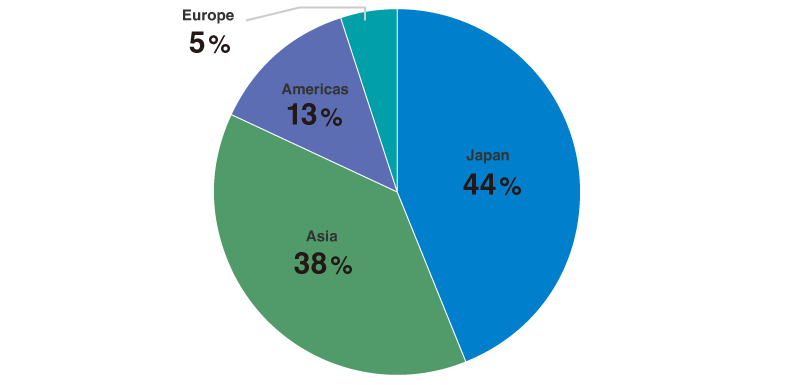
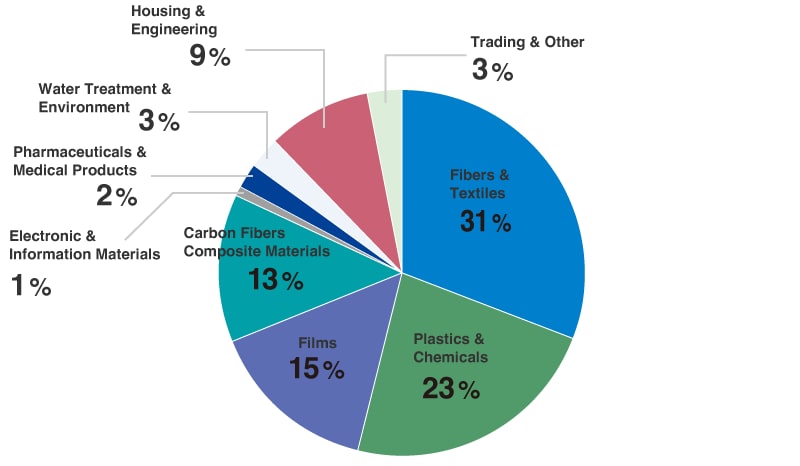
Purchasing Breakdown for Toray Group’s Supply Chain (by Region and Business Segment)
Toray Group’s supply chain extends to diverse countries and regions around the world. Operating in a wide range of industries, the Group’s suppliers include general trading companies, specialized trading companies, and producers of petrochemicals, fuels, pharmaceuticals, molded products, packaging materials, machine tools, precision equipment, machine parts, and processed materials.
In procurement, Toray Group engages in both regular and spot transactions depending on procurement conditions and required specifications. It procures a wide range of products from more than 4,700 primary suppliers worldwide.
Initiatives to Mitigate Global Sustainability Procurement Risk
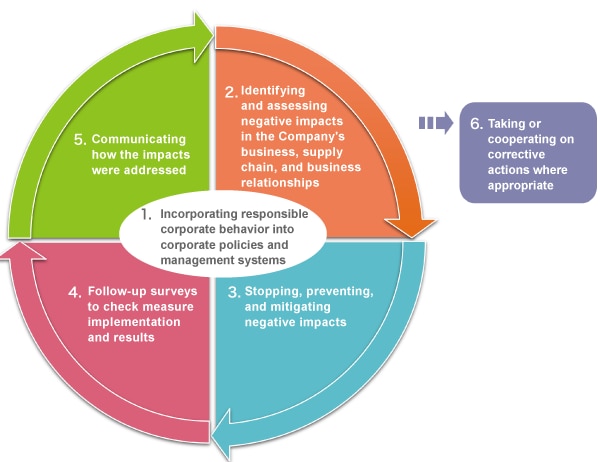
In order to identify and assess human rights violations, environmental impacts, and other risks in the supply chain, and to take measures to prevent or mitigate these risks, Toray Group conducts human rights and environmental due diligence in accordance with the Organisation for Economic Co-operation and Development (OECD) Due Diligence Guidance for Responsible Business Conduct.
| Initiative Details | |
|---|---|
|
|
|
|
|
|
|
|
|
|
|
|
Click here (229.63KB) PDF for more details on Toray Group’s due diligence process.
Sustainability Procurement Risk Map (High-Risk Issues in the Supply Chain)
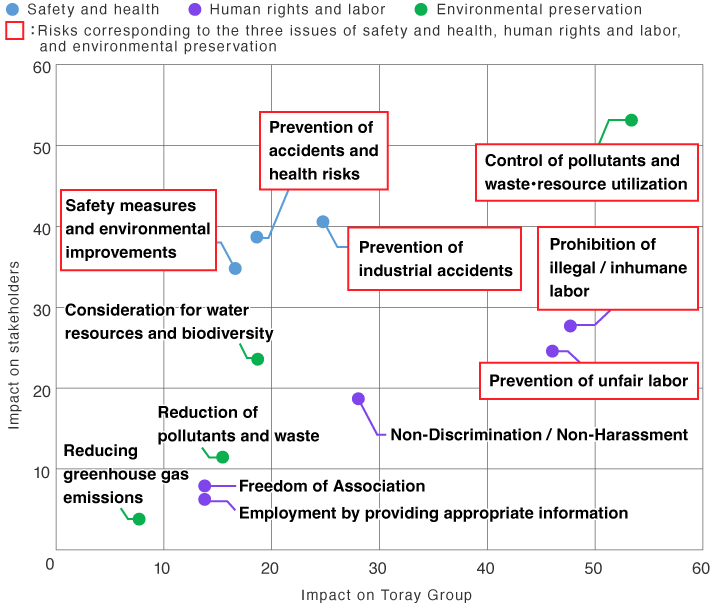
To mitigate sustainability procurement risks within Toray Group, a process was developed to identify key sustainability procurement risk factors from perspectives such as country, region, and industry, as well as suppliers requiring investigation. The process includes the implementation of risk assessments, audits, and mitigation measures.
After identifying and prioritizing sustainability procurement risks, the Group decided to focus on three key issues: safety and health, human rights and labor, and environmental protection. Questionnaires and audit procedures were created to investigate these issues with suppliers.
To verify the feasibility of implementing these tools and procedures, tests were conducted together with group companies in and outside Japan, and the Group has been working to establish the investigation process.
To pick out suppliers requiring investigation, an identification process was created that narrows down suppliers based on information collected from group companies worldwide, taking into account factors such as the supplier country, region, and industry.
Toray Group has set the implementation rate for supply chain due diligence as a KPI and is promoting efforts to conduct risk assessments.
By fiscal 2025, the Group conducted surveys of suppliers among the major suppliers to which overseas group companies had presented the Toray Group Sustainability Procurement Guidelines. The focus has been on suppliers in countries, regions, and industries deemed high-risk in terms of safety and health, human rights and labor, and environmental protection.
Implementation of supply chain due diligence (% of cases)

Target
At least 90%

Result
100%
FY 2025, Toray Group
Supply Chain Due Diligence Implementation Status and Evaluation Results
| Scope | Number of Major Suppliers (excluding companies with no anticipated future transactions) | Number of Suppliers Surveyed | Evaluation Results |
|---|---|---|---|
| Group companies outside Japan (81 companies) | 2,519 | 3 | Risks were assessed as low for all suppliers |
Presentation of the Sustainability Procurement Guidelines and Confirmation of Compliance
Suppliers agreeing to the Toray Group CSR Procurement Guidelines (%)
Target
At least 90%
Result
88.1%
FY 2025, Toray Group
- * At the time this target was set, the document was titled the “Toray Group CSR Procurement Guidelines.” However, following a revision of its content, the title was changed to the “Toray Group Sustainability Procurement Guidelines” after approval by the Board of Directors in August 2026.
Toray Group presents its Sustainability Procurement Guidelines to suppliers and requests their understanding and compliance. These guidelines outline specific and detailed requirements for areas such as ethics, compliance, safety, accident prevention, risk management, environmental preservation, product quality and safety, and human rights promotion.
Toray Industries, Inc. continues to obtain written agreements from its major suppliers. At group companies in and outside Japan, efforts are also underway to consistently obtain written agreements from existing and new suppliers, with support from Toray Industries.
Through these group-wide efforts, Toray Group endeavors to promote sustainability and reduce risks across its supply chain.
Status of Obtaining Written Agreements on the Sustainability Procurement Guidelines (FY 2022-2025)
| Company Category | Number of Major Suppliers (excluding companies with no anticipated future transactions) | Number of Written Agreements Obtained | Percentage of Applicable Suppliers |
|---|---|---|---|
| Toray Industries, Inc. | 714 | 647 | 90.6% |
| Group companies in Japan (41 companies) | 1,565 | 1,483 | 94.8% |
| Group companies outside Japan (81 companies) | 2,519 | 2,096 | 83.2% |
| Total | 4,798 | 4,226 | 88.1% |
Sustainability Procurement Surveys
Toray Industries, Inc.
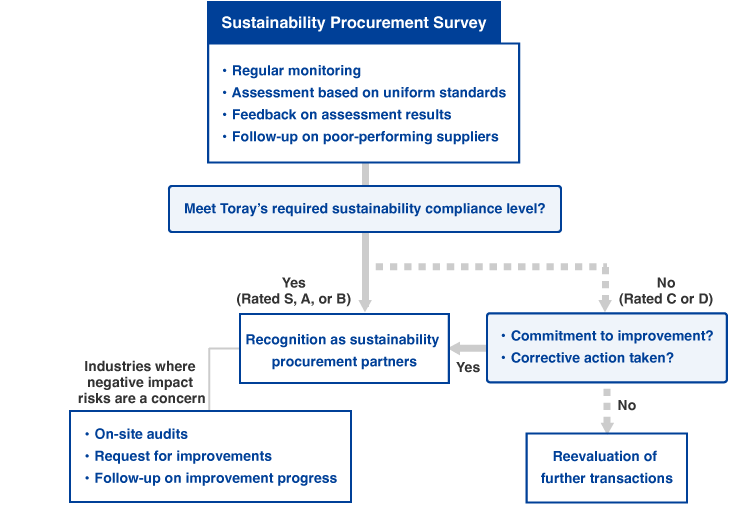
Every two years, in principle, Toray Industries carries out a Sustainability Procurement Survey of major procurement and purchasing suppliers, outsourcing partners and logistics service providers which together account for approximately 90% of the Company’s total procurement value.
The survey is conducted as part of efforts to confirm agreement with the Toray Group Sustainability Procurement Guidelines, understand suppliers’ initiatives, and support their improvement. Using its own survey system, Toray establishes questions based on the Toray Group Sustainability Procurement Policies, and the Toray Group Sustainability Procurement Guidelines, among other standards. The survey comprehensively confirms suppliers’ efforts to address key environmental, governance, and social issues, including reducing greenhouse gas (GHG) emissions, consideration for water resources and biodiversity, as well as their measures for anti-corruption, anti-bribery, and respect for human rights.
In addition, by regularly conducting evaluations, providing feedback, and following up, Toray seeks to raise suppliers’ awareness and promote the identification, prevention, and reduction of risks across the supply chain.
Toray distributes to all suppliers that respond a score sheet containing evaluation results, analysis, and benchmarks, as well as the Toray Group Supply Chain Sustainability Promotion Guidebook, to support and provide guidance on suppliers’ sustainability initiatives.
Actions Based on Evaluation Results
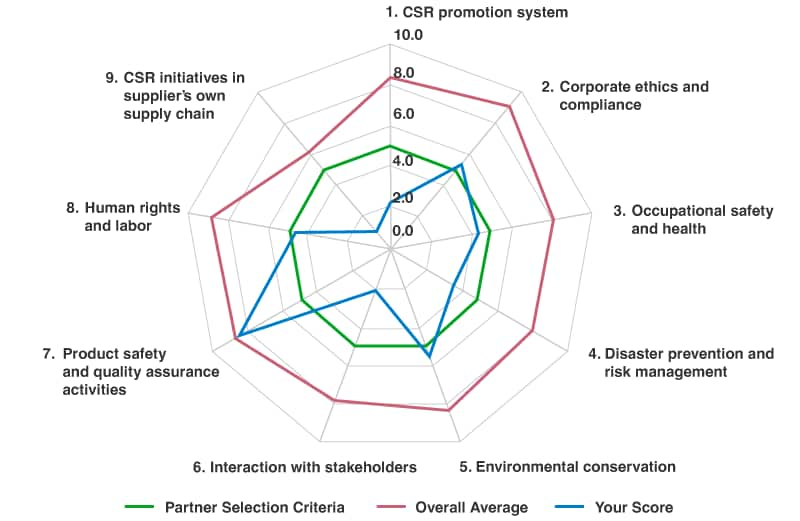
Survey responses are assessed on a 10-point scale for each of the nine survey items. Taking the average score for the 9 items as the overall score, 8 or more points is rated as “S,” while 6 or more points but less than 8 is rated as “A,” 5 or more points but less than 6 is rated as “B,” 3 or more points but less than 5 is rated as “C,” and less than 3 points is rated as “D.”
Suppliers rated S, A, or B are recognized as sustainability procurement partners (suppliers that meet the standards required by Toray Industries). However, even in the case of suppliers rated S, A, or B, the Sustainability Procurement Working Group conducts on-site audits and requests improvements for business partners in industries where the risks of negative impacts are a concern. In fiscal 2025, on-site audits were conducted at three companies.
For suppliers rated C or D, the Company investigates actual conditions through individual visits and interviews, and holds discussions and provides support for corrective actions and improvements. If no improvement is observed or corrective actions are not taken in response to serious violations, the Company considers appropriate measures, including suspension of business transactions.
Main Items of Sustainability Procurement Surveys of Suppliers
Ⅰ. Sustainability promotion system
- □ Establishment of and familiarity with policies and guidelines
- □ Understanding and sharing the Toray Group Sustainability Procurement Guidelines
- □ Establishment of internal system and selection of responsible parties
- □ Establishment of goals and plans, review of activity results
Ⅱ. Corporate ethics and compliance
- □ Anti-corruption and bribery prevention
- □ Prevention of misuse of advantageous position and bid-rigging
- □ Thorough legal and ethical compliance
- □ Prevention of conflicts of interest
- □ Protection of confidential information and personal information
- □ Respect for and protection of intellectual property rights
- □ Avoidance of all involvement with organized criminal groups
- □ Prevention of use of technology barred under regulations and illegal exports
- □ Identification of use of conflict minerals and cobalt and country of origin
- □ Identifying items subject to restrictions on export to third countries
Ⅲ. Occupational safety and health
- □ Safety measures in workplace and improvements to working environment
- □ Prevention of occupational accidents
- □ Prevention of accidents and health risks
- □ Adoption of management system related to occupational safety
Ⅳ. Disaster prevention and risk management
- □ Development of education, training and manuals for disasters
- □ Establishment of business continuity plan (BCP) for large-scale disasters
- □ Establishment of BCP for pandemic
- □ Defense against threats on computer network
Ⅴ. Environmental conservation
- □ Obtaining and maintaining authorizations and registrations
- □ Prevention of pollutants and waste, promotion of resource use (3Rs: reduce, reuse, recycle)
- □ Appropriate management of chemical substances and pollutants in line with laws and regulations
- □ Greenhouse gas emissions management and reduction
- □ Green procurement, green purchasing, energy conservation activities
- □ Consideration for water resources and biodiversity and implementation of assessments
- □ Introduction of environmental conservation management system
Ⅵ. Interaction with stakeholders
- □ Disclosure of financial information and non-financial information
- □ Setting up hotlines for consultation and reporting, protection of whistleblowers
- □ Support for community activities and activities contributing to society, and encouragement of participation in such activities
Ⅶ. Product safety and quality assurance activities
- □ Assessment of product safety, management of substances contained in products
- □ Provision of information on specifications, quality and handling
- □ Managing compliance with product quality standards, inspection standards, and fraud prevention
Ⅷ. Human rights and labor
- □ Prevention of child labor and measures for young workers
- □ Prevention of forced labor, slave labor, and other forms of illegal or inhumane labor practices
- □ Provision of appropriate information to foreign workers and employment
- □ Prevention of undue low wages and wage reductions, as well as labor that exceeds statutory limits
- □ Ban on harassment, physical punishment, abuse, etc.
- □ Protection for freedom of association and collective bargaining, etc.
- □ Responding to the impact of COVID-19
Ⅸ. Ensuring strict compliance and adherence to the Toray Group Sustainability Procurement Guidelines throughout the supply chain
- □ Requests for promotion of sustainability along supply chain
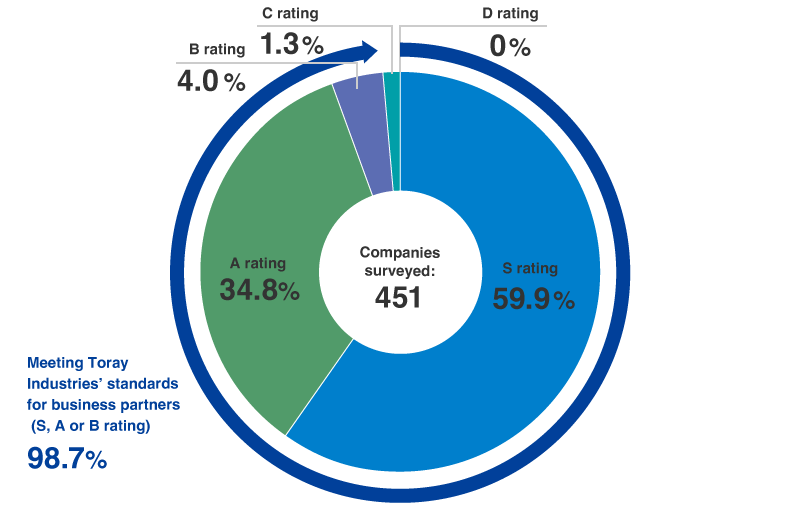
| Total number of respondents | 451 companies | |
|---|---|---|
| Sub-category | Raw material suppliers: 125 | |
| Equipment and material suppliers: 153 | ||
| Distribution companies: 38 | ||
| Sales and production outsourcing partners: 135 | ||
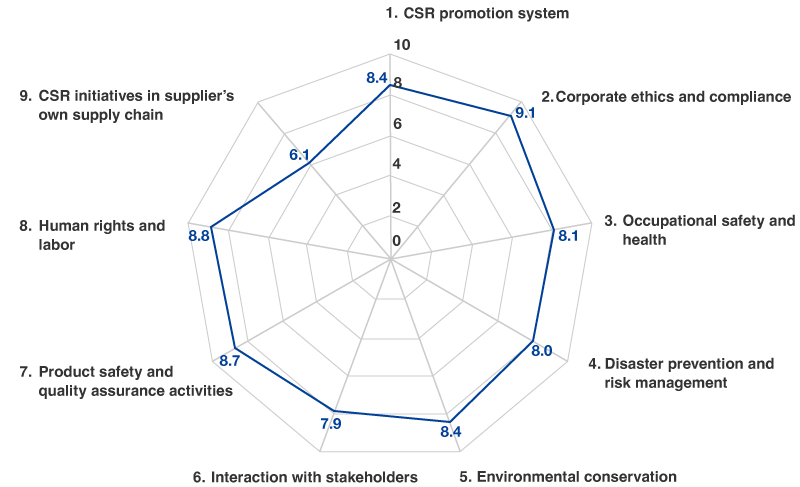
| Trends by survey item | Improvement compared to the previous survey was seen in most items, including environmental preservation, product safety and quality assurance, and human rights and labor. | |
| Improvement from the previous survey | Four out of five suppliers (80%) that were rated C or D in the previous survey improved to an A or higher rating. | |
| Number of suppliers rated C or D in the fiscal 2024 survey | 6 | |
| Actions for suppliers rated C or D |
Individual visits and interviews were conducted in fiscal 2025 to confirm actual conditions, and discussions and support were provided for corrective actions and improvements. Examples of Corrective Actions and Improvements
|
|
Results of Survey Section “Ⅴ. Environmental conservation”
In the “Ⅴ. Environmental conservation” section of the Sustainability Procurement Survey, Toray Group checks the situation regarding supplier compliance with environmental laws, as well as supplier efforts related to environmental preservation, including GHG emissions reduction and biodiversity conservation.
From fiscal 2024, the survey questions on resource and energy conservation efforts were improved by breaking down resources into categories such as water, wood, metals, and oil, allowing for a more detailed understanding.
The survey conducted by Toray Industries in fiscal 2024 confirmed a high rate of implementation of initiatives on 15 of the 16 survey items related to environmental preservation, excluding the item related to requests to secondary suppliers. Meanwhile, improvements were requested in fiscal 2025 from suppliers who answered “Will address in one year” ([1] in the table below) and “Not addressed” ([0] in the table below). The Company will confirm the results of supplier improvement measures using the fiscal 2026 Sustainability Procurement Survey.
| Survey Questions | Implementation rate | Survey results (The results are ranked from 0 to 4. 0 and 1 mean that the company has not addressed the issues.) |
|---|---|---|
| 1. Have you stipulated the policies or guidelines for promote environmental preservation and familiarized them with your employees? | 98.7% |  |
| 2. Have you prepared the internal system and designated the responsible person to promote environmental preservation? | 98.4% |  |
| 3. Do you have any mechanism to identify risks, institute the goals / plans, verify and improve / correct results of the activities in relation to environmental preservation? | 98.7% |  |
| 4. Have you acquired and maintained, and kept up to date all permissions and registrations to be required by the laws and public administration, etc. for the environment? | 95.5% |  |
| 5. Do you work to minimize emissions and waste generation of ecosystem resources such as drinking water and industrial water, and implement resource- and energy-saving initiatives such as reducing, reusing, and recycling (3Rs) resources used? | 87.1% |  |
| 6. Do you work to minimize emissions and waste generation of ecosystem resources such as wood and paper, and implement resource- and energy-saving initiatives such as reducing, reusing, and recycling (3Rs) resources used? | 90.5% |  |
| 7. Do you work to minimize emissions and waste generation of metal resources such as iron and copper, and implement resource- and energy-saving initiatives such as reducing, reusing, and recycling (3Rs) resources used? | 92.5% |  |
| 8. Do you work to minimize emissions and waste generation of energy resources such as gas and electricity, and implement resource- and energy-saving initiatives such as reducing, reusing, and recycling (3Rs) resources used? | 93.8% |  |
| 9. Do you work to minimize emissions and waste generation of plastic resources such as petroleum, and implement resource- and energy-saving initiatives such as reducing, reusing, and recycling (3Rs) resources used? | 90.4% |  |
| 10. Do you comply with the applicable laws / regulations,(REACH, ROHS, etc.) for, and appropriately manage the procured chemical substances? | 98.3% |  |
| 11. Do you work to minimize emissions and waste generation of pollutants, appropriately manage emissions of air pollutants, water pollutants, and other chemical substances into the environment, and implement initiatives to reduce these emissions? | 95.8% |  |
| 12. Do you appropriately manage emission of greenhouse gas and perform the efforts for reduction (prevention of global warming)? | 87.0% |  |
| 13. Do you perform the activities concerning reduction of environmental load and energy saving including green procurement of raw materials and packing materials, green purchasing of office supplies office machinery, power saving of offices, use of EV cars? | 97.1% |  |
| 14. Do you understand your business activities which may cause an impact on water resources and biodiversity, consider sustainable use of resources and perform the activities to minimize the impact for preservation of biodiversity? | 92.9% |  |
| 15. Do you perform the environmental assessment regarding the products (assessment of the products’ impact on the environment)? | 84.8% |  |
| 16. Do you request the suppliers for promotion of environmental preservation? | 82.5% |  |
- Supplemental information:
[4] Addressed well
[3] Addressed
[2] Addressed at minimum level
[1] Will address in one year
[0] Not addressed
For questions 4 to 12, only [3], [1], and [0] are used; no value has been set for [4] or [2].
For questions 13 to 15, only [4] [3], [1], and [0] are used; no value has been set for [2].
Results of Survey Section “Ⅷ. Human rights and labor”
In the “Ⅷ. Human rights and labor” section of the Sustainability Procurement Survey, 13 survey items have been established to confirm the status of initiatives related to respect for human rights and labor conditions. In addition, sustainability procurement surveys are used to investigate whether suppliers are responding appropriately to various issues related to human rights, such as employment and labor issues that could arise due to an infectious disease outbreak, in order to identify and prevent issues within the supply chain.
The survey conducted by Toray Industries in fiscal 2024 confirmed a high rate of implementation of initiatives on 12 survey items, excluding those related to requests to secondary suppliers. In fiscal 2025, the Company requested improvements from those suppliers who answered “Will address in one year” ([1] in the table below) and “Not addressed” ([0] in the table below). The Company will confirm the results of supplier improvement measures using the fiscal 2026 Sustainability Procurement Survey.
| Survey Questions | Implementation rate | Survey results (The results are ranked from 0 to 4. 0 and 1 mean that the company has not addressed the issues.) |
|---|---|---|
| 1. Have policies and guidelines been set and employees educated about respect for human rights, eliminating discrimination and improving the work environment? | 99.7% |  |
| 2. Has an internal system been set up and people responsible for its promotion been designated in regards to respect for human rights, eliminating discrimination and improving the work environment? | 98.9% |  |
| 3. Have goals and plans been set, activity results reviewed and mechanisms for making improvements and corrections devised in regards to respect for human rights, eliminating discrimination and improving the work environment? | 98.6% |  |
| 4. Do you employ anyone under the working age stipulated by applicable laws and regulations? In the case of employees under the age of 18, are the working hours and health and safety of those employees given special consideration in accordance with relevant laws and regulations? | 98.9% |  |
| 5. Do you use any form of labor that is, or is similar to, forced and bonded labor, involuntary or exploitative prison labor, or modern slavery, or that is linked to human trafficking? Do you guarantee that all your employees are free to leave their employment at any time they wish? | 98.9% |  |
| 6. Do you provide each foreign worker with an employment contract, employment rules, and other relevant documents in a language the individual can understand? Also, do you ever confiscate, conceal, or destroy any identification documents, passports, work permits, or other similar documents belonging to such workers, or prevent them from using those documents? | 96.2% |  |
| 7. Do you pay appropriate wages in accordance with relevant laws and regulations when it comes to minimum wages, overtime, wage deductions, piecework wages, and other benefits? Are unfair pay cuts ever used? | 99.6% |  |
| 8. Are conditions appropriately managed and operated to ensure that sexual harassment, power harassment, physical punishment, emotion or physical abuse, pressure and other inhuman treatment and actions do not occur? | 99.8% |  |
| 9. Are conditions appropriately managed and operated to ensure that in recruiting, hiring and employing people, race, the color of one’s skin, age, gender, sexual orientation, nationality, religion and other factors do not result in discriminatory action? | 99.1% |  |
| 10. In all employment activities, including recruitment, hiring, compensation, and retirement, do you have policies and rules in place to prohibit any discrimination based on race, creed, skin color, sex, religion, nationality, language, physical characteristics, wealth, or place of birth, etc.? | 98.0% |  |
| 11. Do you recognize the rights of employees to freedom of association, in accordance with the laws and regulations of each country and region? Are arrangements made for employee representatives and employees to engage in dialogue and consultation with management without fear of retaliation, intimidation, or harassment? | 98.4% |  |
| 12. Are you giving sufficient consideration to and responding appropriately to various issues related to employment, human rights, and labor that may arise during an infectious disease outbreak? | 99.3% |  |
| 13. Do you ask your suppliers to make improvements in regard to respect for human rights, the eradication of discrimination and improvement of the labor environment? | 76.3% |  |
- Supplemental information:
[4] Addressed well
[3] Addressed
[2] Addressed at minimum level
[1] Will address in one year
[0] Not addressed
For questions 4 to 12, only [3], [1], and [0] are used; no value has been set for [4] or [2].
Group Companies
Toray Group Companies in and outside Japan have also established their own internal systems and rules and are conducting sustainability procurement surveys of their suppliers. They also ask suppliers to comply with the Toray Group Sustainability Procurement Guidelines, while conducting audits and other measures to continually ascertain the status of supplier sustainability initiatives and to request improvements.
Group companies in Japan
Each group company in Japan conducts sustainability procurement surveys of its major suppliers. Based on the assessment results received as feedback each company then investigates actual conditions at suppliers and requests improvements as necessary.
| Status of sustainability procurement surveys at group companies in Japan (FY 2025) | Responses were received from 992 companies |
|---|
Group companies outside Japan
Group companies outside Japan ask their suppliers to implement sustainability initiatives. Toray Industries supports these activities, including by conducting sustainability procurement surveys as necessary.
Addressing Conflict Minerals
The Toray Group Sustainability Procurement Policies prohibit the use of minerals that come from conflict zones or high-risk areas, as well as those that are clearly tied to armed conflict or human rights violations.
Once a year, Toray Industries investigates whether conflict minerals (tin, tantalum, tungsten, and gold) are used in any of the raw materials and production equipment used for all products sold by the Company. If the use of any of the target minerals is confirmed, the Company obtains a CMRT (Conflict Minerals Reporting Template) from the suppliers and confirms whether the minerals are sourced from conflict zones or high-risk areas. In addition, the Company confirms that the minerals are sourced from smelters certified by the RMI (Responsible Minerals Initiative) as having no involvement in human rights violations.
Toray Industries has also set up an internal system for surveys and responses so that it can respond promptly and appropriately to requests from customers in regard to surveys on conflict minerals.
Sustainable Palm Oil Procurement
Oil procurement needs met by palm oil sourced in a manner that is environmentally responsible and respectful of human rights (% of oil purchased, by value)
Target
At least 90%
Result
100%
FY 2025, Toray Industries, Inc.
Toray Industries continuously investigates whether certain oil products it procures are made from palm oil grown and harvested based on principles of environmental conservation and respect for human rights.
During the verification process, evaluations are conducted from perspectives such as biodiversity protection and ensuring that products are free from forced or slave labor. For specific determinations, status regarding the acquisition of RSPO1 certification is also taken into consideration. These concepts and requirements are based on the Toray Group Sustainability Procurement Guidelines.
Toray Industries has also set up an internal system for surveys and responses so that it can respond promptly and appropriately to requests from customers in regard to surveys on palm oil use. Furthermore, the Company is a member of the RSPO and promotes the procurement of sustainable palm oil.
- 1 Roundtable on Sustainable Palm Oil, an international non-profit organization promoting the production and use of sustainable palm oil.
Sustainability Procurement Education and Training
Toray Group continuously conducts education and training internally and across the entire supply chain to promote sustainability procurement. Through these initiatives, the Group deepens the understanding of the significance of sustainability procurement and due diligence, while striving to reduce risks.
List of Education and Training Programs for Sustainability Procurement
| Category | Education / Training Content | Target Audience | Frequency / Track Record | Overview |
|---|---|---|---|---|
| Toray Industries, Inc. | E-learning | All executives and employees (including contractual workers, part-time staff, and temporary workers) Total participants: 13,947 | November 2020 and February 2021 | Sustainability procurement is included as part of the content. |
| Webinar | Toray Group employees (including purchasing personnel) | March 2024 | Significance of sustainability procurement, due diligence Webinar |
|
| Sustainability procurement training sessions and seminars | Purchasing and logistics operational personnel | Conducted continuously | Laws, regulations, and tax systems to be observed in practice and sustainability procurement | |
| Group companies in Japan | Distribution of educational materials | Group companies in and outside Japan | Conducted continuously | Necessity of sustainability procurement, required initiatives, risk case studies |
| National Logistics Conference | Group companies in Japan | Regular (Once a year) FY 2025 results: September | Legal and environmental compliance | |
| Supply chain | Compliance Briefing Session | Suppliers | Regular (Once a year) FY 2025 results: September | Toray Group Sustainability Procurement Guidelines and export control |
| Basic Distribution Policy Briefings | Distribution companies | Regular (Once a year) FY 2025 results: May | Toray Group Sustainability Procurement Guidelines, Basic Distribution Policies, Environmental initiatives, and sustainability procurement within the supply chain | |
| Education on sustainability initiatives | Suppliers | Regular (once every 2 years) FY 2025 results: First half | Toray Group Supply Chain Sustainability Promotion Guidebook | |
| Human rights education | Asian manufacturers contracted to make textile products | Conducted continuously | Mitigating human rights risks | |
| Human rights training | Contracted security companies | Conducted according to regional conditions | Security duties and human rights |
Responding to Sustainability Inquiries and Survey Requests
Sustainability Related Inquiries (General)
As part of efforts to promote human rights protections and environmental conservation in the supply chain, the Company enables individuals to report relevant issues at any time via the Toray website.
If you have any concerns or information related to the Group’s activities in the areas of ethics and compliance, safety and health, environmental preservation, and human rights and labor, please submit them via the web form below.
Out of a total of 336 inquiries and consultations received in fiscal 2025 via the CSR inquiry form on the Toray website, none were related to environmental preservation and human rights in the supply chain.
Responding to Survey Requests Regarding Sustainability Procurement
Toray Industries has established an internal survey and response system to respond promptly and accurately to sustainability procurement survey requests from customers.
Specifically, in addition to general sustainability surveys, the Company has set up a framework to appropriately respond to survey requests on specific themes, such as conflict minerals and palm oil.
Through these efforts, the Company ensures reliable and highly transparent information provision in response to customer requests, striving to maintain a highly reliable supply chain.