- HOME
- Sustainability
- Toray Sustainability Principles
- Environment
- Reducing Environmental Impact
- Managing Energy Use and Reducing Greenhouse Gas Emissions
Managing Energy Use and Reducing Greenhouse Gas Emissions
Toray Group is pursuing initiatives for reducing greenhouse gas (GHG) emissions toward realizing a carbon-neutral society.
In the Toray Group Sustainability Vision announced in July 2018, the Group set out the target of reducing GHG emissions1 from production activities per unit of revenue by 30% compared with the baseline year of fiscal 2013 by fiscal 2030. The Group has pursued initiatives such as promoting energy conservation, utilizing renewable energy, and reducing coal consumption. As a result, the Group reduced GHG emissions per unit of revenue by 34.6%2 by the end of fiscal 2022, and by 44.8% by the end of fiscal 2025.
Building on the results of these initiatives, from fiscal 2026, under TORAY Challenges 2035, our long-term management strategy, the Group aims to reduce absolute GHG emissions by 35% compared with fiscal 2013 by fiscal 2035, with an interim target of a 20% reduction by fiscal 2030. In addition, under IGNITION 2028, our medium-term management program, the Group has set a target of reducing GHG emissions per unit of revenue by 48% compared with fiscal 2013 by fiscal 2028, and is pursuing further reductions.
- 1 Scope 1 (direct emissions from plants, offices, and vehicles, etc. owned by the Group) and Scope 2 (indirect emissions resulting from the production of electricity and other energy consumed by the Group) emissions.
- 2 Until fiscal 2022, the calculation was based on Toray Industries' equity share. In fiscal 2023, however, the calculation method changed, and the degree of financial control Toray Industries has over the individual subsidiary (not the equity share) is now used, in accordance with the GHG Protocol, the international standard. For fiscal 2022, the reduction calculated under this new method would be 32.7%.
Managing Energy Use
As part of its energy management, Toray Group sets annual energy-conserving targets for each company and plant and promotes group-wide energy-conserving activities. It also checks the progress of its energy-conserving measures on a monthly basis.
Toray Industries undergoes audits of its environmental data, including energy consumption, to identify opportunities for improving its energy performance. Using the results as a reference, the Company is promoting energy-conserving activities with a goal of reducing its per-unit energy consumption3 by 2% annually.
| Target | Result (FY 2025) | Main Factors |
|---|---|---|
| Reducing its per-unit energy consumption by 2% annually | 4.7% reduction (15.4% reduction compared with FY 1990) |
|
- 3 Energy consumption per converted production volume
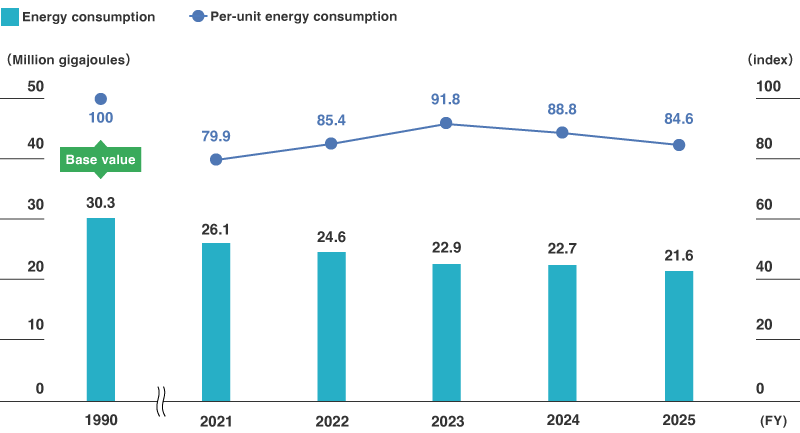
Note: The energy consumption shown in this graph does not include renewable energy.
Greenhouse Gas Emissions (Scope 1 and 2)
Under the CSR Roadmap 2025, Toray Group set a target to reduce GHG emissions (Scope 1 and 2) per unit of revenue by 40% compared to fiscal 2013 by fiscal 2025. Accordingly, it has been implementing initiatives such as promoting energy conservation through process improvements, utilizing renewable energy, and reducing coal use.
As a result, GHG emissions per unit of revenue in fiscal 2025 decreased by 44.8% compared to fiscal 2013, achieving the target. In addition, overall GHG (Scope 1 and 2) for Toray Group in fiscal 2025 decreased by 6.4% year on year to 4.341 million tons-CO2.
Reduction of greenhouse gas emissions per unit of revenue (%)

Target
At least 40%
lower than fiscal 2013 (Fiscal 2025)

Result
44.8%
reduction compared to fiscal 2013
FY 2025, Toray Group
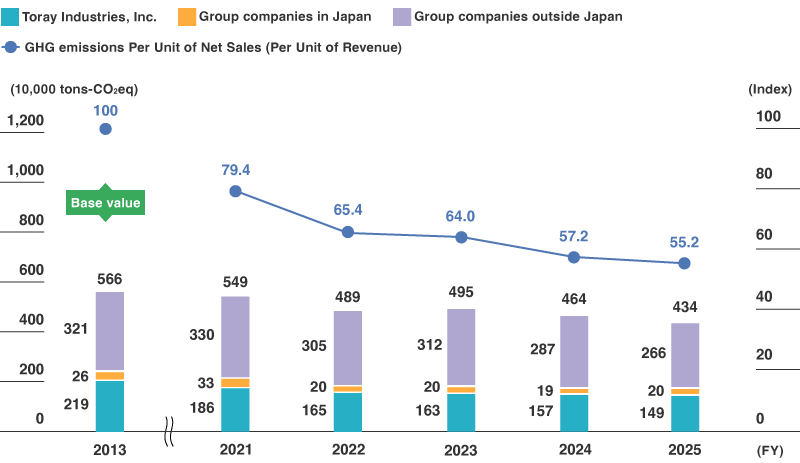
Reduction of GHG Emissions Per Unit of Revenue (%) (FY 2025 for Toray Industries and Its Group Companies in Japan)
| Result | Main Factors |
|---|---|
| 44.8% reduction compared to fiscal 2013 [Reference] GHG Emissions (Scope 1 and 2) for Toray Industries and Its Group Companies in Japan: 1.69 million tons-CO2 equivalent (decreased by 4.4% year on year) |
|
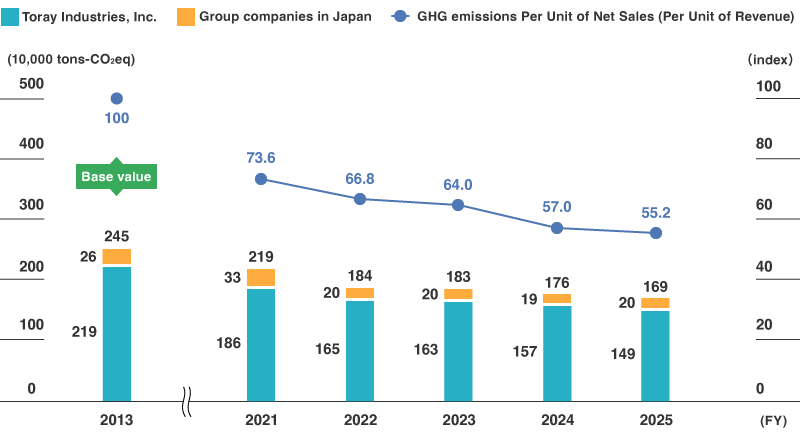
Supplementary Information on GHG Calculation:
- Figures for the baseline year of fiscal 2013 are calculated using Japanese GAAP and include companies that joined Toray Group in fiscal 2014 or later.
- The calculation method for the baseline year of fiscal 2013 and for fiscal 2023 onward changed to multiplying GHG emissions by the degree of financial control Toray Industries has over the individual subsidiary, in accordance with the GHG Protocol, the international standard.
- The calculations for fiscal 2020 through fiscal 2022 are based on multiplying GHG emissions by equity share. Using the financial control approach, Toray Group's GHG emissions for fiscal 2022 are 5.12 million tons.
Greenhouse Gas Emissions (Scope 3)
Toray Group calculates Scope 3 emissions to ascertain and reduce GHG emissions across the entire value chain.
Scope 3 Emissions (FY 2025)
(10,000 tons-CO2eq)
| Category 1: Purchased goods and services | 1,057.1 |
|---|---|
| Category 2: Capital goods | 51.1 |
| Category 3: Fuel and energy related activities | 87.2 |
| Category 4: Upstream transportation and distribution | 18.7 |
| Category 5: Waste generated in operations | 0.8 |
| Category 6: Business travel | 0.6 |
| Category 7: Employee commuting | 2.1 |
| Category 8: Upstream leased assets | 0.2 |
| Category 9: Transportation and delivery (downstream) | 2.8 |
| Category 10: Processing of sold products | ─ |
| Category 11: Use of sold products | 254.7 |
| Category 12: End-of-life treatment of sold products | 455.4 |
| Category 13: Leased assets (downstream) | 0.9 |
| Category 14: Franchises | 0.0 |
| Category 15: Investments | ─ |
| Total | 1,931.6 |
For information on the calculation method for Scope 3, please see the following PDF.
Calculation Method for Scope 3 (191.99KB) PDF
Related Information
Toray Group has obtained third-party assurance of its Scope 1, 2 and 3 GHG emissions from LRQA Limited.
For details, please see the following page.
Initiatives for Greenhouse Gas Emissions Reduction
Installing Renewable Energy Systems
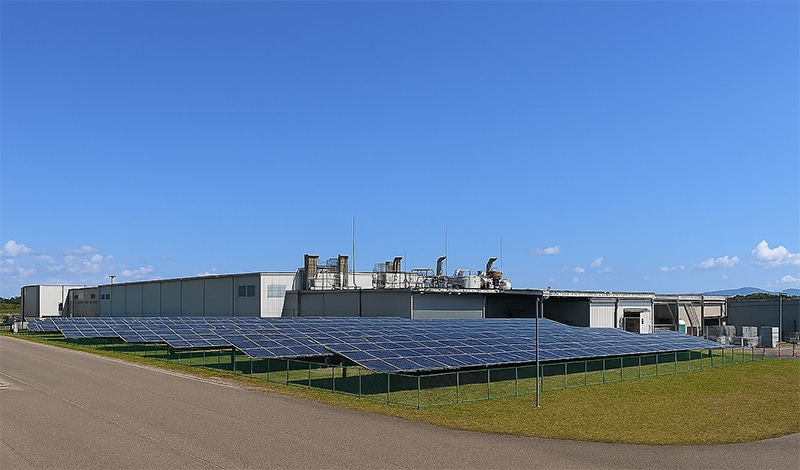 Solar power generation system at Toray Advanced Film Co., Ltd.
Toray Group is promoting the adoption of renewable energy systems and has set the rate of increase for solar power generation capacity as a KPI.
In fiscal 2025, a total of 5.2 MW of solar power generation systems were installed and commenced full-scale operation at unused land and building rooftops at the Toray Industries Ishikawa Plant and Toray Advanced Film Co., Ltd., utilizing the PPA scheme4.
In addition, as a result of proceeding with new installations at Sowa Textile Co., Ltd. and expanding systems at group company plants in China, solar power generation capacity increased to 344% of the fiscal 2022 level.
In fiscal 2026, operations will sequentially commence at the Toray Industries Nagoya Plant, Aichi Plant, and Okazaki Plant, as well as at Toray Monofilament Co., Ltd. and other locations, promoting reductions in GHG emissions through the consumption of renewable energy generated onsite.
- 4 Power Purchase Agreement (PPA): A scheme in which a power generation company installs and owns a solar power generation system on the premises of an electricity customer, and the customer purchases the electricity generated.
Increase in solar power generation capacity (%)
Target
At least 10%
higher than fiscal 2022 (Fiscal 2025)
Result
344%
FY 2025, Toray Group
- Renewable energy generated in fiscal 2025
- 125,653 MWh
Toray Group has installed solar power generation facilities at the following plants:
| Toray Industries, Inc. |
|
|---|
| Group companies in Japan |
|
|---|
| Group companies outside Japan | |
|---|---|
| America | |
| United States |
|
| Europe | |
| United Kingdom |
|
| Italy |
|
| Hungary |
|
| Asia | |
| East Asia |
|
| Southeast Asia |
|
Substantial Use of Renewable Electricity at Toray Industries
Toray Industries signed a green power supply service5 agreement with Mitsui Fudosan Co., Ltd. for its head office located in Tokyo's Nihonbashi Mitsui Tower. This tower utilizes a cogeneration system6 fueled by city gas to efficiently supply electricity and heat, thereby optimizing energy use and enhancing resilience in the event of a disaster. By utilizing, through Mitsui Fudosan, the environmental value of the wind power facilities that Electric Power Development Co., Ltd. operates, Toray Industries' head office has effectively used 100% renewable energy since April 2022. On a global basis, the estimated annual reduction in GHG emissions should be around 1,500 tons-CO2.
In April 2023, the Nagoya Branch of Toray Industries, which is located in the Nagoya Mitsui New Building, introduced a Green Power Supply Service, allowing it to effectively procure renewable energy. This same step was taken by the Osaka Head Office, which is located in the Nakanoshima Mitsui Building, in April 2024, and by the Chugoku & Shikoku Branch, which is located in the Hiroshima Train Vert Building, in April 2025.
In addition, at the Shiga Plant and the Gifu Plant of Toray Industries, a portion of the electricity used in the production process for Ultrasuede was switched to CO2-free power sources starting in April 2024 in order to reduce CO2 emissions from electricity consumption.
From fiscal 2025, the Company is also proceeding with the switch to CO2-free electricity for a portion of the electricity used at the Ehime Plant, Nagoya Plant, and Ishikawa Plant. These initiatives are expected to reduce GHG emissions by approximately 69,000 tons-CO2 annually.
- 5 Green power supply service: A unique service developed by Mitsui Fudosan that uses non-fossil fuel energy certificates to provide electricity to the tenants of its office buildings, which is effectively generated using 100% renewable energy.
- 6 Cogeneration system: A system that simultaneously generates electricity and heat (hot water, steam, or chilled water) using a single fuel source, mainly city gas.
Promoting Energy-Saving Activities and Sharing Technologies Internally
As part of its energy conservation activities, Toray Group makes energy-saving investments annually. An annual group-wide energy-saving technology presentation meeting is held every year in June, where participants share the results of the Group’s energy-saving initiatives and awards are presented. This initiative is aimed at raising employees’ awareness of energy conservation and promoting the deployment of effective technologies across group companies.
At the meeting, about 25 energy-saving projects nominated by Toray Group companies are reviewed, and five outstanding cases are selected for recognition. Presenters explain the background and key points behind their projects, the technical innovations applied, and the challenges they faced in implementation. Approximately 300 employees, including both in-person attendees and online participants, usually take part in the event.
In fiscal 2025, the following plants and group companies gave presentations:
| Toray Industries, Inc. | Tokai Plant, Okazaki Plant, Ishikawa Plant |
|---|---|
| Group companies outside Japan | Toray Advanced Materials Korea Inc., P.T. Easterntex |
Furthermore, as part of its concrete on-site support, energy-saving diagnostics are conducted at Toray Industries and group company plants in and outside Japan by members with expertise in manufacturing processes and equipment, to identify energy-saving ideas. In fiscal 2025, these diagnostics were carried out at one of Toray Industries’ plants and four overseas group companies. As a result, the Group reduced GHG emissions by about 16,000 tons-CO2 per year or more through the energy-saving effects of these diagnostics.
Finally, in conjunction with these diagnostics, Toray Group also implements an energy conservation education program aimed at raising employee awareness of energy efficiency. To date, 488 employees have participated in this program.
Related Information
See the following webpage for information on climate-related disclosures in line with the recommendations of the Task Force on Climate-related Financial Disclosures (TCFD).