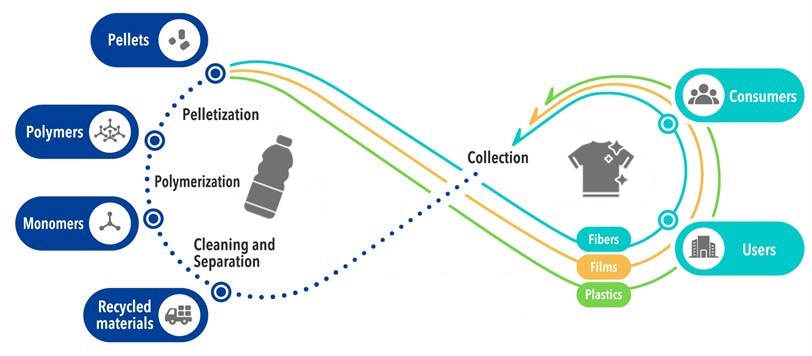
Realizing a Circular Economy
Basic Approach
In TORAY VISION 2050, the Group identifies “a world where people live in harmony with the planet, resources are recycled, and nature regenerates” (environment) as one of the outcomes it aims to achieve by 2050. Conventional social structures have given rise to various social issues, including resource depletion, marine pollution caused by increasing amounts of waste, and growing CO2 emissions.
Facing the need to address these social issues, the Group recognizes initiatives toward a circular economy as one of the important perspectives for anticipating changes in the business environment over the medium to long term.
Toray Group views the transition to a circular economy as presenting both risks requiring appropriate responses and opportunities for business growth, and has categorized them as follows:
Main risks associated with the transition to a circular economy
- Increased cost of waste processing
- Contraction of the materials market due to a shift away from mass production and consumption
- Lost opportunities due to any delay in adapting to the circular economy
Main opportunities associated with the transition to a circular economy
- Growth of materials business through use of biomass-derived materials
- Growth of materials business through use of recycled materials
- Growth of businesses that help reduce waste (waste reduction, and product durability)
As a materials manufacturer, Toray Group places importance on contributing to the resolution of social issues through its business activities. It positioned “Achieve circular economy (CE)” as one of the important issues under its Medium-Term Management Program, Project AP-G 2025, and has advanced initiatives accordingly.
Furthermore, under IGNITION 2028, our medium-term management program that began in fiscal 2026, the Group continues to position contribution to the circular economy as an important issue. Under this program, in order to reduce risks and capture opportunities associated with the transition to a circular economy, the Group will integrate the shift from fossil resources to recycled and biomass-derived resources more closely than ever before with each of its businesses, promote research and technology development, and work to achieve both its growth strategies and value creation.
In addition, to translate the results of this research and technology development into social implementation, Toray Group will make phased investments in research facilities, demonstration facilities, and production facilities. Through these efforts, the Group will continue to promote the creation and widespread adoption of technologies and products that contribute to a circular economy.
Initiatives for Resource Circulation
Toray Group is promoting initiatives for resource circulation with a view to the entire product life cycle, toward the realization of a circular economy that makes effective use of resources. With the aim of contributing to waste reduction and improved resource efficiency, the Group is utilizing various technologies for the recycling of discarded plastic products and materials generated during the manufacturing process (“production scrap”), the conversion of raw materials to biomass-derived materials, the adoption of renewable energy and hydrogen for energy use, and the reuse of water.
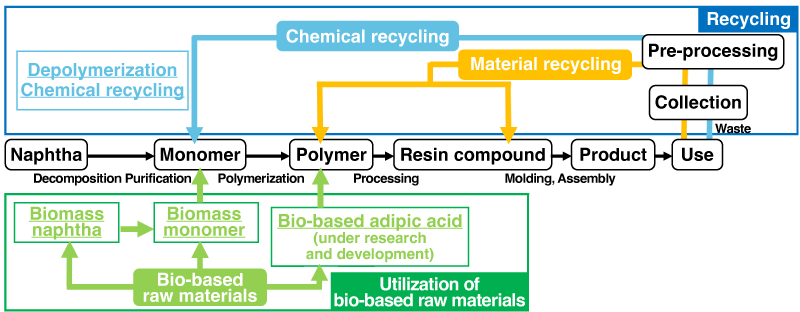
Specifically, the Group is promoting the reuse of discarded products and production scrap, such as fibers/fabrics, resins, and films, through material recycling1. In addition, for products and production scrap that are difficult to recycle through material recycling, the Group is also working on chemical recycling2, which chemically decomposes them and converts them back into monomers. Chemical recycling has already been commercialized for nylon fiber products.
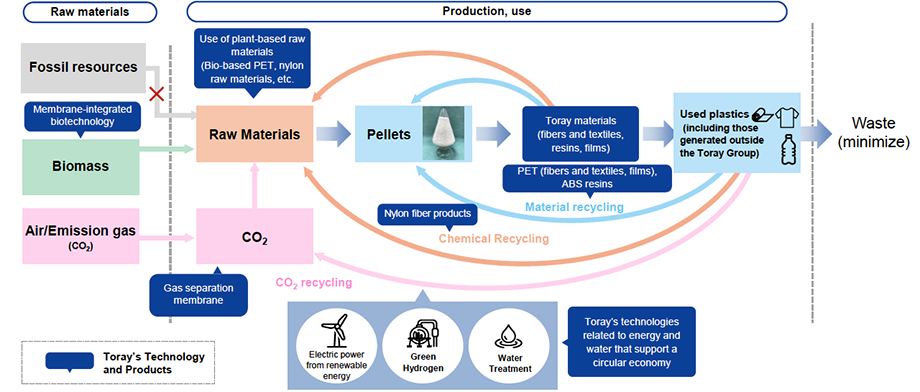
- 1 Material recycling is a process that regenerates pre-consumer or post-consumer materials into recycled materials through physical means. Examples include cutting, sorting, crushing, washing and decontamination (removal of dirt and foreign matter), and melting.
- 2 Chemical recycling is a process that chemically decomposes pre-consumer or post-consumer materials to recover useful chemical substances. Examples include decomposition, liquefaction, gasification, and depolymerization.
Furthermore, from the perspective of reducing dependence on fossil resources, Toray Group is promoting the development of materials made from biomass-derived resources, as well as the development of membrane-integrated bioprocess technology that can efficiently produce these raw materials. In addition, from a medium- to long-term perspective, the Group is promoting research and development into carbon recycling, including the utilization of CO2 as a resource.
For research and technology development related to resource circulation, the Group is establishing research and development facilities, as well as proceeding with investment in production facilities as necessary, with a view to transitioning from the demonstration stage to the manufacturing and sales stages.
Collaboration with the Supply Chain
In addition to its own initiatives, Toray Group is promoting value creation across the market toward the realization of a circular economy through collaboration with its supply chain.
The BlueRebirth Council was founded in June 2025 by six companies: DENSO CORPORATION, Nomura Research Institute, Ltd., Honda Motor Co., Ltd., MATEC Inc., REVER CORPORATION, and Toray Industries, Inc. The council was established with the aim of realizing car-to-car recycling, starting with the automated and highly precise dismantling of end-of-life vehicles (ELVs), and of building a value chain that integrates arterial industries (production and supply) and venous industries (recycling and resource recovery).
In addition, Toray Industries is participating in the development of a global supply chain for renewable plastics made from biomass-derived resources in collaboration with companies including Sony Corporation and Mitsubishi Corporation. Within this framework, Toray Advanced Materials Korea Inc. is responsible for manufacturing PET resins and films with assigned biomass characteristics using the mass balance approach.
Establishing a Foundation for Social Implementation
Toray Group is developing a foundation based on internationally recognized certification systems in order to provide a stable supply of products made from circular materials.
For recycled and biomass-based products, the Group confirms and manages applicable products based on its internal certification criteria, the Toray Group Certification Standards for Recycled and Biomass-based Products, so that their characteristics can be clearly communicated to customers and markets.
Toray Group has adopted the mass balance approach3. Toray companies and sites have obtained ISCC PLUS certification, one of the internationally recognized certification schemes for the mass balance approach.
The ISCC PLUS certification system ensures appropriate management and traceability of products derived from renewable resources (biomass-derived materials) and recycled materials, based on the mass balance approach across the entire global supply chain. Certified sites are able to allocate and use biomass or recycled materials according to the mass balance approach and produce and supply products with verifiable levels of sustainability.
Toray Industries follows the latest ISCC regulations and the ISCC PLUS requirements.
- 3 Mass Balance Approach: During the processing and distribution stages from raw material procurement to finished product delivery, materials with specific characteristics (e.g., biomass-derived raw materials) are often mixed with materials without those characteristics (e.g., petroleum-derived raw materials). The mass balance approach is a method for reliably allocating the characteristics of specific raw materials to a portion of the finished product based on the input amount of those raw materials.
In addition to responding to such certification systems, Toray Group is working to address challenges in achieving a circular economy through collaboration with industries, government agencies, international organizations, and others.
As part of these efforts, the main initiatives in which Toray Industries participates are as follows.
- Ministry of Economy, Trade and Industry (METI): Circular Partners
- SusPla (Sustainable Plastics Initiative) (available only in Japanese)
- Textile Exchange
Target
For the core polymers of polyester and nylon, Toray Group has set a target for the percentage of recycled and biomass-derived resources in total raw material input of 20% by fiscal 2030 and 30% by fiscal 2035.
The percentage in fiscal 2025 is expected to be 8%. Toward the fiscal 2030 target, the Group will continue to promote recycling and the use of biomass-derived raw materials.
Revised August 2026 (Approved by the Board of Directors)
- We shall design, produce, and sell recycled products. (Recycled products refer to products produced using recycled materials exclusively or in part.)
- We shall promote the purchase of recycled materials, as well as the procurement and use of recycled products. (Recycled materials refer to pre-consumer or post-consumer materials—either processed through internal or external recycling streams, or purchased post-processing—that we use in final products or component parts.)
- We shall promote the reduction and reuse of waste that we generate.
- We shall cooperate with customers to recycle our products.
- We shall regularly disclose information regarding the details and results of these efforts through our reports and website.
Related Information
- Reducing Environmental Impact
For more information on Toray Group waste reduction, chemical management, energy management, and greenhouse gas emissions reduction, please visit the website below.
Biomass-derived materials business
From the perspective of reducing dependence on fossil resources, Toray Group is promoting the development of materials made from biomass-derived resources. As a representative initiative, Toray Group mass produces partially bio-based polyethylene terephthalate (PET) fibers that are made from plant-based ethylene glycol, derived from molasses byproducts. These fibers are also used in uniforms, sports apparel, and traditional Japanese clothing, as well as in Ultrasuede™ PX and Ultrasuede™ BX synthetic suede texture fabrics.
Toray Group is proceeding with prototype sales of bio-based PET fiber, in which both of the main raw materials, ethylene glycol and terephthalic acid, are derived from biomass resources. The Group is also developing membrane-integrated bioprocesses for the in-house production of these raw materials.
In the field of nylon fibers, the Group has recently developed and launched Ecodear™ N510, a nylon fiber made from 100% plant-based raw materials. As part of collaborative projects, this fiber has been utilized for the TANKER series of bags by Yoshida Co., Ltd. and in the STRINGS lineup of clothing from ISSEY MIYAKE Inc.
Furthermore, Toray Advanced Materials Korea Inc. plans to manufacture PET resins and films with assigned biomass characteristics using the mass balance approach.
Membrane-Integrated Bioprocesses
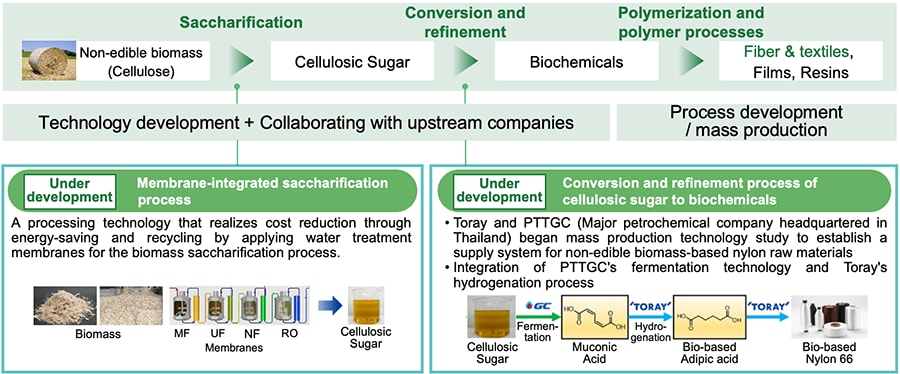
Toray Group is developing a membrane-integrated bioprocess to enable biomass-derived raw materials to be manufactured with greater efficiency. This membrane-integrated bioprocess combines membrane separation technology and biotechnology to create new applications for water treatment membranes in processes such as saccharification, fermentation, and purification. The technology significantly improves the manufacturing of raw sugar from non-edible biomass and increases fermentation efficiency, thereby contributing to realizing materials made from biomass-derived raw materials. Toray Group is currently operating a technology demonstration project for a saccharification process that produces sugars from nonedible biomass. Toray Group will work to commercialize the technology, with a view to its future deployment in commercial-scale production facilities, in order to build a supply chain for producing materials and chemicals from non-edible biomass.
In 2023, Toray Industries, Inc. and PTT Global Chemical Public Company Limited began jointly developing technology to produce muconic acid and bio-based adipic acid—raw materials for nylon 66—using sugars derived from non-edible biomass as feedstock. These sugars are manufactured at Cellulosic Biomass Technology Co., Ltd. (Southeast Asia), in which Toray Industries holds an 84% stake. Through this initiative, Toray has established the world's first technology for the integrated manufacturing of 100% bio-based nylon 66. Toray is currently building a supply chain with the goal of launching sales of fiber products using 100% bio-based nylon 66 in fiscal 2028.
Promoting Recycling
Toray Group is promoting recycling initiatives across a wide range of business segments including fibers & textiles, plastics, and films. The Group offers a diverse range of products utilizing recycled materials, such as fibers derived from recycled plastic (PET) bottles and production scrap ends (“production scrap”), recycled resin made from production scrap and used plastics, as well as film products made by recovering and recycling films that have been used in customer processes.
In the fiber/textile segment, Toray Group uses discarded PET bottles as raw materials, along with filtering and cleaning technologies to remove foreign matter, making it possible to develop a wide variety of recycled products. In 2019, Toray Group introduced the &+™ (And plus) brand of recycled fibers that include Toray’s original traceability function. After rebranding in April 2023, the Group added recycled fiber products made using nylon recovered from discarded fishing nets to the &+™ brand.
In 2024, the Group analyzed the depolymerization reaction of Nylon 66 using subcritical water4 and, through its proprietary technology that suppresses side reactions, successfully recovered two types of monomers at high yield and efficiency, then repolymerized them to regenerate Nylon 66.
This nylon is mainly used in automotive and industrial applications such as airbags, leaving open the possibility of expanding the range of applications in chemical recycling.
By utilizing fibers, resin, and film that were previously treated as waste, the Group is promoting research and technological development to recycle these materials into useful resources, while also driving phased investments in production equipment for recycling-related products to implement these technologies in society.
- 4 Subcritical water: Water in a high-temperature, high-pressure state just below its critical point (374°C, 22 MPa), possessing properties such as the ability to dissolve and hydrolyze organic compounds. This state differs from the characteristics of water at room temperature and regular atmospheric pressure.
Fiber and Textile Recycling
&+™ Recycled Fiber Brand
Previously, fibers derived from recycled PET bottles were limited in variety due to contaminants mixed into raw materials, which made it difficult to produce special cross-sections and fine fibers.
In response, Toray Industries together with Kyoei Industry Co., Ltd. developed contaminant filtering technology and advanced plastic bottle cleaning techniques to stabilize the supply of high-quality raw materials. Combining these technologies with Toray’s fiber production technology, it is possible to achieve the same level of diversity in fabric applications as with fiber materials made directly from fossil resources.
Moreover, Toray has commercialized its highly reliable polyester fiber under the &+™ brand by incorporating its proprietary traceability technology that can detect special additives incorporated into plastic bottle-based raw materials. The goal is to expand the scale of the &+™ brand by utilizing a diverse supply chain that extends beyond fibers to include textiles and sewn products, as well as production sites around the world.
The Group is also creating a unique recovery scheme for discarded fishing nets in collaboration with a recycling company and a fishing net manufacturer. The nylon in the recovered nets will be used for a newly released recycled nylon fiber material sold under the &+™ brand. Through the production and sale of high-value-added recycled nylon fiber based on Toray Industries’ chemical recycling technology, the Group aims to raise awareness of the need to help recover discarded fishing nets and is working to further promote the activity.
In addition, at Expo 2025 Osaka, Kansai, Japan, Toray Industries exhibited attendant uniforms that utilized Toray Industries’ partially plant-derived polyester fibers as well as &+™, a recycled polyester fiber made from recovered PET bottles as a raw material. In a circular recycling initiative, uniforms collected after use are processed into recycled PET resin by Ecolog Recycling Japan Co., Ltd. and repurposed into items such as flower pots.
Furthermore, Toray Industries is promoting collaboration and cooperation with students who will drive the future of the apparel industry, through activities such as conducting special lectures on the &+™ brand at the Ueda College of Fashion and adopting &+™ brand textiles in the Bunka Fashion College fashion show.
Promoting Recycling with UNIQLO Co., Ltd.
Together with UNIQLO Co., Ltd., Toray Industries has been promoting new initiatives for sustainable products. Toray Industries uses and supplies recycled fibers derived from PET bottles for jointly developed products such as HEATTECH, AIRism, and KANDO Pants.
In addition, UNIQLO stores are collecting used down items from customers to recycle the feathers. Conventionally, the stuffing in duvets and other objects incorporating down is manually removed. Such processes are arduous with Ultra Light Down items because of their thin outer fabric and complex construction.
By developing special extraction machinery, Toray Industries has fully automated cutting, stirring and separating, and recovery, for 50-fold the process capacity of manual processes, thus greatly alleviating workloads. The collected feathers are reused as a material for new down products, and Toray Industries is promoting circular product development together with UNIQLO.
Resin Recycling
Toray Group is developing sustainable resin materials using recycled and biomass-derived raw materials. In the area of resin recycling, in addition to material recycling, the Group utilizes chemical recycling (depolymerization chemical recycling: a method that breaks down used products and production scrap into monomer raw materials before re-polymerizing them) to develop and market recycled resins based on a proprietary formulation design.
Going forward, the Group will actively work to utilize resin derived from collected post-consumer products (post-consumer recycled material), thereby promoting effective resource utilization.
1. Recycled Nylon 6 Resin AMILAN™
Honda R&D Co., Ltd. and Toray Industries have begun a joint development project for chemical recycling of automotive nylon 6 resin. In this initiative, the companies are developing a technology that uses subcritical water to depolymerize glass fiber-reinforced nylon 6 resin parts recovered from scrap vehicles, thereby recycling them into the raw monomer caprolactam.
As a form of high-temperature, high-pressure water, subcritical water has the characteristics of high permeability, dissolving power, and hydrolyzing power with regard to resins. It can depolymerize nylon 6 in a short time with a high yield, without the use of catalysts and without being affected by additives. After the recovered monomer is separated and purified for repolymerization, it can be recycled as nylon 6 with physical properties equivalent to those of virgin material.
2. Recycled Nylon 66 Resin AMILAN™
Toray Industries has developed a recycled nylon 66 resin compound that is made by removing silicone from airbag fabric scrap cuttings, and then washing the remaining material. With Toray’s proprietary additive compounding technology, residual silicone resin is prevented from migrating to the surface of molded products, and mold adhesion is also significantly reduced. Accordingly, the flowability and mechanical properties of recycled nylon 66 AMILAN™ are on par with injection molding grades derived from virgin raw materials.
3. Recycled PBT (polybutylene terephthalate) resin TORAYCON™
Toray Industries has launched a recycled PBT resin, TORAYCON™, as a chemically recycled resin with physical properties comparable to virgin materials.
4. Recycled PPS (polyphenylene sulfide) resin TORELINA™
Toray Industries has developed a material recycling technology for glass fiber reinforced PPS resin and is now distributing TORELINA™ as a recycled resin.
Furthermore, in the area of utilizing biomass-derived raw materials and pyrolysis chemical recycling raw materials, Toray has obtained ISCC PLUS certification and is establishing a supply system for ABS resin, PPS resin, PA6 resin, PBT resin, and LCP resin based on the mass balance approach.
Film Recycling
Toray Group promotes resource-conscious production by effectively utilizing PET recovered and re-pelletized from production scrap generated during the manufacture of polyester (PET) film Lumirror™ and other products. In addition to reuse in film applications, the recycled PET is used as a raw material for textiles and resin products.
In addition, the Company operates a system for collecting used PET film from customer manufacturing processes, and then recycling it as raw material for film.
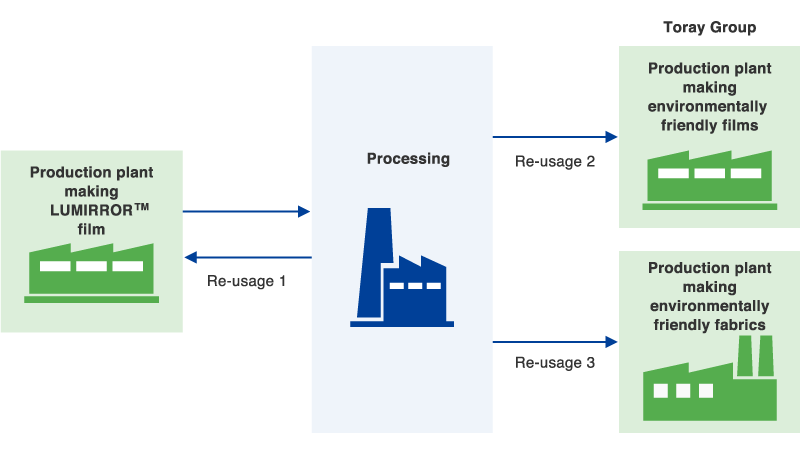
Reusing waste PET film from customer manufacturing processes
Toray Industries has established a recycling system to collect and reuse PET films utilized in electronic component applications. The system utilizes recycling processing technologies to remove coating materials and resins from the surfaces of used films. Combined with contaminant removal processes throughout manufacturing, these technologies enable closed-loop material recycling into new film products without compromising mechanical properties or reliability.
These PET films have reduced the amount of fossil-based resin used as a raw material and can therefore lower CO2 emissions by up to 50% compared to conventional films.
Toray Group will continue to utilize this system to help build a circular economy.
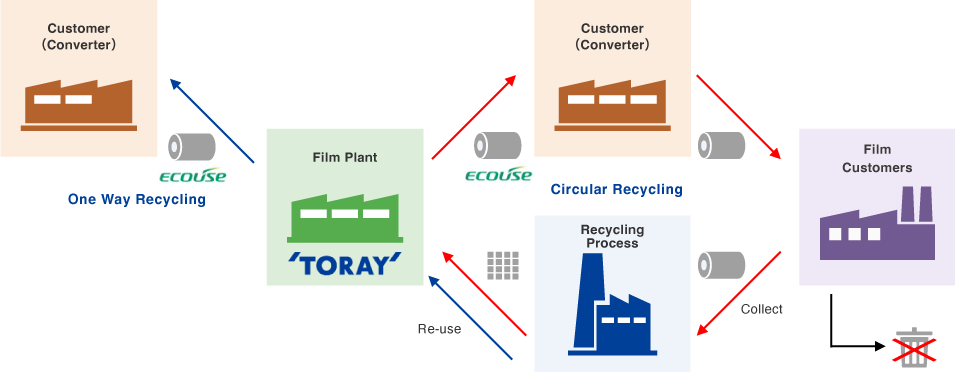
Product website for recycled PET film under the Lumirror™ brand
Carbon Fiber Recycling
With its excellent mechanical properties, TORAYCA™ carbon fiber is a material that helps create lighter-weight and longer-lived products, while also helping to reduce CO2 emissions throughout the product’s lifecycle. In particular, in applications such as large wind turbines, aircraft, and hydrogen tanks, the use of carbon fiber is expected to significantly reduce CO2 emissions during the operational stage. As demand for carbon fiber grows, market demand for the recycling of used carbon fiber is also increasing.
The successful development of recycled carbon fiber (rCF) and associated applications requires collaboration with a wide range of customers to explore various possibilities for use in specific parts and materials. Toray carbon fiber is used in the Boeing 787. Off-cuts generated during this production process are turned into rCF, which Lenovo has utilized to make casings for its computers.
Toray Industries is also moving forward with exploring the collection of scrap and waste materials from customers’ factories to reuse them as new recycled carbon fiber (rCF) reinforcement materials. The Company is accelerating product development of high value-added products using rCF in collaboration with companies committed to advancing a circular economy for carbon fiber.
Carbon fiber offers excellent resistance to heat and ultraviolet light and does not absorb moisture. Moreover, carbon fiber can also be produced from biomass-derived raw materials. By leveraging these characteristics, the Company aims to build a resource utilization model unique to carbon fiber that includes the use of biomass-derived and recycled raw materials.
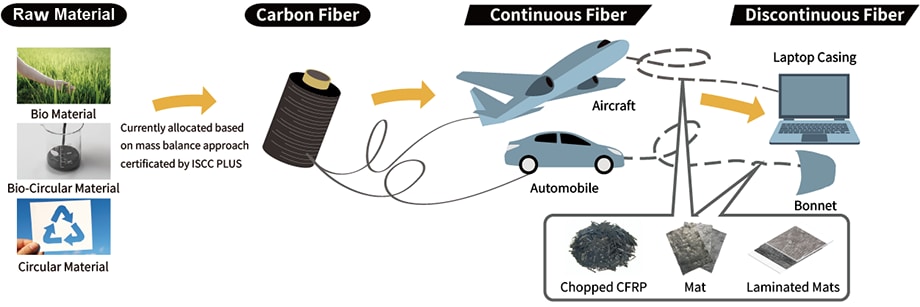
Blockchain-based Traceability
Since recycled materials basically have the same physical properties as virgin materials derived from fossil resources, ensuring traceability becomes important to properly identify and explain whether a product is derived from recycled sources.
To address these challenges, Toray Group engaged in a small-scale demonstration of a system to visualize manufacturing and transport information across product supply chains. The system utilizes blockchain technology, which prevents tampering with input data by its nature.