- HOME
- Sustainability
- Toray Sustainability Principles
- Governance
- Ethics and Compliance
- Research Ethics
Research Ethics
Toray Industries, Inc. recognizes that, while research and development activities contribute to people’s health and the development of society, they may also directly involve the lives and dignity of human beings and animals. Accordingly, under its corporate social responsibility, the Company is committed to ensuring research ethics, taking into account not only the scientific validity of research but also ethics, social acceptability, and compliance with laws and regulations as important prerequisites, whether the subjects of research are human samples and information or experimental animals.
In addition, based on relevant laws and regulations and national guidelines, Toray Industries has established a system to ensure that research is conducted appropriately through the development of internal rules and review systems, the provision of employee education, and ongoing inspections and evaluations.
Ethics and Governance for Research Involving Human Biological Subjects and Information
Toray Industries aims to expand its business by helping to realize “a world where everyone enjoys good health and hygiene.” In addition to developing new products in the pharmaceutical and medical fields, the Company is working on creating high-value-added materials for the broader healthcare market, including functional fibers designed to appeal to human sensibilities.
During its research and development processes, when conducting studies using human subjects or samples/information obtained from people (“research/testing involving humans”; hereafter, “human studies”), Toray personnel comply with the Company's ethical standards1, which are based on national ethics guidelines2.
The most important consideration for human studies is to protect the dignity and human rights of the research participants (providers of human samples or information). Therefore, individuals engaged in human studies (hereafter, “researchers”) are required to undergo prior training before starting their involvement, receive regular refresher training at least once a year, and submit research plans in advance for review and approval by internal and external experts.
The Company has established an Ethics Committee on Research Involving Human Biological Subjects3 (the “Ethics Committee”) and an Ethics Review Committee on Research Involving Human Biological Subjects4 (the “Ethics Review Committee”) to deliberate on the ethical and scientific validity of proposed human studies.
Research plans submitted by researchers to the Ethics Committee are rigorously reviewed by the Ethics Review Committee from the perspectives of ethical validity, scientific rationality, and the appropriateness of personal information management. The conclusions are then reported to the Ethics Committee. Based on this report, the Ethics Committee makes a comprehensive determination on whether to approve a proposed human study, taking into account factors such as institutional suitability.
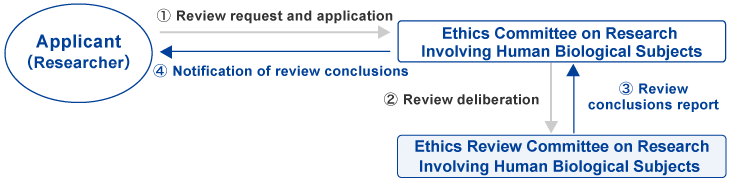
The operation and review activities of the Ethics Review Committee are conducted in accordance with the Operational Procedures for the Ethics Review Committee on Research Involving Human Biological Subjects (hereafter, the “Procedures”) created based on the Company's ethical standards. In addition to reviewing proposed studies, the Ethics Review Committee also conducts researcher training, and fiscal year-end reviews of all current studies. It plays a key role in managing and ensuring the proper operation of the entire process for human studies.
The Ethics Review Committee members, the Procedures, and the committee minutes are released on the Company’s website and submitted to the Research Ethics Review Committee Reporting System operated by Japan’s Ministry of Health, Labour and Welfare.
- 1 The Company's ethical standards: Toray Ethic Code for Research Involving Human Biological Subjects (established March 10, 2011; revised August 1, 2023; 6th Edition)
- 2 National ethics guidelines: “Ethical Guidelines for Medical and Biological Research Involving Human Subjects” (March 21, 2021; Ministry of Education, Culture, Sports, Science and Technology / Ministry of Health, Labour and Welfare / Ministry of Economy, Trade and Industry Notification No. 1)
- 3 Ethics Committee on Research Involving Human Biological Subjects: This body, chaired by the head of the Research & Development Division, manages and oversees the Ethics Review Committee. As of July 2026, the corporate vice president serves as the head of the R&D Division.
- 4 Ethics Review Committee on Research Involving Human Biological Subjects: Taking a scientific and ethical standpoint, this body deliberates on whether proposed human studies should proceed based on Toray's ethical standards. Its conclusions are reported back to the Ethics Committee. The Ethics Review Committee consists of i) internal experts in natural sciences, ii) internal experts in humanities and social sciences, and iii) members of the public. The committee chair is an internal expert appointed by the Ethics Committee chair, and as of July 2026, the position is held by the vice president.
- Member of Ethics Review Committee on Research Involving Human Biological Subjects (176KB)
- Minutes of 16th Ethics Review Committee on Research Involving Human Biological Subjects (270KB)
- Minutes of 1st Ethics Review Committee on Research Involving Human Biological Subjects (87KB)
- Minutes of 2nd Ethics Review Committee on Research Involving Human Biological Subjects (83KB)
- Minutes of 3rd Ethics Review Committee on Research Involving Human Biological Subjects (85KB)
- Minutes of 4th Ethics Review Committee on Research Involving Human Biological Subjects (85KB)
- Minutes of 5th Ethics Review Committee on Research Involving Human Biological Subjects (88KB)
- Minutes of 6th Ethics Review Committee on Research Involving Human Biological Subjects (85KB)
- Minutes of 7th Ethics Review Committee on Research Involving Human Biological Subjects (85KB)
- Minutes of 8th Ethics Review Committee on Research Involving Human Biological Subjects (85KB)
- Minutes of 9th Ethics Review Committee on Research Involving Human Biological Subjects (85KB)
- Minutes of 10th Ethics Review Committee on Research Involving Human Biological Subjects (85KB)
- Minutes of 11th Ethics Review Committee on Research Involving Human Biological Subjects (86KB)
- Minutes of 12th Ethics Review Committee on Research Involving Human Biological Subjects (83KB)
- Minutes of 13th Ethics Review Committee on Research Involving Human Biological Subjects (112KB)
- Minutes of 14th Ethics Review Committee on Research Involving Human Biological Subjects (112KB)
- Minutes of 15th Ethics Review Committee on Research Involving Human Biological Subjects (113KB)
Ethics and Governance for Research Involving Laboratory Animals
Toray Industries aims to contribute to society and personal health enhancement through the creation of new pharmaceuticals and medical devices. The Company believes that animal testing is necessary and required for verifying the safety and efficacy of these products. However, these tests must be carried out with respect for animal life, considering the 3R principles for animal testing; Replacement (use of alternatives to animals), Reduction (reducing the number of animals used), and Refinement (minimization of pain).
With these 3R principles as the core philosophy, the Company has established the Toray Industries Research & Development Division Animal Experiment Guidelines5 (established as internal company regulations on April 1, 2005 and revised May 25, 2026) to ensure that its animal testing is conducted properly and ethically. The Guidelines comply with the Act on Welfare and Management of Animals, the Standards Relating to the Care and Keeping and Reducing Pain of Laboratory Animals, the Guidelines for Proper Conduct of Animal Experiments, and other relevant laws and guidelines. Under these Guidelines, the Company is committed to the proper care and scientific use of laboratory animals, and will strive to use alternatives to animals, reduce the number used, and minimize their pain to the full extent.
Under the leadership of the head of the testing facility6, the Company has set up an Animal Experiment Ethics Committee7 (“Animal Care and Use Committee”). This committee carries out ethical and scientific reviews of all animal testing plans from the perspectives of the use of alternatives to animals, reducing the number of animals used, and the minimization of pain, and other considerations. Through these efforts, the Company strives to conduct appropriate animal testing based on the 3R principles.
Specifically, as alternatives to animal testing, Toray has proactively adopted in silico evaluation8 using computers and in vitro evaluation9 using cultured cells. For pharmacokinetic evaluation, the Company has been able to reduce the number of animals used by adopting a simultaneous analysis method for multiple compounds administered in mixed doses. Humane endpoints (criteria for suspending and discontinuing experiments to avoid causing undue suffering) are also set for all planned experiments.
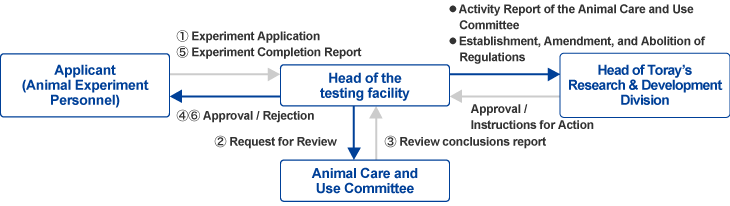
The committee provides all staff involved in animal testing with training on the handling of laboratory animals and biannual ethics education, making completion of these educational programs mandatory for those involved in such activities. The committee also works continuously to raise awareness of animal testing and laboratory ethics.
In addition, the Animal Care and Use Committee carries out annual self-monitoring and evaluation of the regulations and systems in place, the committee actions, facility maintenance, and animal testing to verify that each test is conducted appropriately.
Toray Industries’ Basic Research Center has continually received certification from the Assessment and Accreditation Center for Laboratory Animal Care and Use, Japan Pharmaceutical Information Center10 since 2012.
Finally, as a symbolic act to express gratitude and respect toward the animals used in its tests, the Company holds a memorial service every year to honor these laboratory animals.
- 5 Toray Industries Research & Development Division Animal Experiment Guidelines: Approval is given by the head of the Research & Development Division of Toray Industries. As of July 2026, the corporate vice president serves as the head of the R&D Division.
- 6 Head of the testing facility: In accordance with the Company’s internal regulations, the head of the Basic Research Center serves as the head of the testing facility. As of July 2026, the vice president serves as the head of the Basic Research Center. The deliberations and activities of the Animal Care and Use Committee are reported to the Research & Development Division’s Biological Experiments Review Board, which is chaired by the head of the same division.
- 7 Animal Care and Use Committee: This body, upon submission of a request for review by the head of the testing facility, reviews whether animal experiment plans comply with the Company’s internal regulations and other applicable requirements, and submits its recommendations based on the results. The members are appointed by the head of the testing facility and comprise: i) persons with extensive knowledge and expertise in animal experiments and related matters; ii) persons with extensive knowledge and expertise in laboratory animals; and iii) other persons with relevant academic knowledge and experience.
- 8 in silico evaluation: An evaluation method that uses computers to predict the physiological activity, pharmacokinetics, toxicity, and other characteristics of a compound from existing data.
- 9 in vitro evaluation: An evaluation method that detects the physiological activity, pharmacokinetics, toxicity, and other characteristics of a compound using human or animal cells and tissues in test tubes or culture dishes.
- 10 For a list of facilities certified by the Japan Pharmaceutical Information Center, visit its website.