- HOME
- Sustainability
- CSR Activity Report (CSR Guideline Activity Reports)
- Establishing Sustainable Supply Chain
- Socially Responsible Procurement Initiatives at Toray Group
Socially Responsible Procurement Initiatives at Toray Group
Toray Group Supply Chain
Toray Group’s supply chain extends to diverse countries and regions around the world. In fiscal 2024, the Group’s purchasing by region was 42% in Japan, 39% in the rest of Asia, 6% in Europe, and 13% in the Americas.
Purchasing by business segment was 31% for Fibers & Textiles, 23% for Plastics & Chemicals, 16% for Films, 13% for Carbon Fibers Composite Materials, and 17% for others.
Operating in a wide range of industries, the Group’s suppliers include general trading companies, specialized trading companies, and worldwide producers of petrochemicals, fuels, pharmaceuticals, molded products, packaging materials, machine tools, precision equipment, machine parts, and processed materials. Toray Group engages in either regular or spot transactions and purchases from a wide range of primary suppliers, approximately 4,200, with offices around the world.
FY 2024 Purchasing Breakdowns by Region and Business Segment (Based on Transaction Value)
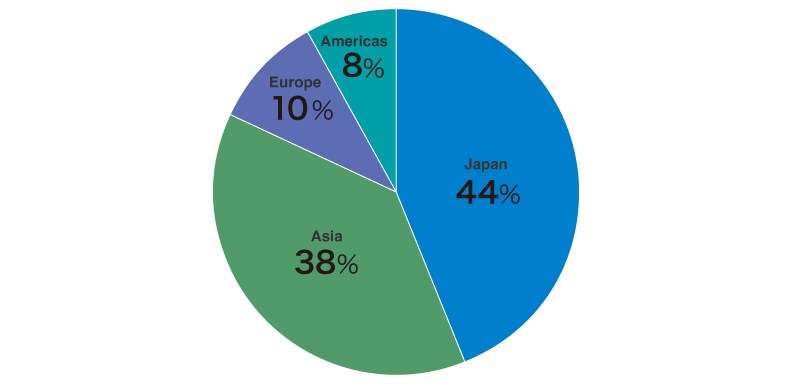
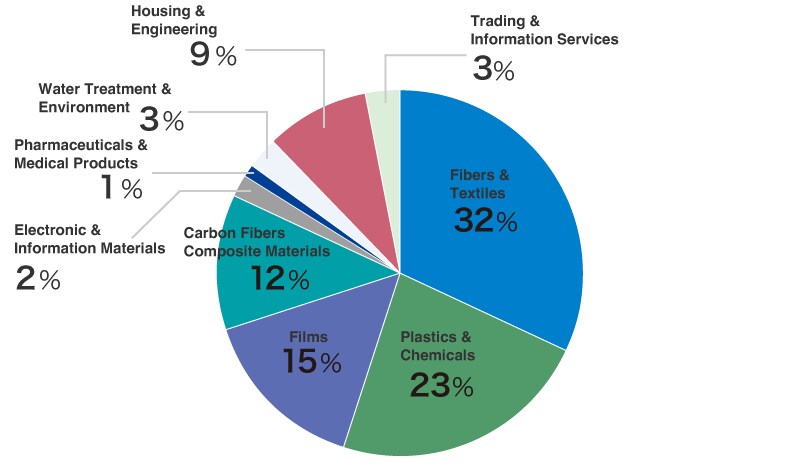
Toray Group's Socially Responsible Procurement Activities
Suppliers agreeing to the Toray Group CSR Procurement Guidelines (%)
- ■Reporting scope
- Toray Group
- ■Target in fiscal 2024
- At least 85%
Result in fiscal 2024
85.5%
Implementation of supply chain due diligence (% of cases)
- ■Reporting scope
- Toray Group
- ■Target
- At least 60% (Fiscal 2024)
Result in fiscal 2024
66.7%
With its global supply chain, Toray Group places top priority on ascertaining suppliers' CSR activities and requesting them to implement the necessary initiatives. Toray Group is facilitating CSR initiatives across its supply chains, including at group companies in Japan and around the world. These efforts include developing CSR procurement systems and responding to customers’ requests. With regard to suppliers, Toray Group also monitors supplier initiatives, educates suppliers, carries out CSR surveys of suppliers, requests compliance with the Toray Group CSR Procurement Guidelines, and conducts activities to obtain written agreements on these guidelines.
In addition, the Group holds briefings for suppliers on compliance-related topics (August 7 and 8, in fiscal 2024) and Basic Distribution Policy Briefings for logistics companies (May 23, in fiscal 2024), to further promote understanding and education concerning the Toray Group CSR Procurement Guidelines.
 The Toray Group Supply Chain CSR Promotion Guidebook
Toray Group uses its own questionnaire survey system to conduct regular surveys of suppliers and monitor their CSR efforts. The Group assesses suppliers based on uniform group standards, provides feedback on the results to suppliers, and follows up on poor-performing suppliers. By maintaining this due diligence process, the Group endeavors to raise suppliers’ awareness and efficiently and effectively ascertain, prevent, and lower CSR risks across the supply chain. Through this process, Toray Group recognizes suppliers meeting the required CSR compliance level as CSR procurement partners.
When poorly assessed companies demonstrate during follow-up a lack of commitment to making improvements, continue to be poorly assessed in CSR procurement questionnaires, take no corrective action for serious violations, or otherwise fail to meet the compliance levels that Toray requires, Toray Group may reevaluate further transactions with the supplier. Further, the Group has established the Toray Group Supply Chain CSR Promotion Guidebook, which is regularly distributed to suppliers as educational material during CSR procurement survey feedback sessions, as well as at other opportunities. The guidebook is used as part of the Toray supplier education and support program to promote and strengthen CSR along the supply chain.
Initiatives to Mitigate Global CSR Procurement Risk
To mitigate CSR procurement risks within Toray Group, a process was developed to identify key CSR procurement risk factors such as country, region, and industry. The process identifies suppliers for investigation, followed by risk assessments, audits, and mitigation measures.
After identifying and prioritizing CSR procurement risks, the Group decided to focus on three key issues for detailed investigation: human rights and labor, safety and hygiene, and environmental protection. Questionnaires and audit procedures were created to investigate these issues with suppliers.
To evaluate the operational feasibility of the prepared questionnaires and audit procedures, tests were conducted together with group companies worldwide, in preparation for the actual implementation of the investigation process.
To pick out suppliers requiring investigation, an identification process was created that narrows down suppliers based on information collected from group companies worldwide, taking into account factors such as the supplier country, region, and industry.
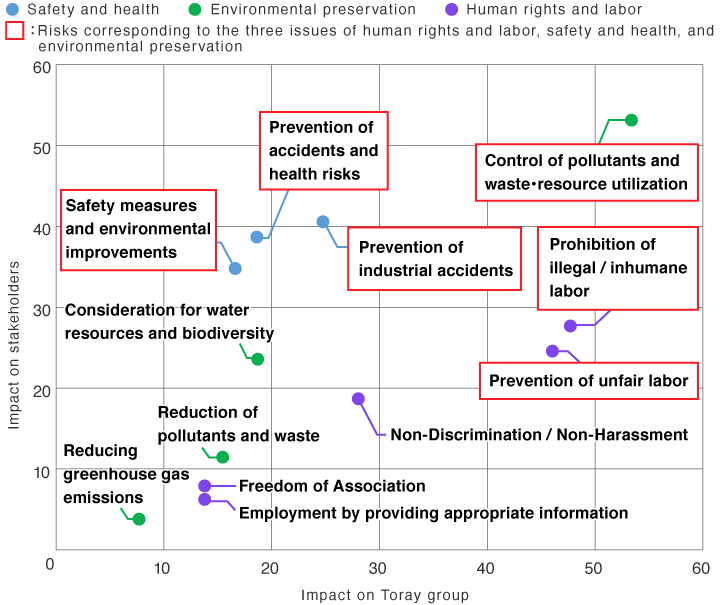
As a KPI under its CSR Roadmap 2025, Toray Group has adopted the implementation rate for supply chain due diligence and is promoting efforts accordingly. Each of the 80 group companies outside Japan is working to identify and survey suppliers deemed high-risk in terms of human rights and labor, safety and hygiene, and environmental protection. This applies to the 2,220 major suppliers that have received the Toray Group CSR Procurement Guidelines. The higher risk suppliers are identified based on factors such as the country, region, and industry.
The goal is to achieve a due diligence implementation rate of 60% or higher by fiscal 2024 and 90% or higher by fiscal 2025. In fiscal 2024, the Group conducted a risk survey and evaluation of three selected companies. As a result, two of these suppliers were assessed as posing a low risk. For the one remaining supplier, the Groupe will conduct audit and follow-up when risks are present. Through these initiatives, Toray Group will strive to reduce the CSR procurement risk to the Group as a whole.
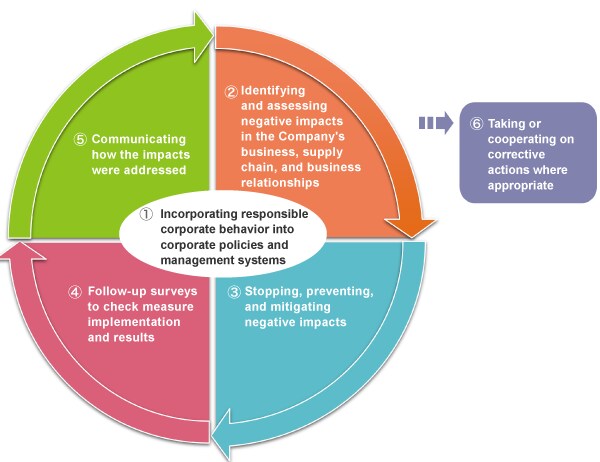
- 1. Incorporating responsible corporate behavior into corporate policies and management systems
- Toray Group Policy for Human Rights
- Ten Basic Environmental Rules
- Recycling Activity Principles
- Toray Group Biodiversity Basic Policy
- Toray Group's Basic Policy for Increasing Green Areas
- Toray Group CSR Procurement Policies
- Presenting the Toray Group CSR Procurement Guidelines to business partners and obtaining written agreements for compliance
- 2. Identifying and assessing negative impacts in the Company's business, supply chain, and business relationships
- Conducting and evaluating the CSR Procurement Survey
- Establishing a whistleblowing hotline system
- Investigating high-risk issues related to CSR procurement
- Confirming business partner risks using a corporate search system
- Auditing business partners
- 3. Stopping, preventing, and mitigating negative impacts
- Providing individual feedback to each business partner using the evaluation results of the CSR Procurement Survey
- Visiting low-score companies and requesting improvements
- 4. Follow-up surveys to check measure implementation and results
- Verifying improvement situations using the next CSR Procurement Survey and other means
- 5. Communicating how the impacts were addressed
- Public announcement in the Group’s CSR Report and in the UK Modern Slavery Act statement
- 6. Taking or cooperating on corrective actions where appropriate
- Establishing a compliance violation reporting mechanism (setting up a whistleblowing hotline)
Click here (229.8KB)PDF for more details on Toray Group’s due diligence process.
Main Items of CSR Surveys of Suppliers
Ⅰ. CSR promotion system
- □ Establishment of and familiarity with policies and guidelines
- □ Understanding and sharing the Toray Group CSR Procurement Guidelines
- □ Establishment of internal system and selection of responsible parties
- □ Establishment of goals and plans, review of activity results
Ⅱ. Corporate ethics and compliance
- □ Anti-corruption and bribery prevention
- □ Prevention of misuse of advantageous position and bid-rigging
- □ Thorough legal and ethical compliance
- □ Prevention of conflicts of interest
- □ Protection of confidential information and personal information
- □ Respect for and protection of intellectual property rights
- □ Avoidance of all involvement with organized criminal groups
- □ Prevention of use of technology barred under regulations and illegal exports
- □ Identification of use of conflict minerals and cobalt and country of origin
- □ Identifying items subject to restrictions on export to third countries
Ⅲ. Occupational safety and health
- □ Safety measures in workplace and improvements to working environment
- □ Prevention of occupational accidents
- □ Prevention of accidents and health risks
- □ Adoption of management system related to occupational safety
Ⅳ. Disaster prevention and risk management
- □ Development of education, training and manuals for disasters
- □ Establishment of business continuity plan (BCP) for large-scale disasters
- □ Establishment of BCP for pandemic
- □ Defense against threats on computer network
Ⅴ. Environmental conservation
- □ Obtaining and maintaining authorizations and registrations
- □ Prevention of pollutants and waste, promotion of resource use (3Rs: reduce, reuse, recycle)
- □ Appropriate management of chemical substances and pollutants in line with laws and regulations
- □ Greenhouse gas emissions management and reduction
- □ Green procurement, green purchasing, energy conservation activities
- □ Consideration for water resources and biodiversity and implementation of assessments
- □ Introduction of environmental conservation management system
Ⅵ. Interaction with stakeholders
- □ Disclosure of financial information and non-financial information
- □ Setting up hotlines for consultation and reporting, protection of whistleblowers
- □ Support for community activities and activities contributing to society, and encouragement of participation in such activities
Ⅶ. Product safety and quality assurance activities
- □ Assessment of product safety, management of substances contained in products
- □ Provision of information on specifications, quality and handling
- □ Managing compliance with product quality standards, inspection standards, and fraud prevention
Ⅷ. Human rights and labor
- □ Prevention of child labor and measures for young workers
- □ Prevention of forced labor, slave labor, and other forms of illegal or inhumane labor practices
- □ Provision of appropriate information to foreign workers and employment
- □ Prevention of undue low wages and wage reductions, as well as labor that exceeds statutory limits
- □ Ban on harassment, physical punishment, abuse, etc.
- □ Protection for freedom of association and collective bargaining, etc.
- □ Responding to the impact of COVID-19
Ⅸ. CSR initiatives in supplier's own supply chain
- □ Requests for promotion of CSR along supply chain
Socially Responsible Procurement Initiatives at Toray Industries
CSR Procurement Surveys to Ascertain and Evaluate Current Supplier Situations
Every two years, in principle, Toray Industries carries out a CSR survey of major suppliers, business partners and distribution companies which together are responsible for 90% of the Company’s total procurement value. Questions are established based on the Toray Group CSR Procurement Policies and the Toray Group CSR Procurement Guidelines. The surveys exhaustively confirm the extent to which suppliers are addressing CSR, requesting actions on a variety of social issues such as anti-corruption and anti-bribery measures, respect for human rights, and a variety of environmental conservation activities, including reduction of greenhouse gas emissions and consideration for and assessment of water resources and biodiversity.
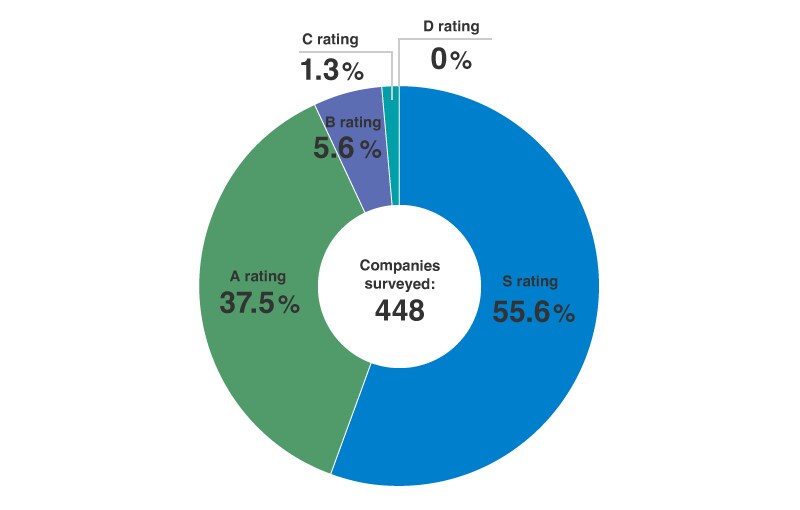
In fiscal 2024, Toray Industries carried out CSR surveys of major suppliers and received 451 responses (125 raw material suppliers, 153 equipment and material suppliers, 38 logistics companies, as well as 135 production and processing contractors). The results indicated that about 99% of companies surveyed were rated S, A or B1 for CSR practices, thus meeting the Company’s standards for business partners. The companies surveyed rated C or D, requiring further investigation of their CSR practices, accounted for just 1%.
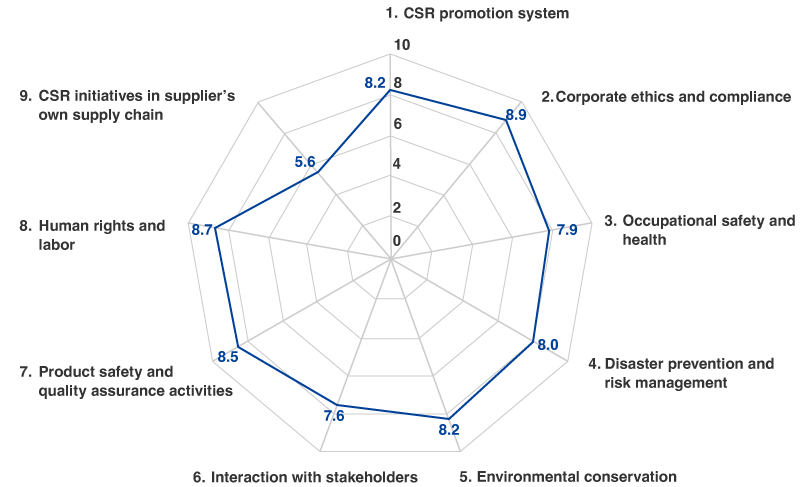
Analysis revealed that the average scores for the 451 companies improved compared to the previous survey with respect to most survey items such as environmental conservation, product safety and quality assurance activities, and human rights and labor. The results have reaffirmed that each company is promoting CSR initiatives. In addition, 80% (or four out of five) of the companies that were rated C or D in the previous survey, which were visited to confirm actual conditions and requested to make improvements, improved to an A or higher rating in the current survey.
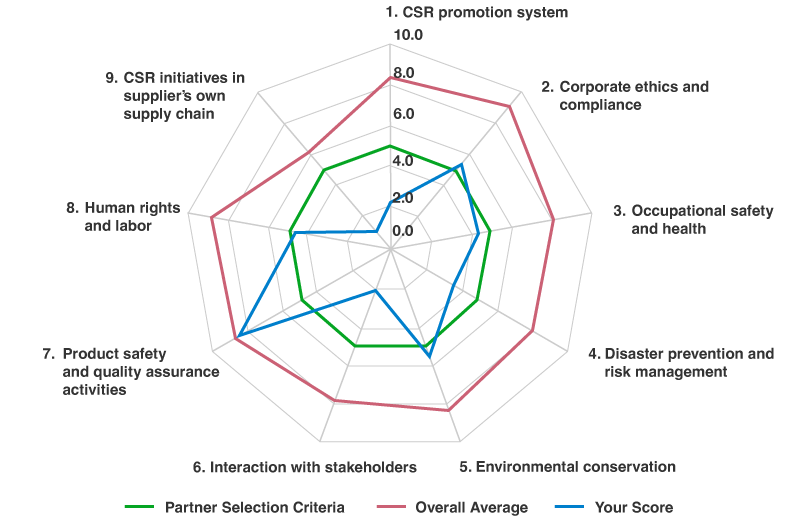
Furthermore, all 451 companies that responded were provided with feedback in the form of a score sheet, which included not only their individual assessment and the contents of the analysis, but also the overall averages for each survey item, including the scores of other companies as benchmarks. The Toray Group Supply Chain CSR Promotion Guidebook was also distributed along with this feedback.
In fiscal 2025, the Company will individually visit all six suppliers that were rated C or D to confirm actual conditions and hold discussions and provide support for corrective actions and improvements. Furthermore, in the case of business partners that meet the standards required by Toray Industries based on the CSR Procurement Survey results, on-site audits are also progressively being planned and carried out by the CSR Procurement Working Group for those in industries where the risks of negative impacts are a concern. The Company then checks in intermittently to confirm progress on the improvements indicated on the follow-up sheet.
- 1 Survey responses are assessed on a 10-point scale for each of the nine survey items. Taking the average score for the nine items as the overall score, 8 or more points is rated as S, 6 or more points but less than 8 is rated as A, 5 or more points but less than 6 is rated as B, 3 or more points but less than 5 is rated as C, and less than 3 points is rated as D.
- Percentage of suppliers with the level of efforts required by the Company (Rated as S, A, or B)
- 99%
Providing the CSR Procurement Guidelines and Confirming Compliance
In parallel with efforts to understand, assess, and improve the current status through CSR Procurement Surveys, Toray Industries is mitigating CSR-related risks by asking its suppliers to understand and comply with the Toray Group CSR Procurement Guidelines, established in March 2022, as part of efforts to further enhance CSR activities throughout the entire supply chain.
These guidelines outline specific and detailed requirements for areas such as ethics, compliance, safety, accident prevention, risk management, environmental preservation, product quality and safety, and human rights promotion.
Over the three years from fiscal 2022 to fiscal 2024, the Company sent the Toray Group CSR Procurement Guidelines to a total of 539 major suppliers and requested their understanding and compliance. It has been working to obtain and confirm written agreements from suppliers stating that they will adhere to the guidelines. As a result, 446 companies had provided such agreements by the end of fiscal 2024.
In addition, rules for responses to CSR surveys from customers are set and a system is in place to facilitate prompt and accurate responses.
Socially Responsible Procurement Initiatives at Toray Group Companies in and outside Japan
Toray Group Companies in and outside Japan have also established their own internal systems and rules and are conducting CSR procurement surveys of their suppliers. They also ask suppliers to comply with the Toray Group CSR Procurement Guidelines, while conducting audits and other measures to continually ascertain the status of supplier CSR initiatives and to request improvements.
CSR Procurement Surveys to Ascertain and Evaluate Current Situation
Group companies in Japan continued to request that their suppliers practice CSR procurement. In fiscal 2024, these companies conducted a CSR procurement survey among their major suppliers and received 129 responses. In addition to checking the CSR promotion situation at each supplier using the questionnaire, the relevant evaluation results were shared with each supplier as feedback. The suppliers requiring further investigation of their CSR practices were subject to such investigation, and group companies in Japan requested that suppliers requiring further investigation of their CSR practices make improvements. Group companies outside Japan ask their suppliers to implement CSR initiatives. For suppliers that have not received such requests, Toray Industries conducts CSR procurement surveys and other measures to support CSR procurement at overseas group companies.
Providing the CSR Procurement Guidelines and Confirming Compliance
Over the three years from fiscal 2022 to fiscal 2024, 41 group companies in Japan sent the Toray Group CSR Procurement Guidelines to 1,553 major suppliers and requested their cooperation and compliance. They have been working to obtain written agreements from suppliers on adherence to the guidelines. As a result, by the end of fiscal 2024, these group companies obtained written agreements from 1,414 suppliers, excluding 57 suppliers that these group companies do not expect to do business with in the future. Over the three years from fiscal 2022 to fiscal 2024, 80 group companies outside Japan sent the Toray Group CSR Procurement Guidelines to a total of 2,341 major suppliers, requesting their cooperation and compliance. The group companies are working to obtain written agreements from suppliers on adherence to the guidelines. As a result, by the end of fiscal 2024, they had obtained such agreements from 1,779 suppliers, excluding 121 companies that group companies do not expect to do business with in the future. With the support of Toray Industries, group companies worldwide will continue to obtain written agreements from existing and new suppliers.
Furthermore, the CSR Roadmap 2025 sets KPI for the percentage of group-wide suppliers that have agreed to follow the Toray Group CSR Procurement Guidelines. The targets for fiscal 2023, 2024, and 2025 are 75%, 85% and 90% or higher, respectively. In fiscal 2024, agreement was obtained from 3,639 out of 4,255 major Toray Group suppliers, representing 85.5% of business partners.
Human Rights and Environmental Preservation in the Supply Chain
Toray Group believes that respect for human rights and environmental preservation are especially crucial elements in ensuring that the supply chain is stable and sustainable.
The Toray Group CSR Procurement Policies state that Toray will work to build a supply chain that promotes human rights and preserves the environment. The Group requests that suppliers comply with the Toray Group CSR Procurement Guidelines and take measures to respect human rights; prohibit forced labor, slave labor, child labor, and unfair low-wage labor; and to protect the environment, including by reducing GHG emissions and conserving biodiversity.
With the CSR procurement questionnaire, the Company strives to understand and evaluate suppliers' initiatives related to human rights, labor practices, and environmental preservation. It also ascertains and prevents issues from arising in the supply chain.
Results of Fiscal 2024 CSR Survey of Suppliers Regarding Respect for Human Rights
The survey conducted by Toray Industries in fiscal 2024 confirmed a high rate of implementation of initiatives on 12 survey items, excluding those related to requests to secondary suppliers, out of 13 items related to human rights and labor.
In fiscal 2025, the Company conducted individual status checks and requested responses from those suppliers who answered “Will address in one year” ([1] in the table below) and “Not addressed” ([0] in the table below). The Company will confirm the results of supplier improvement measures using the fiscal 2026 CSR Procurement Survey.
In addition, CSR procurement surveys are used to investigate whether suppliers are responding appropriately to various issues related to human rights, such as employment and labor issues that could arise due to an infectious disease outbreak, in order to identify and prevent issues within the supply chain.
| Survey Questions | Implementation rate | Survey results (The results are ranked from 0 to 4. 0 and 1 mean that the company has not addressed the issues.) |
|---|---|---|
| 1. Have policies and guidelines been set and employees educated about respect for human rights, eliminating discrimination and improving the work environment? | 99.7% |  |
| 2. Has an internal system been set up and people responsible for its promotion been designated in regards to respect for human rights, eliminating discrimination and improving the work environment? | 98.9% |  |
| 3. Have goals and plans been set, activity results reviewed and mechanisms for making improvements and corrections devised in regards to respect for human rights, eliminating discrimination and improving the work environment? | 98.6% |  |
| 4. Do you employ anyone under the working age stipulated by applicable laws and regulations? In the case of employees under the age of 18, are the working hours and health and safety of those employees given special consideration in accordance with relevant laws and regulations? | 98.9% |  |
| 5. Do you use any form of labor that is, or is similar to, forced and bonded labor, involuntary or exploitative prison labor, or modern slavery, or that is linked to human trafficking? Do you guarantee that all your employees are free to leave their employment at any time they wish? | 98.9% |  |
| 6. Do you provide each foreign worker with an employment contract, employment rules, and other relevant documents in a language the individual can understand? Also, do you ever confiscate, conceal, or destroy any identification documents, passports, work permits, or other similar documents belonging to such workers, or prevent them from using those documents? | 96.2% |  |
| 7. Do you pay appropriate wages in accordance with relevant laws and regulations when it comes to minimum wages, overtime, wage deductions, piecework wages, and other benefits? Are unfair pay cuts ever used? | 99.6% |  |
| 8. Are conditions appropriately managed and operated to ensure that sexual harassment, power harassment, physical punishment, emotion or physical abuse, pressure and other inhuman treatment and actions do not occur? | 99.8% |  |
| 9. Are conditions appropriately managed and operated to ensure that in recruiting, hiring and employing people, race, the color of one’s skin, age, gender, sexual orientation, nationality, religion and other factors do not result in discriminatory action? | 99.1% |  |
| 10. In all employment activities, including recruitment, hiring, compensation, and retirement, do you have policies and rules in place to prohibit any discrimination based on race, creed, skin color, sex, religion, nationality, language, physical characteristics, wealth, or place of birth, etc.? | 98.0% |  |
| 11. Do you recognize the rights of employees to freedom of association, in accordance with the laws and regulations of each country and region? Are arrangements made for employee representatives and employees to engage in dialogue and consultation with management without fear of retaliation, intimidation, or harassment? | 98.4% |  |
| 12. Are you giving sufficient consideration to and responding appropriately to various issues related to employment, human rights, and labor that may arise during an infectious disease outbreak? | 99.3% |  |
| 13. Do you ask your suppliers to make improvements in regard to respect for human rights, the eradication of discrimination and improvement of the labor environment? | 76.3% |  |
- Supplemental information:
[4] Addressed well
[3] Addressed
[2] Addressed at minimum level
[1] Will address in one year
[0] Not addressed
For questions 4 to 12, only [3], [1], and [0] are used; no value has been set for [4] or [2].
Results of Fiscal 2024 CSR Survey of Suppliers Regarding Environmental Preservation
Toray Group considers the reduction of greenhouse gas emissions and biodiversity conservation to be important issues for preserving the global environment. Using CSR procurement surveys, the Group also checks the situation for supplier compliance with environmental laws, as well as supplier efforts to reduce GHG emissions and preserve biodiversity.
The survey conducted by Toray Industries in fiscal 2024 confirmed a high rate of implementation of initiatives on 15 survey items, excluding those related to requests to secondary suppliers, out of 16 items related to environmental preservation. For example, the Company confirmed that 87% of its major suppliers are taking steps to reduce GHG emissions.
Each supplier is provided with feedback on their questionnaire results, and those with insufficient CSR measures are asked to improve their compliance efforts. In fiscal 2024, the Group improved the survey questions on resource and energy conservation efforts by breaking down resources into categories such as water, wood, metals, and oil, allowing for a more detailed understanding.
In fiscal 2025, the Company conducted individual status checks of those suppliers who answered “Will address in one year” ([1] in the table below) and “Not addressed” ([0] in the table below) in the fiscal 2024 questionnaire on questions concerning compliance with environmental laws, GHG emissions reduction, and biodiversity conservation initiatives. Improvements were requested as necessary, and the Company will confirm the results of supplier improvement measures using the fiscal 2026 CSR Procurement Survey.
| Survey Questions | Implementation rate | Survey results (The results are ranked from 0 to 4. 0 and 1 mean that the company has not addressed the issues.) |
|---|---|---|
| 1. Have you stipulated the policies or guidelines for promote environmental preservation and familiarized them with your employees? | 98.7% |  |
| 2. Have you prepared the internal system and designated the responsible person to promote environmental preservation? | 98.4% |  |
| 3. Do you have any mechanism to identify risks, institute the goals / plans, verify and improve / correct results of the activities in relation to environmental preservation? | 98.7% |  |
| 4. Have you acquired and maintained, and kept up to date all permissions and registrations to be required by the laws and public administration, etc. for the environment? | 95.5% |  |
| 5. Do you work to minimize emissions and waste generation of ecosystem resources such as drinking water and industrial water, and implement resource- and energy-saving initiatives such as reducing, reusing, and recycling (3Rs) resources used? | 87.1% |  |
| 6. Do you work to minimize emissions and waste generation of ecosystem resources such as wood and paper, and implement resource- and energy-saving initiatives such as reducing, reusing, and recycling (3Rs) resources used? | 90.5% |  |
| 7. Do you work to minimize emissions and waste generation of metal resources such as iron and copper, and implement resource- and energy-saving initiatives such as reducing, reusing, and recycling (3Rs) resources used? | 92.5% |  |
| 8. Do you work to minimize emissions and waste generation of energy resources such as gas and electricity, and implement resource- and energy-saving initiatives such as reducing, reusing, and recycling (3Rs) resources used? | 93.8% |  |
| 9. Do you work to minimize emissions and waste generation of plastic resources such as petroleum, and implement resource- and energy-saving initiatives such as reducing, reusing, and recycling (3Rs) resources used? | 90.4% |  |
| 10. Do you comply with the applicable laws / regulations,(REACH, ROHS, etc.) for, and appropriately manage the procured chemical substances? | 98.3% |  |
| 11. Do you work to minimize emissions and waste generation of pollutants, appropriately manage emissions of air pollutants, water pollutants, and other chemical substances into the environment, and implement initiatives to reduce these emissions? | 95.8% |  |
| 12. Do you appropriately manage emission of greenhouse gas and perform the efforts for reduction (prevention of global warming)? | 87.0% |  |
| 13. Do you perform the activities concerning reduction of environmental load and energy saving including green procurement of raw materials and packing materials, green purchasing of office supplies office machinery, power saving of offices, use of EV cars? | 97.1% |  |
| 14. Do you understand your business activities which may cause an impact on water resources and biodiversity, consider sustainable use of resources and perform the activities to minimize the impact for preservation of biodiversity? | 92.9% |  |
| 15. Do you perform the environmental assessment regarding the products (assessment of the products’ impact on the environment)? | 84.8% |  |
| 16. Do you request the suppliers for promotion of environmental preservation? | 82.5% |  |
- Supplemental information:
[4] Addressed well
[3] Addressed
[2] Addressed at minimum level
[1] Will address in one year
[0] Not addressed
For questions 4 to 12, only [3], [1], and [0] are used; no value has been set for [4] or [2].
For questions 13 to 15, only [4] [3], [1], and [0] are used; no value has been set for [2].
As part of efforts to promote human rights protections and environmental conservation in the supply chain, the Company enables individuals to report relevant issues at any time via the Toray website.
Out of a total of 313 inquiries and consultations received in fiscal 2024 via the CSR inquiry form on the Toray website, there was one related to human rights and environmental preservation in the supply chain, which was appropriately addressed.
CSR Related Inquiries
The Group uses an external portal to receive reports and inquiries regarding its CSR initiatives.
If you have any concerns or information related to the Group’s activities in the areas of human rights, labor, safety, health, environmental preservation, ethics or compliance, please submit them via the web form below.
Addressing Conflict Minerals
The Toray Group CSR Procurement Policies prohibit the use of minerals that come from conflict zones or high-risk areas, as well as those that are clearly tied to armed conflict or human rights violations.
To comply with the rules, Toray Industries investigates whether conflict minerals are used in any of the raw materials and production equipment used for its products. If conflict minerals are used, the Company investigates the suppliers to determine the locations of smelters and mines.
In fiscal 2024, the Company also investigated products made with four raw materials: tin, tantalum, tungsten, and gold. It confirmed that none of the raw materials used were from conflict areas. Toray Industries has also set up an internal system for surveys and responses so that it can respond promptly and appropriately to requests from customers in regard to surveys on conflict minerals.
Sustainable Palm Oil Procurement
Oil procurement needs met by palm oil sourced in a manner that is environmentally responsible and respectful of human rights (% of oil purchased, by value)
- ■Reporting scope
- Toray Industries, Inc.
- ■Target
- At least 70% (Fiscal 2024)
Result in fiscal 2024
94.9%
Toray Industries is investigating whether certain oil products it procures are made from palm oil grown and harvested based on principles of environmental conservation and respect for human rights. The Company has set a target for fiscal 2024 of at least 70% for the proportion of relevant products it procures made from sustainable palm oil. This serves as a KPI under the CSR Roadmap 2025, and the aim is to achieve at least 90% by fiscal 2025.
In fiscal 2024, the Company confirmed that its purchases of oils and lubricants containing RSPO2-certified palm oil or sustainably and ethically produced palm oil accounted for 94.9% of total oil and lubricant purchased. Considerations such as biodiversity protection and ensuring that products are free from forced or slave labor are defined in the Toray Group CSR Procurement Guidelines. Toray Industries has also set up an internal system for surveys and responses so that it can respond promptly and appropriately to requests from customers in regard to surveys on palm oil use.
- 2 Roundtable on Sustainable Palm Oil, an international non-profit organization promoting the production and use of sustainable palm oil.
CSR Procurement Education and Training
Toray Group
- In November 2020 and February 2021, Toray Industries delivered two separate CSR e-learning modules to all executives and employees (including contractual workers, part-time staff, and temporary workers), which included content related to CSR procurement. A total of 13,947 individuals participated in the training. Special articles on CSR procurement have been featured in the Toray Group's internal newsletter to enhance group-wide awareness. In March 2024, Toray Industries invited an external consultant with expertise in CSR procurement to conduct a CSR webinar titled “The Importance of CSR Procurement and Due Diligence.” The online seminar was for Toray Group employees, including procurement personnel, to enhance their understanding of this topic.
- The Toray Industries Purchasing and Logistics Division regularly holds CSR procurement training sessions and seminars for employees in charge of purchasing and logistics operations.
- In order to raise the awareness and skill level of employees in charge of these operations, the sessions cover the laws, regulations, and taxation systems with which companies must comply in their purchasing and logistics operations.
Supply Chain
- Human Rights Education in Collaboration with Logistics Companies
Toray Industries prioritizes collaboration with logistics companies to reduce environmental impact and improve quality in logistics operations. As part of this effort, the Company holds an annual Toray Group Basic Distribution Policy Briefing.
At this briefing, the Company shares not only basic logistics policies and environmental initiatives but also the promotion of CSR procurement within the supply chain. - Human Rights Education for Overseas Business Partners
With the aim of mitigating human rights risks, group companies outside Japan provide human rights education to Asian manufacturers contracted to make textile products. - Human Rights Training for Contracted Security Companies
Toray Group outsources security services to companies specialized in that field, depending on the situation in the area where a business site is located.
In addition to training on the guard services required, the Group also provides training on human rights as necessary when contracting services.
Click here for the main initiatives for CSR Guideline 9, "Establishing Sustainable Supply Chain" in CSR Roadmap 2025.